In the spring of 1745, a combined force of New England militia and British warships captured the Fortress of Louisbourg on Cape Breton Island, the most powerful French fortification in North America. The loss stunned Versailles. Louisbourg had guarded the entrance to the St. Lawrence and protected France's North American possessions for over three decades. Its fall demanded a response of extraordinary scale. What followed was the largest military expedition France had ever sent across the Atlantic: 64 ships, 11,000 men, and a level of secrecy that still raises questions nearly three centuries later. The fleet's destination was Chibouctou, the harbour the British would later rename Halifax, barely fifty miles from Oak Island.
 18th-century wharf nail→
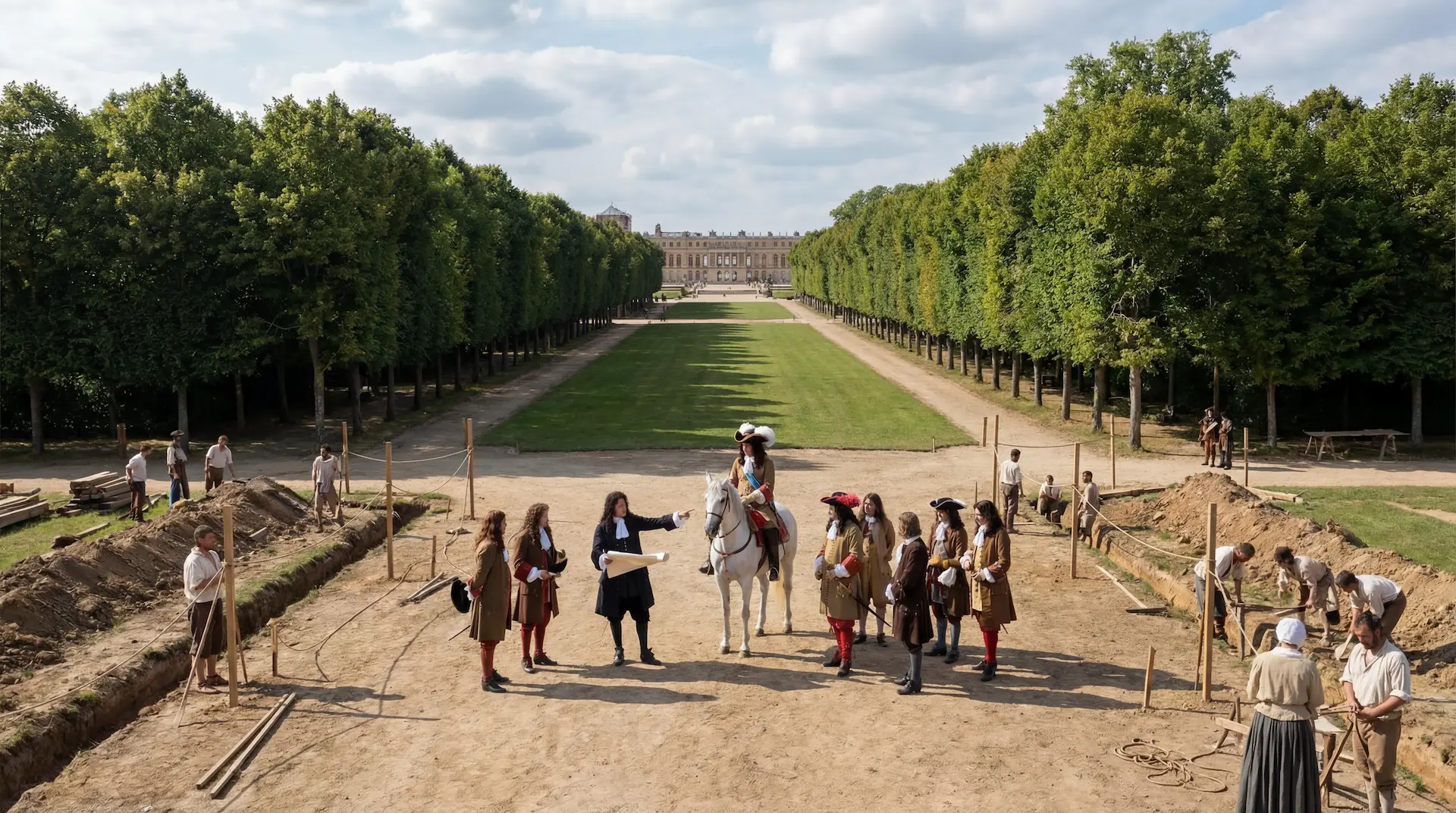 The Versailles Alignment to Oak Island→
The Organisation
1 min
The man chosen to lead the expedition was Jean-Baptiste Louis Frederic de Roye de La Rochefoucauld, Duc d'Anville. He was a member of the powerful Rochefoucauld family, one of the oldest noble houses in France. Maurepas, the Minister of the Navy, established the orders. Monsieur Meric was to supervise coordination between the various army corps, and all logistical planning was handled by a certain M. Le Brun. By March 1746, operations were already behind schedule and tensions between Anville and various officials were growing.
On the 9th of March, a man named Bigot was summoned to Versailles. Francois Bigot had served as head of the administration in Louisbourg during the British siege and knew the fortress and its operations in detail. He remained at court until the 22nd of February, when he departed as general supervisor of the expedition. His promotion was unexpected and came with unusual conditions. Maurepas insisted on extreme secrecy around Bigot's involvement; he could not appear on the docks and was to remain invisible to everyone connected to the fleet. His previous role in Louisbourg made him recognisable, and the destination of the expedition had to remain confidential at all costs. In his memoirs, Bigot later recalled having knowledge of the secrets of the operation. He was sent to the port of Rochefort to oversee the fitting of certain ships, fittings that had been discussed at length during his time at Versailles.
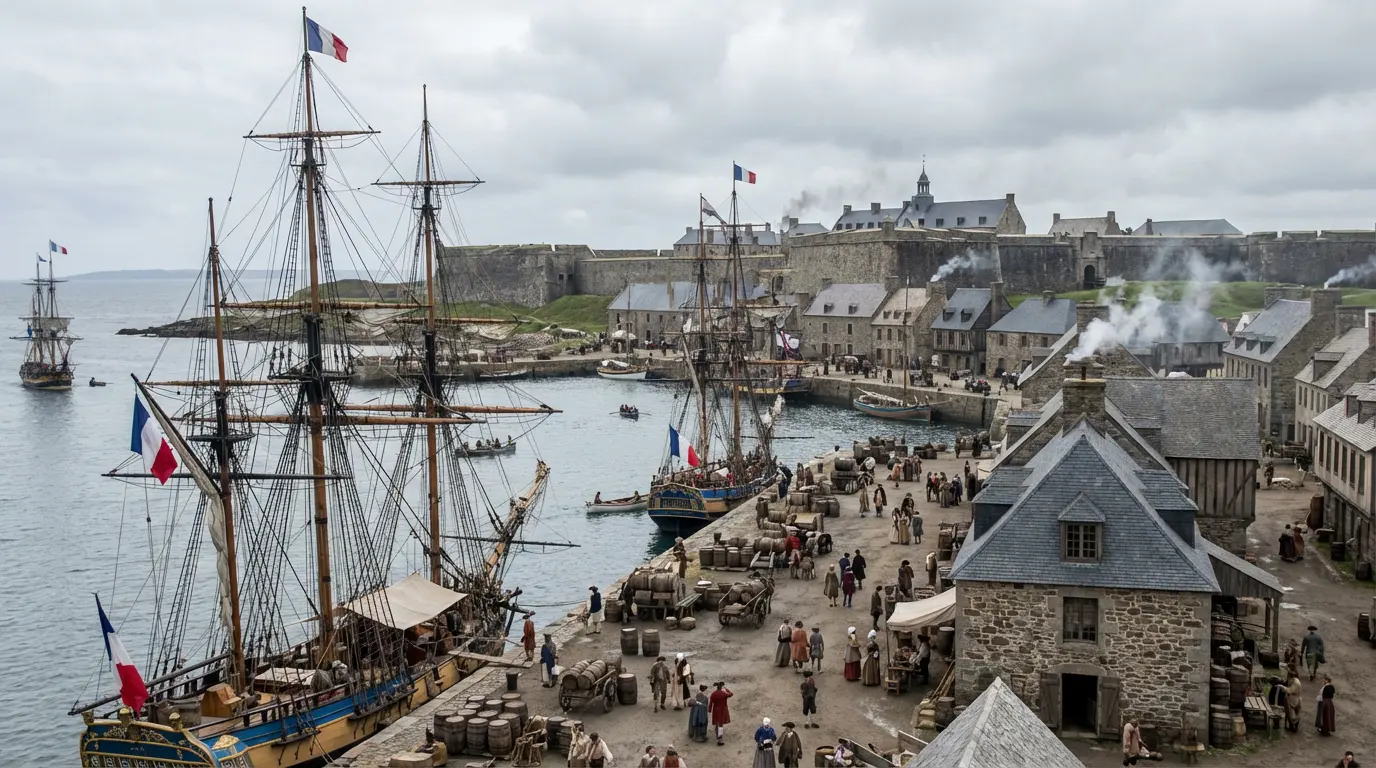 The Treasure of Louisbourg→
The Advance Ships
3 min
Months before the main fleet departed, two warships were sent ahead to Nova Scotia with orders to wait for Anville at Chibouctou. L'Aurore, a frigate under the King's orders, was commanded by Monsieur du Vigneau, identified in the French naval archives as Jean-Julien d'Herisson de Vigneux, from a military family near Paris. Le Castor, a smaller vessel, sailed under Monsieur de Salies. Both departed Brest on the 9th of April 1746.
Their stories diverge almost immediately. On the 4th of June, du Vigneau ordered Le Castor to separate and proceed alone to the Banc a Vert off the coast of Newfoundland for a surveying mission. De Salies protested. His crew was sick, provisions were low, and no one on board had any knowledge of the waters they were being sent to. He asked to follow L'Aurore to Chibouctou to resupply and make contact with Beauharnois, the governor general, to coordinate arrangements for Anville's arrival. Du Vigneau refused. Le Castor was sent north, as far from Nova Scotia as possible.
With Le Castor out of the way, L'Aurore made for the Acadian coast. On the 9th of June she was seven leagues from Cap de Sambourle. The next day du Vigneau chased an English boat into the Bay of La Heve. From the ship's log, we know that L'Aurore then navigated close to the coast, anchoring at coordinates recorded as 44 degrees 38 minutes. These are the coordinates of St. Margaret's Bay, immediately adjacent to Mahone Bay and Oak Island. On the 12th of June, when another ship was spotted, du Vigneau ordered his pilot to give chase while pulling L'Aurore out of the bay so that the English vessel "would not know we were there." On the 13th, after sending a pilot to shore near l'Isle Ronde, where he encountered a group of Mi'kmaq and an Acadian who confirmed his identity, L'Aurore sailed into Chibouctou harbour.
There, the missionary Le Loutre came aboard and explained he had been waiting for fifteen days by order of Beauharnois. Le Loutre carried a package for the Duc d'Anville and had instructions about recognition signals. He expressed surprise that L'Aurore had made no signals upon entering the harbour. Du Vigneau replied that he had received no orders about signalling, which suggests that Le Loutre was not expecting any French ship before Anville's fleet itself.
What happened next is harder to trace. On the 24th of June, du Vigneau received news of an English fleet off the coast. On the 27th, L'Aurore moved further into the bay to stay hidden. Then the journal falls silent for two weeks. When entries resume on the 12th of July, the captain describes arming a schooner under Monsieur de Vante and sending it toward Saint Sembre to find a discreet bay near the cape, land men on shore, and survey the coast. The schooner carried signal knowledge and a pilot, accompanied by Mi'kmaq with canoes. Another gap of twelve days follows. L'Aurore remained in the area for over two months before departing for France on the 13th of August, leaving behind seized schooners, supplies, and canons hidden in the woods.
The most revealing detail comes from the letter that accompanied du Vigneau's journal. In it, the captain writes: "I will not speak to anyone about this place, but I am obliged to warn you that it is difficult to hide it from the quantity of people who have knowledge of it." The recipient of this letter has never been identified. Nor has the place to which du Vigneau was referring.
When Le Castor finally reached Chibouctou on the 9th of July, de Salies noted his surprise that du Vigneau had made no contact with Beauharnois despite having been in the harbour for weeks. Du Vigneau had shown no desire to coordinate, no interest in communicating with officials on land, and had avoided the very person whose instructions he was supposed to deliver. De Salies recorded: "I was surprised that Monsieur du Vigneau let this general ignore his stay at Chibouctou."
The Masked Man
2 min
Back in France, the main fleet was ready but refused to leave. Official reports blamed contrary winds, though the explanation was questioned at the time. On the 24th of May, the Duc d'Anville received a letter from a messenger and departed at once for Bordeaux. He had strict orders not to mention the destination of the squadron and carried a packet from Versailles that could only be opened after departure.
On the evening of the 20th of June 1746, the Northumberland, Anville's flagship, was anchored at La Rochelle. An officer from the squadron who had been in town left around five o'clock with post horses. He returned with another person, wearing a mask, on horseback. The two rode through the city, boarded a dinghy at the port, and were rowed to the Northumberland. The fleet departed shortly after.
Three independent sources describe this event. The earliest is a letter written the following day by Seigneur Hastrel in La Rochelle, an eyewitness account addressed to a Monsieur de B. whose identity remains unknown. The second is the chronicle of Barbier, a Parisian attorney who compiled detailed records of events in France, writing that the dinghy carried "six men in post, including one who was masked" and noting that rumours on board suggested the figure was "the Pretender or the Duke of York, his brother." The third source is the British Gentleman's Magazine, which published a different version: "A lady in a masque accompanied with several well-dressed people came this morning to our gate... This lady is called by others a prince."
The speculation that the figure might be the Stuart Pretender or the Duke of York suggests that whoever it was spoke English, or at least carried themselves in a way that implied British or royal origins. Wearing a mask was not a common act in the 1740s. It implied the person was important enough to be recognised, and that being recognised would be dangerous, either for them or for the secrecy of the expedition.
The Crossing
1 min
The secrecy on board had taken its toll. Until the 24th of July, the crews and officers had no idea where they were going; most assumed the destination was Port Mahon or Gibraltar. When Anville finally announced they were heading for Acadia, the mood darkened. During the crossing, two ships were detached from the fleet under special orders. On the 16th of July, the frigate La Mutine was given a sealed package by the General and told to leave. Her captain was not allowed to open the package until twenty-four hours later; she was reportedly sent to deliver weapons to Mississippi. On the 19th of July, La Renommee was ordered to leave the fleet and sail directly to Chibouctou to warn L'Aurore and Le Castor of Anville's late arrival. She carried munitions and supplies for the advance ships. La Renommee was expected to guide the fleet into harbour on its arrival, but she never did.
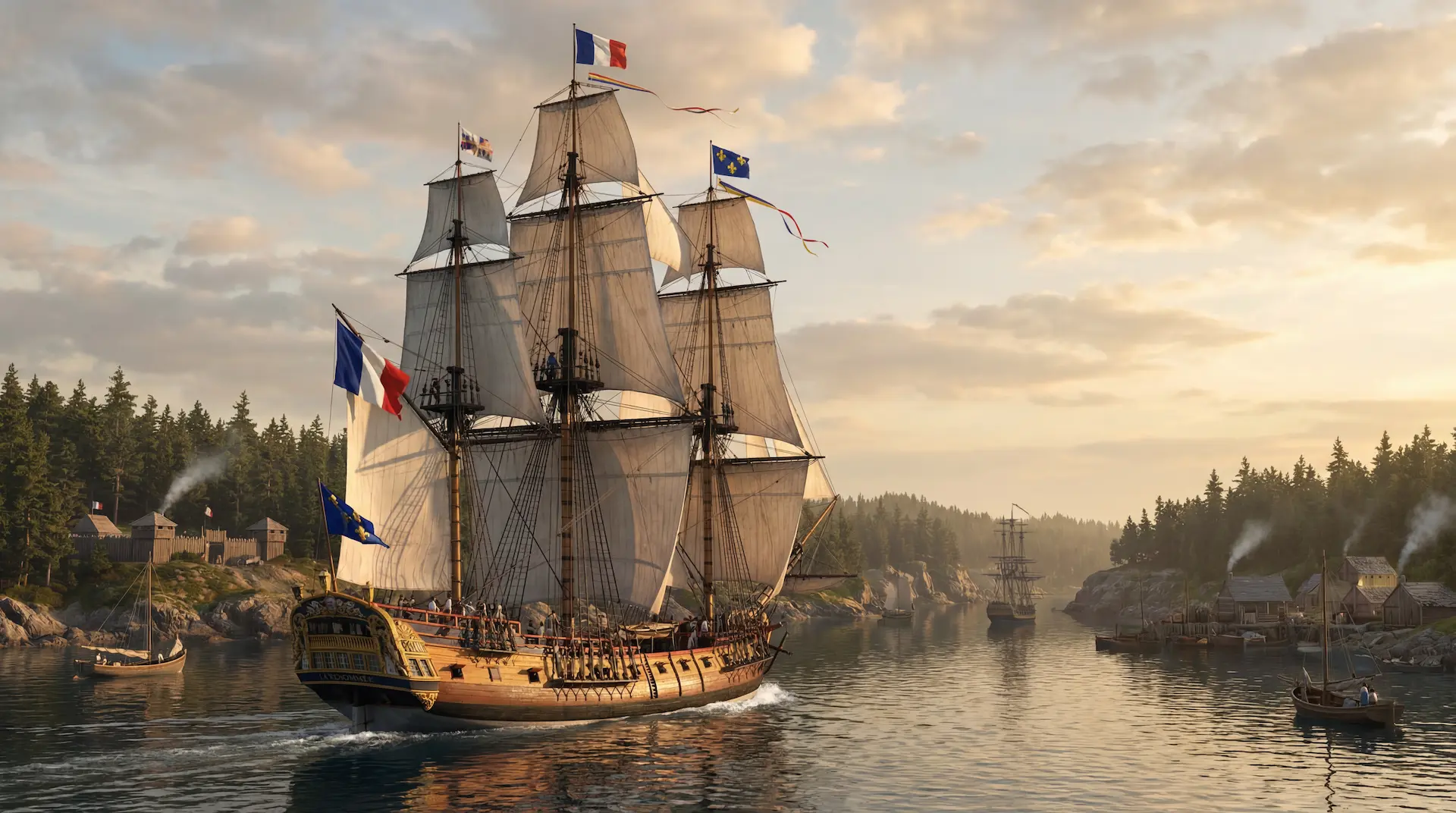
By the end of August, the ships were devastated by illness. Up to fifty men were dying each day. When the fleet finally reached the Acadian coast, a severe storm scattered the ships. Most of the main vessels are accounted for in the records, and nothing in the surviving logs points to a planned visit to Mahone Bay. One detail, however, stands out: Le Trident, navigating in poor visibility, confused the entrance to St. Margaret's Bay for the entrance to Chibouctou. The ship's log records that an officer from Le Prince d'Orange assured them that the island they could see was at the entrance to the harbour of "Saint Margueritte," which the manuals had been mistaking for Chibouctou. The fleet was navigating blind, and some of its ships were passing within sight of Mahone Bay.
Chibouctou
2 min
The Duc d'Anville arrived in Halifax on the 19th of September 1746 with the remnants of his fleet. La Renommee, which had been sent ahead weeks earlier, had not returned to guide them in. Instead, her captain Monsieur Kersaint had moored in Le Havre au Castor, sent a boat to Chibouctou where no one was waiting, and then sailed to the harbour himself, arriving just two hours after the Northumberland.
Within days, the expedition collapsed. On the 27th of September, the Duc d'Anville died. An autopsy performed on board attributed the cause to a fit of apoplexy, though the British later suggested poison or suicide. His replacement, Monsieur d'Estourmel, assumed command and immediately summoned a war council. The officers opened Anville's sealed packet from Versailles and read the letter from the King with his orders for the mission. D'Estourmel appeared shaken. He wanted to pull back from any attack. On the night of the 1st of October, cries were heard from his cabin. The men who entered found him in a pool of blood, a sword through his body. The accounts vary: either the sword was found on the deck beside him, or the surgeon removed it. D'Estourmel resigned his command. Speculation spread that the two men had fought, or that d'Estourmel had been attacked to remove him from his position.
Command passed to La Jonquiere. In the weeks that followed, strange events continued. Around the 10th of October, a small fleet of ships appeared outside Halifax harbour. Men in the port speculated that it was the squadron of Conflans, which had been ordered to sail from Martinique and rendezvous with Anville. La Jonquiere sent a small boat to investigate; they concluded the ships were British. The fleet disappeared, but on the 17th of October, more than seventy cannon shots were heard from outside the harbour. No explanation was ever recorded.
Two days later, the frigate La Megere was sent toward La Heve to defend a French vessel under attack by an English privateer. The captain of the rescued ship reported meeting a group of French boats "in the far end of a bay, seven to eight leagues from Chibouctou." These were described as fishing boats. He had attacked them and burned their ships. La Megere returned to the bay and moored overnight, hoping to find the escaped privateer.
The Conflans Squadron
1 min
Conflans' supporting fleet of four warships had departed Martinique on the 7th of September with orders to join Anville at Chibouctou. On the 28th of September they sighted l'Isle de Sable and spent the next fifteen days navigating the area. On the 9th of October, Conflans called his captains together and asked whether anyone recognised the coastline. No one did. Confused and running low on supplies, the squadron turned toward l'Isle Royale. Near Canso, the ship l'Alcyon was separated in bad weather and fog; her captain opened sealed orders confirming the rendezvous at Chibouctou, but his efforts to reach the harbour failed. On the 13th of October, Conflans ordered the return to France. His ships reached port on the 6th of November. L'Alcyon arrived two days later. Two logbooks from the squadron are missing, and Conflans left no personal account. The records that survive suggest the fleet never approached Mahone Bay, but the gaps in the record leave room for doubt.
The Return
1 min
La Jonquiere attempted to move the fleet from Chibouctou toward Port-Royal, but the weather and the condition of the squadron made the attempt impossible. The return crossing to France was as catastrophic as the outward voyage. Ships battled illness and starvation; there are reports of men eating ropes and of discussions about cannibalism.
The fate of La Renommee on her return stands apart from the rest of the fleet. At fifteen leagues from the French coast, she was spotted by a squadron of British warships that gave chase. The battle lasted thirteen hours before La Renommee fought her way into harbour at l'Isle de Groix. From a secondhand account, the British squadron was led by Commander Anson, the brother of Thomas Anson, and he had been "searching for her." No direct source for Anson's search has been found, but the coincidence is difficult to ignore.
Once the surviving ships reached France, Maurepas gathered the officers and navigators for a full debrief. In the weeks that followed, he was alarmed to find detailed information about the expedition appearing in British and Dutch publications. During the return voyage, the ship carrying the court's instructions and Anville's letters had been caught in battle and forced to throw them overboard. The British recovered what they could and published some of it.
The Oak Island Connection
2 min
The Anville expedition did not, according to any surviving document, visit Mahone Bay. But the records, drawn from French naval archives, contain a series of details that researchers have found difficult to dismiss.
The advance ship L'Aurore, under the secretive du Vigneau, navigated to within sight of Mahone Bay and anchored at coordinates corresponding to St. Margaret's Bay, one bay to the east. Du Vigneau's behaviour, sending Le Castor away, avoiding contact with Beauharnois, making no signals, and operating with an excellent pilot who knew the coast, does not match an officer on a routine mission. His letter about a "place" that he would never speak of, but that would be "difficult to hide from the quantity of people who have knowledge of it," has never been explained.
The main fleet's navigators confused St. Margaret's Bay for Chibouctou. Beauharnois ordered Coulon-de-Villiers and Le Loutre to send patrols along the coast between La Heve and Chibouctou "to prevent any new British establishment," an area that encompasses Mahone Bay. French boats were found and burned in a bay seven to eight leagues from Halifax, a distance that places them in the vicinity of Chester or Mahone.
And then there is the matter of who was involved. The Duc d'Anville was born a Rochefoucauld. The land forces coordinating with the expedition in Acadia were commanded by Nicolas Antoine II Coulon-de-Villiers, who claimed descent from Philippe de Villiers de L'Isle Adam, Grand Master of the Knights of St. John. A Rochefoucauld leading the fleet. A Villiers commanding on shore. Both families carried deep historical connections to the military religious orders, converging on the same stretch of Nova Scotian coast in the same operation.
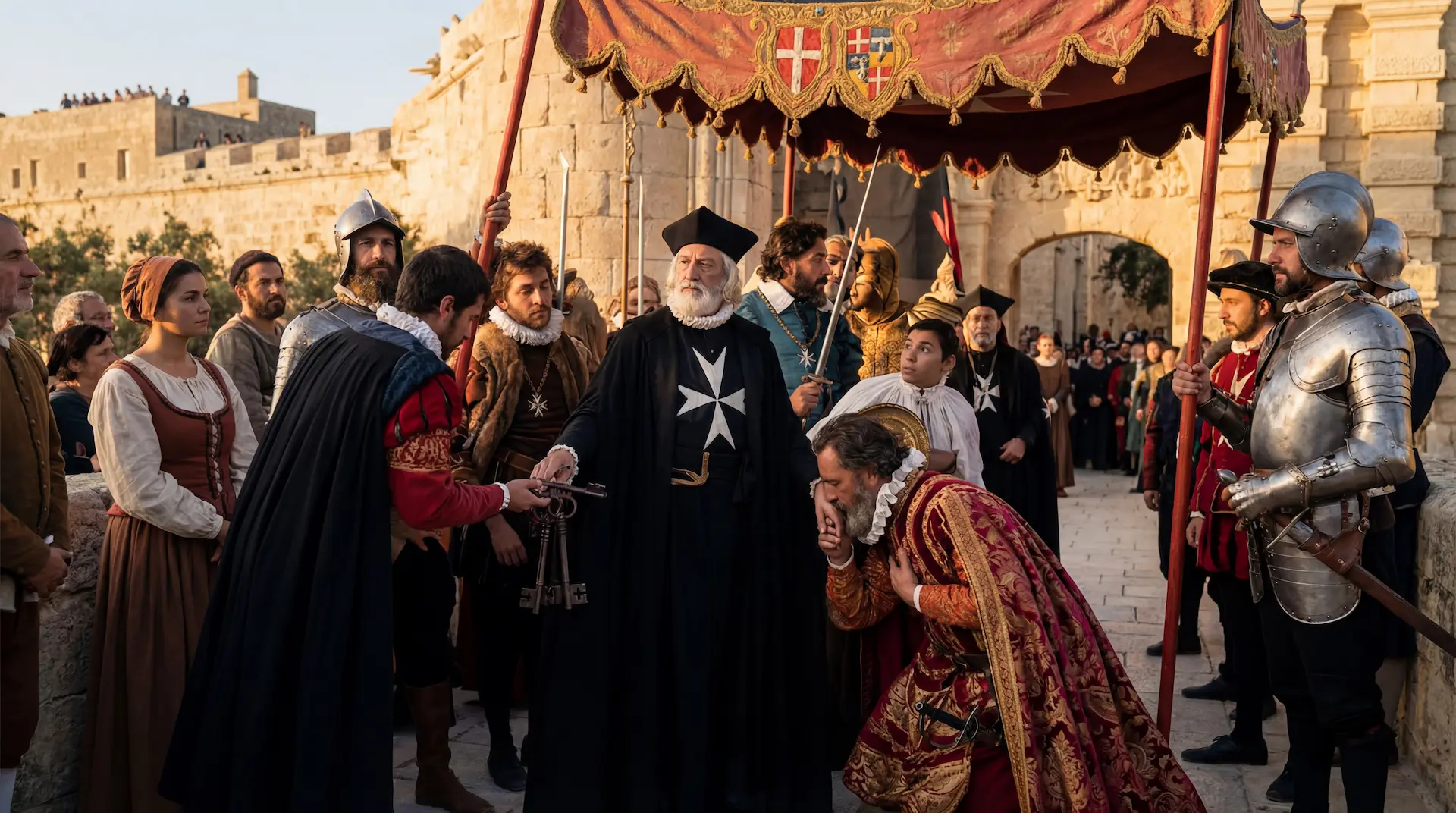 De Villiers: The Treasure Bloodline→
The masked man remains unidentified. The sealed packets from Versailles were never recovered. Of the 13,000 men who left France, only a fraction returned, and whatever they knew about the expedition's true purpose, if it extended beyond the recapture of Louisbourg, went with them to their graves or to the bottom of the Atlantic.