About This Carved Stone
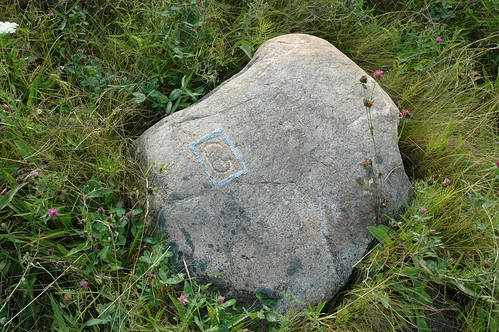
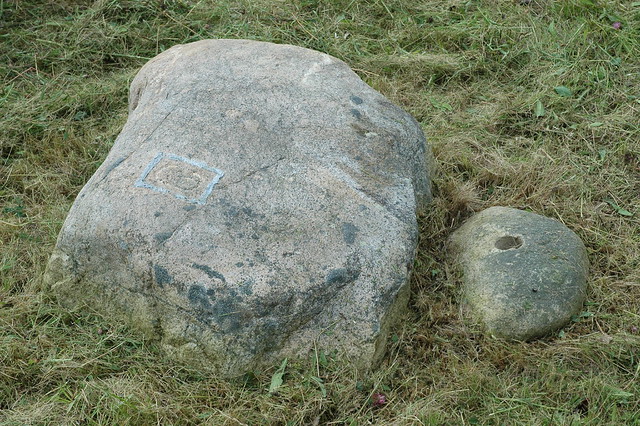
The G Stone is a large granite boulder bearing a single letter G carved inside what appears to be a rectangular border. The carving is deeply incised and clearly deliberate, with no ambiguity about the letterform. The stone has been on display at Oak Island since its recovery and currently rests at the bottom of the hill near Smith's Cove.
The stone was discovered by accident in 1967, when workers operating heavy machinery were backfilling the Cave-in Pit, a collapsed shaft located between Smith's Cove and the Money Pit. Dan Blankenship, then serving as field manager for the newly formed Triton Alliance, noticed the carving as the stone was pushed out of the ground and moved quickly to retrieve it. Blankenship was confident the marking was not a hoax or the work of a previous searcher, because the side bearing the letter G had been embedded face-down in the earth, while a border of lichen had grown around the rock above the line where it had jutted from the ground. The lichen growth indicated the stone had lain undisturbed in that position for a considerable period.
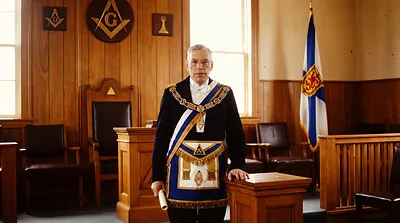
The letter G is one of the most recognizable symbols in Freemasonry, typically displayed alongside the overlapping compass and square. In Masonic tradition the G signifies the supremacy of God, referred to as the Grand Geometrician, and is prominently displayed on the eastern wall of every Masonic lodge and suspended above the Master Mason's chair. Author Mark Finnan described the G Stone as an artifact that would leave little doubt of a sacred aspect to the Oak Island treasure, provided the marking is authentic. However, researcher Scott Clarke has offered an alternative interpretation, noting that the G is positioned in the upper left corner of the stone as though it were the beginning of a word rather than a standalone symbol. Clarke proposed the letter could refer to the surname Gifford, as John Gifford and Richard Smith were the first recorded owners of Oak Island, granted the land on December 27, 1753, by Lieutenant-Governor Charles Lawrence, who was at that time the master of Saint Andrew's Lodge in Halifax.
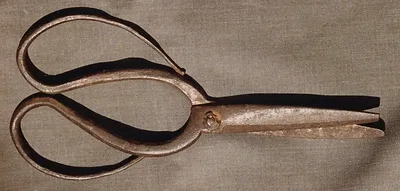
The stone's discovery near Smith's Cove places it in the same area where other artifacts with possible Masonic or pre-depositor connections have been found, including a heart-shaped stone, a metal set-square, and wrought iron scissors, all recovered by Blankenship during the same period of excavation in the late 1960s. No formal scientific dating has been performed on the G Stone itself, and its age remains undetermined.
Historical Context
Clarke, Oak Island Odyssey (2023); Finnan, Oak Island Secrets (2002), pp. 87-88, 151-152; Season 1 Episode 2; Photo: Alessandra Nadudvari
Where It Was Found
Found at Smith's Cove. Location: the cove at the east end of Oak Island where the flood system's box drains were found in 1850.
Gallery