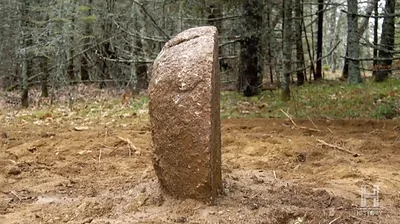
About This Carved Stone
In the summer of 1936, Gilbert Hedden was searching the north shore of Oak Island near Joudrey's Cove when he came across a large granite rock half-buried in the beach bearing unusual markings. One of his workmen told him that roughly fifteen years earlier, an even larger boulder with strange markings had been found in the same area, dynamited by someone hoping treasure lay beneath it, and broken up for souvenirs. Hedden organized a search party that recovered a major surviving fragment, weighing several hundred pounds, from the beach. It bore three symbols: the letter H, a cross at the centre, and a circumpunct, a circle with a dot at its heart. The name H+O stone, in common use ever since, is a misreading of that third symbol. It is not the letter O.
Hedden was a well-educated Freemason and recognised the markings immediately. Within Freemasonry, each of the three symbols carries established meaning. The central cross represents Christ and is embedded in the higher degrees of Masonic ritual. The letter H is read by some Masonic scholars as a derived form of the Hebrew letter for God or Jehovah. The circumpunct, the point within the circle, is one of the most widely used symbols in the entire Masonic system. Masons are taught that it represents the individual positioned at the centre of his duty, from which he cannot err. The same circumpunct appears on the 90-foot stone from the Money Pit. Outside of Freemasonry, the symbol has ancient roots as a representation of the sun, and in alchemical tradition it is the symbol for gold.
During the Lagina team's research trip to Portugal in Season 9, Doug Crowell spotted a circumpunct carved into the exterior wall of the Church of Fontarcada in Povoa De Lanhoso, donated to the Knights Templar by Lady Teresa in 1126. Templar historian Joao Fiandeiro noted that the same symbol appears over the entrance to the Castle of Tomar, the Templars' Portuguese headquarters. At the Convento de Cristo in Tomar, Corjan Mol pointed out a stone above the original gate bearing a cross with four dots at its corners, identical to a symbol on the H+O stone. When Doug asked Fiandeiro directly whether the stone could be of Portuguese origin, he replied that if the Portuguese were on Oak Island, they could have made it.
In Season 11, at Morimondo Abbey in northern Italy, a 12th-century Cistercian foundation with documented Templar connections, Doug spotted two four-dot crosses on the exterior ceramic vessels matching the H+O stone. Inside the scriptorium, mid-13th-century paintings by Cistercian monks showed a four-dot cross on a pillar alongside a Tree of Life symbol. At the Caestert limestone quarry near Maastricht in the Netherlands, where medieval monks quarried stone for Catholic churches through fifteen miles of underground tunnels, the team found drawings of four-dot crosses and circumpuncts side by side on the quarry walls. Cultural historian Jacquo Silvertant suggested the recurring symbols may have indicated the direction in which the Templars' treasure was being moved. The same symbols were reported at Valkenburg Castle during the Season 11 end-of-year review.
Researchers James McQuiston and Doc Hamels have argued that the markings are consistent with nineteenth and early twentieth-century surveying conventions used by Nova Scotia land surveyors to mark boundaries and reference points, and that the stone may be a modern marker with no connection to the Oak Island mystery.
Historical Context
Historical finds
Where It Was Found
Found at Oak Island surface. Location: Oak Island, Nova Scotia, Canada.