Rick Lagina calls Marty with news of the possible ship's railing recovered from ten feet below sea level in the swamp. The team returns to expand the excavation, but overnight rain has turned the site into a nightmare of recirculating water and collapsing mud. Billy Gerhardt confirms wood on the bottom and pulls up a large timber, yet each attempt to dig deeper destabilizes the walls further. With conditions deteriorating and winter approaching, the team concludes that a cofferdam using sheet piling will be needed to properly excavate the area and decides to postpone the investigation until spring.
On Lot 25, archaeologists Laird Niven and Liz Michels continue excavating the 18th-century stone foundation of the home that once belonged to Samuel Ball, a man who arrived on Oak Island in 1787 as a cabbage farmer but mysteriously became one of Nova Scotia's wealthiest landowners. Charles Barkhouse and Scott Barlow join the dig, where the team uncovers a metal hinge and pieces of wood with a crosspiece embedded in the cellar's dirt floor, forming what appears to be a doorway or hatchway. Rick Lagina, Gary Drayton, and David Fornetti later inspect the finds, and Gary identifies the hinge as too small for a cellar door, suggesting it more likely came from a chest or box, a conclusion consistent with a similar strap hinge found on the Ball property one year earlier by artifact conservator Kelly Bourassa.
Near the eastern edge of the swamp, Gary Drayton recovers a perfectly square wooden object from the excavated spoils along the stone pathway. Dr. Aaron Taylor and Dr. Ian Spooner examine it and suggest it may be an architectural tool, while Doug Crowell's subsequent research identifies it as closely resembling a stonemason's T-square. Marty, Doug, and Gary inspect the artifact in the research center, noting its potential Masonic significance given the longstanding connections between the Freemasons, the Knights Templar, and the Oak Island mystery. Marty orders carbon-14 dating. Separately, Gary and David Fornetti discover a large, badly burned iron object near the pathway's boulder field that Dr. Aaron Taylor identifies as likely having been part of a wooden ship structure, with charcoal still adhering to the iron from intense burning.
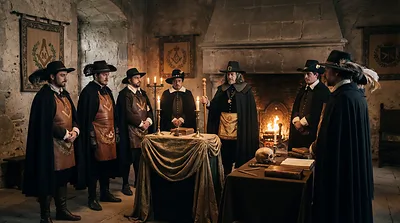
In the War Room, researcher and theorist Philip Stephenson presents a Masonic cipher he believes is directly connected to Oak Island. His decoded symbols share striking similarities with the "la formule" document presented by the late Zena Halpern in 2016, which contained many of the same symbols reportedly found on the legendary 90-foot stone. Stephenson's analysis points to a specific target he calls "Z," located on Lot 20 near the Money Pit at a depth of only 40 feet, close to one of the four nonferrous deposits identified on the 1988 Barringer survey. The team drills borehole PS-1 at the designated coordinates, where Terry Matheson, Steve Guptill, and Charles Barkhouse monitor the cores through dense blue-gray till. At the 40-foot target depth, the core returns material but no evidence of a treasure vault. Marty suggests the cipher may be correctly decoded but the starting point, the altar location, remains uncertain.
Craig Tester presents carbon-14 results on the wooden T-square in the War Room: the wood dates to between 1632 and 1668, more than 160 years before the discovery of the Money Pit. Dr. Aaron Taylor admits the date is far older than he expected, and the result aligns with the theory presented weeks earlier by author James McQuiston, who proposed that 17th-century Scottish Knights Baronets with ties to both Freemasonry and the Knights Templar took shelter in Mahone Bay after being ousted by the French in the spring of 1632 and may have buried treasure on Oak Island. Rick, Marty, Alex Lagina, Jack Begley, Laird Niven, and Doug Crowell all acknowledge the mounting evidence that something significant occurred on the island well before the Money Pit's discovery.