About This Tool
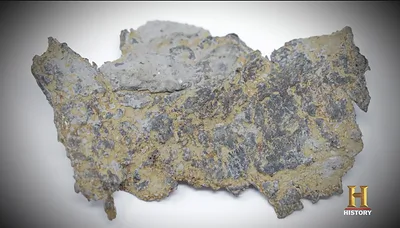
The axe was recovered at approximately 123 feet below the surface during the 1931 Chappell expedition. It had a straight wooden handle three feet long and a head reported to be of an obsolete pattern, badly rusted except for the wide blade, which was clean. It came from a depth distinct from the other tools recovered during the same dig: the anchor fluke appeared at 116 feet and the miner's pick at 127 feet. The Chappell expedition was led by William Chappell, who had operated the drill that struck the cement vault in 1897, together with his son Melbourne, his brother Renerick, and nephew Claude. Frederick Blair served as field manager. The team sank a twelve-by-fourteen-foot shaft (No. 21) to 163 feet, using an electric pump capable of shifting four to five hundred gallons per minute, and then drilled exploratory holes another fourteen feet deeper. Despite reaching greater depth than any previous team, they found no trace of the cement vault, the wooden boxes, or the iron barrier encountered during the 1897 drilling. Blair believed the Chappell shaft sat at least six feet away from the original Money Pit. At the time of its finding the axe was judged to be of Acadian origin and about 250 years old, which would date it to around 1680, though the basis for both conclusions was never recorded. Fanthorpe later described it as "an Acadian axe of a slightly later pattern" than the anchor fluke, which he dated to the fourteenth or fifteenth century. The Acadian designation associates the tool with the French colonial settlers of Nova Scotia, active in the region from the early 1600s through their expulsion in 1755. Graham Harris and Les MacPhie, the geotechnical engineers who wrote Oak Island and its Lost Treasure, question that label. They point to documents from the 1680s and 1690s showing that the Acadians bought their axes, scythes and other essential tools from English merchants in Boston, and to the manifest of a ship loaded at Boston for Acadia on 13 September 1695 that included six dozen axes. Comparing the photographs with Henry Mercer's Ancient Carpenters' Tools, they identify the type as an old Anglo-American felling axe, a pattern that emerged in the early 1700s and was made until about 1840, usually by local blacksmiths who welded a strip of steel into an iron head to form the blade. The long handle and the two different metals visible in the head and blade fit that description. Because the type was made for more than a century in many places, they conclude the axe cannot be dated or traced to a maker with any precision, only that it was a tool for felling trees. The axe, anchor, and pick were all found well below the deepest recorded working level of any nineteenth-century search expedition. Fanthorpe noted that the tools lay "as much as twenty feet lower than the recorded working depths of the nineteenth and early-twentieth-century shafts," and how they came to that depth remained unexplained. Blair's own opinion was that the axe and the pick belonged to earlier searchers and dropped to their depths in the collapse of the Money Pit in 1861. Harris and MacPhie argue against this. Before 1861 the pit had been dug to 93 feet in 1804 and 86 feet in 1849, so both tools would have had to fall thirty to forty feet. Both were also found standing vertically and completely embedded in soft, disturbed ground, which they consider inconsistent with objects tumbled downward by a collapse. Their conclusion is that the axe and pick come from work carried out before 1795. The axe, originally in Blair's possession, has since been lost; only photographs survive.
Historical Context
Chappell expedition, 1931. Graham Harris and Les MacPhie, Oak Island and its Lost Treasure, third edition (Formac Publishing, Halifax, 2013), chapter 5, citing Henry C. Mercer, Ancient Carpenters' Tools, and Sally Ross and Alphonse Deveau, The Acadians of Nova Scotia Past and Present. Photographs of the axe (photos 5 and 6) appear in Harris and MacPhie.
Where It Was Found
Found at Money Pit area, 123 ft depth. Location: the original 1795 excavation shaft on Oak Island, Nova Scotia.