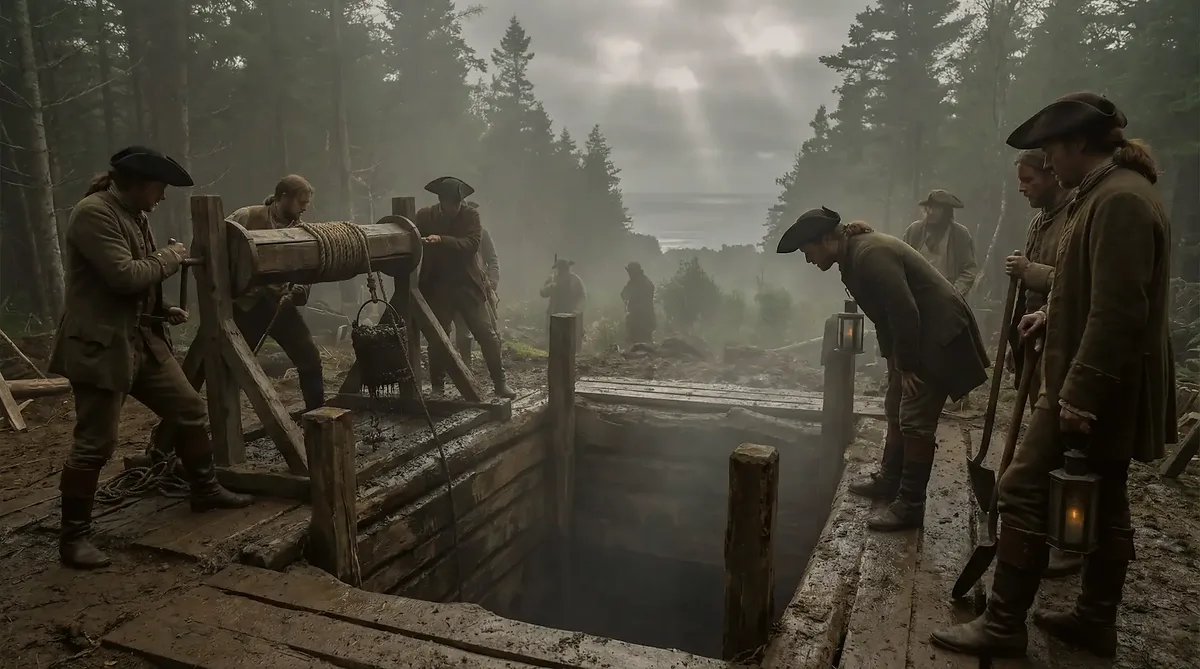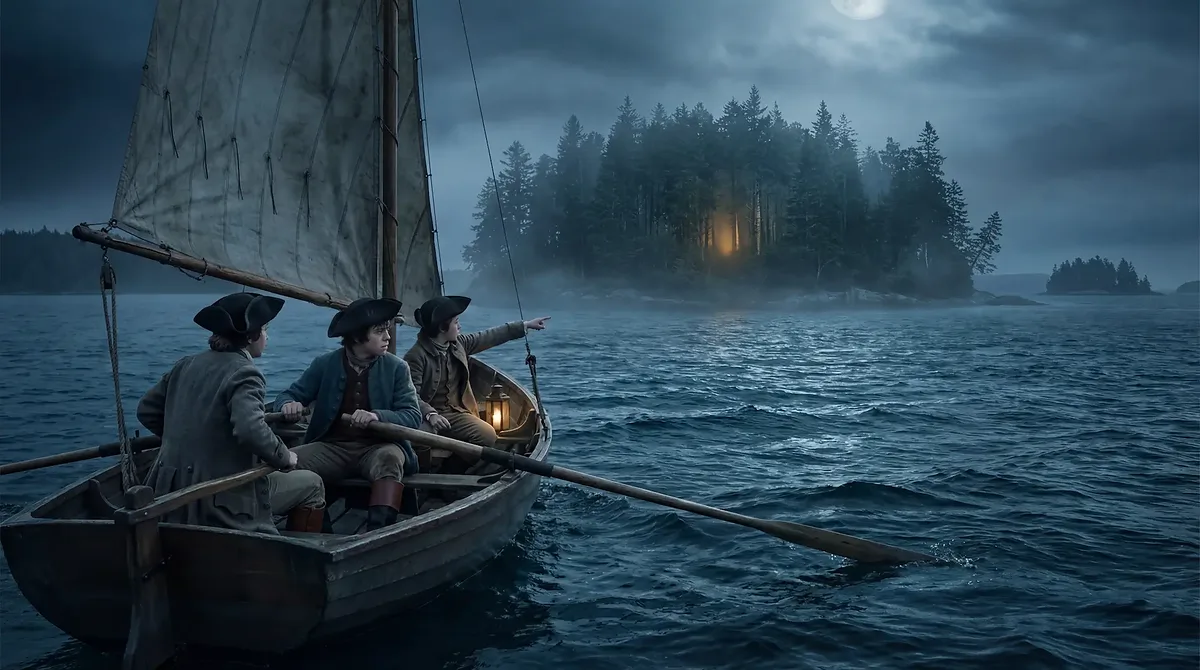
In 1762, at the height of the Seven Years' War, Britain launched one of the most ambitious amphibious operations of the 18th century: a full-scale assault on Havana, the wealthiest and most heavily fortified port in Spain's American empire. The siege lasted more than two months, cost thousands of lives, and ended with the British in possession of an extraordinary haul of treasure, warships, and military stores. Thirty-three years later, a young man exploring Oak Island found a hollow in the ground beneath an old oak. Around it the forest had once been cut, and was growing back. Two centuries on, a Halifax engineer would fix on that detail and ask how long a clearing takes to disappear. His answer led him back to Havana.
A Secret War on the Richest Port
2 min
Spain had remained neutral through much of the Seven Years' War, but that changed in 1761 when King Charles III signed the Third Bourbon Family Compact, a secret alliance with France against Britain. When word of the pact reached London, Britain declared war on Spain in January 1762. The response was immediate and devastating. Lord George Anson, First Lord of the Admiralty, and General John Ligonier proposed a strike at Spain's most valuable colonial possession: Havana, the gateway through which the wealth of the Americas flowed on its way to Madrid.
The task force assembled for the operation was enormous. Admiral Sir George Pocock commanded a fleet of roughly 180 vessels, including 22 ships of the line, frigates, sloops, bomb vessels, and transports. General George Keppel, 3rd Earl of Albemarle, led the land forces, which eventually numbered some 14,000 soldiers drawn from Britain, North America, and the West Indies, including 3,188 reinforcements from New York who arrived late in the siege. Keppel's two younger brothers played key roles: Major General William Keppel commanded troops on the ground, and Commodore Augustus Keppel led a portion of the naval assault. Pocock navigated the fleet through the treacherous Old Bahama Strait from Jamaica, arriving off the Cuban coast on June 6, 1762. Troops landed the following day at Cojimar Bay, six miles east of the city, meeting little initial resistance.
The prize that awaited them was immense. Since the early 1500s, Havana had served as the staging point for Spain's treasure fleets, the convoys that carried silver, gold, emeralds, indigo, cocoa, and Oriental goods across the Atlantic. The city's harbour could accommodate over 100 warships, and its royal shipyard was the finest in the Americas. Defending the harbour entrance was the formidable Castillo de los Tres Reyes del Morro, better known as Morro Castle, perched on a rocky headland and armed with 64 guns. On the opposite side stood the Castillo de San Salvador de la Punta. Between them, a boom chain stretched across the channel. The garrison, under Captain General Juan de Prado, numbered roughly 11,000 men, including regular troops, sailors, marines, and militia.
Mines Beneath the Morro
1 min
The Spanish strategy was to delay the British long enough for tropical disease and the approaching hurricane season to do what the garrison alone could not. For weeks, the defenders held. A naval bombardment of Morro Castle on July 1 by HMS Cambridge, Marlborough, and Dragon was beaten back with heavy losses. But the fortress had a critical weakness: the unfortified hill of La Cabaña overlooked its walls, and the British exploited it mercilessly, installing siege batteries that pounded the castle day after day. On July 30, British engineers detonated mines beneath a section of wall, and infantry stormed through the breach. The castle's heroic commander, Luis Vicente de Velasco, had been mortally wounded the previous day; the Spanish navy would name a ship in his honour for generations afterward.
With Morro Castle in British hands, the fall of Havana was only a matter of time. Batteries were positioned along the northern shore of the harbour entrance, and on August 11, a bombardment of 47 heavy guns, 10 mortars, and 5 howitzers opened on the city itself. Fort la Punta was silenced within hours. Captain General de Prado surrendered on August 13, and British forces entered Havana the following day.
Fortunes for Admirals, Four Pounds for the Men
2 min
The scale of the plunder was staggering. The British seized military equipment valued at 1,828,116 Spanish pesos and merchandise worth an additional 1,000,000 pesos. Some contemporary estimates placed the total value of captured stores and valuables at up to £3 million, an almost inconceivable sum for the period. Nine Spanish ships of the line fell intact into British hands, representing roughly a fifth of Spain's entire naval strength: the Infante, Reina, Soberano, Tigre, Aquilón, San Antonio, América, Conquistador, and San Genaro, along with frigates, sloops, and nearly 100 merchant vessels. Two additional warships under construction in the dockyards were burned.
The division of prize money became a source of lasting bitterness. Admiral Pocock and Lord Albemarle each received £122,697, an extraordinary personal fortune. Commodore Augustus Keppel took home £24,539. The 42 naval captains present each received roughly £1,600. Ordinary soldiers and sailors, by contrast, received approximately £4 each, a paltry sum given the months of brutal fighting, disease, and death they had endured. Of the British forces engaged at Havana, around 1,790 were killed, wounded, or listed as missing in combat, but by October, a further 5,000 had died of tropical fevers. The disparity between the fortunes amassed by senior officers and the scraps handed to the men who actually fought would become a persistent grievance, and it forms the basis of the Oak Island connection.
The men at the top had written the rules before a shot was fired. On February 18, 1762, the Admiralty wrote to Pocock in the king's name: the booty was to go to the sea and land forces, and Albemarle and Pocock were to settle the proportions between themselves. They settled them generously. One-third of everything would be split between the two of them, and one-fifteenth of the remainder would go to their seconds-in-command, Lieutenant-General George Eliott and Commodore Keppel. Reading those papers more than two centuries later, William S. Crooker, a Halifax engineer and surveyor, noticed who was missing from them. There was no share for the Crown. A young king had approved an expedition against the richest port in the Americas and, on paper, asked for nothing in return. Crooker found that hard to accept. He also noticed the arithmetic. Pocock's own final account, dated March 7, 1772, shows 737,000 pounds paid to the captors. A private search of Spanish archives in 1977, as Crooker reported it, put the plunder at many millions of pounds, and a biography of Augustus Keppel put the prize money above three million.
An Engineer Reads the Trees
3 min
William S. Crooker came to Oak Island the way many people do, by overhearing a story. In 1957 he was an engineering student running a survey crew on a highway job a few miles north of Mahone Bay, and during a coffee break he heard his men talking about an island where people were digging for a fortune. He followed the hunt for the next thirty-five years. He cruised the bay every summer in his boat, the Scotia Lass, wrote The Oak Island Quest in 1978, and in 1992 was hired by Fred Nolan to survey the stones of Nolan's Cross. His Havana theory, set out in Oak Island Gold, began not with Havana but with trees.
Every early account of the discovery mentions a clearing. The Colonist of January 2, 1864 said the first growth of wood "had been cut down, and that another was springing up," and Anthony Vaughan, one of the three discoverers, told Adams A. Tupper that the spot "had every appearance of having been cleared many years before." Crooker had spent more than thirty years surveying in Nova Scotia's woods, and he knew how quickly they close over. Red oaks of six to eight inches, the province's Department of Natural Resources told him, would be forty to fifty years old on Oak Island's soil. Edmund S. Telfer, a forester with Environment Canada who grew up in southern Nova Scotia, remembered a farm field in his home village turning to forest in thirty years. The two men agreed that the clearing could hardly have been more than fifty years old in 1795, and was more likely about thirty. That put the diggers on the island somewhere between 1745 and 1765. Looking for an event in that window, Crooker found one in Thomas H. Raddall's history of Halifax: the Havana force coming north "with its enormous loot," and a winter in which soldiers and sailors flung "pistareens, pieces of eight, and doubloons" over the tavern bars of a town that Raddall said became "more like a pirates' rendezvous than a modest British settlement."
Crooker's suspects were not angry junior officers. They sat much closer to the throne. They included the king's uncle, William Augustus, Duke of Cumberland, who decided who got military commands, and Albemarle, Cumberland's former secretary and favorite aide-de-camp, a man with no distinguished record who was nonetheless handed the land command. The others were Albemarle's brother Augustus Keppel; Pocock; and Lord Anson at the Admiralty, who had once paraded a captured Spanish galleon's treasure through London on thirty-two wagons, with the young Augustus Keppel among his crew. Crooker told the rest in plain terms. In the spring of 1762 a warship drops an engineer, a work crew and a small guard in Mahone Bay. Through the winter they sink the shaft, cut the tunnels and build the flood system, believing they are making an ammunition magazine for Halifax. In mid-December Albemarle's ship anchors off the island and unloads heavy wooden boxes. Crooker tied the timing to a real letter. On October 9, 1762, Pocock told the Admiralty that three warships had gone to Halifax after news that the French had invaded Newfoundland, and that Albemarle meant to sail from Havana on his own toward the end of December. To explain why nobody came back, Crooker pointed to the illness of George III, which first struck in January 1765 and returned for the rest of his life. He was careful to label the scenario for what it was. "This is how I see it," he wrote.
Fred Nolan, the man who had hired him, saw the island differently. Nolan believed the real deposit lay close to the surface near his swamp, and that the Money Pit was a decoy.
The geography supports the route. After the siege, captured Spanish vessels and British warships sailed north through waters that pass within easy reach of Nova Scotia. Halifax, the Royal Navy's principal North Atlantic base, lies roughly 1,200 miles from Havana, a voyage of days for a well-crewed warship. Oak Island sits in Mahone Bay, just 60 miles southwest of Halifax, a sheltered location that would have been familiar to any naval officer operating out of the Halifax station. A simpler popular version of the theory proposes that rogue British officers, resentful of the prize money system that enriched admirals while leaving common sailors with almost nothing, ordered a ship diverted to Oak Island, where the treasure was buried using the engineering skills readily available to military personnel of the period.
Buttons and Musket Lead on Lot 24
1 min
In Season 4, Episode 8 ("The Mystery of Samuel Ball"), metal detection expert Gary Drayton and Oak Island historian Charles Barkhouse explored Lot 24, once part of the property owned by Samuel Ball, a former slave who fought for the British in the American Revolution before settling on Oak Island in 1786 and becoming one of its wealthiest residents. Drayton recovered an 18th-century "dandy button," a copper coin bearing the head of King George II (who reigned from 1727 to 1760), a lead ingot of the type used by British soldiers for casting musket balls, and a metal plate bearing a faded inscription that appeared to come from the stock of a musket. Barkhouse noted that these finds were consistent with Fred Nolan's theory of a British military presence on the island connected to the Havana spoils.
In 1977, Nolan himself discovered a carved stone surveyor's monument in the Oak Island woods while following a survey line. The stone bore chisel scars and scorch marks and had a shape that Nolan compared to a Spanish treasure galleon. While the stone alone proves nothing, Nolan regarded it as further evidence that military surveyors had been active on the island, laying out the kind of precise measurements that would be required for a large-scale construction project like the Money Pit and its flood defences.
The Cabbage Farmer's Fortune
1 min
The Havana theory also intersects with one of Oak Island's most enduring sub-mysteries: the sudden prosperity of Samuel Ball. Born into slavery in South Carolina in 1764, Ball gained his freedom by serving in the British forces during the American Revolution. After the war, he resettled in Nova Scotia and purchased a four-acre lot on Oak Island in 1786, later expanding his holdings to over 100 acres across several lots. Ball grew cabbages commercially, but the scale of his landholdings and the comfortable estate he left behind have long fuelled speculation that farming alone could not account for his wealth. Some researchers believe Ball may have discovered treasure already present on the island, possibly buried by the same British military personnel who had been there decades earlier. Whether Ball's fortune derived from the soil above or something hidden below remains one of Oak Island's unanswered questions.
White Bags Tied With Blue String
1 min
Crooker had already sent his manuscript to the publisher when a friend mailed him a newspaper clipping. It was a Halifax Herald story from September 9, 1991, by Nadine Fowness, and it was about Carl Mosher. When Mosher was thirteen or fourteen, his grandmother, Lucy Vaughan, took him upstairs in the family house on the Western Shore, across the water from Oak Island, and opened a wooden trunk. Inside were "all kinds of nice white bags tied at the top with blue string." His grandfather, George Vaughan, told him the chest had come off Oak Island. Crooker went to see Mosher on April 7, 1993, at the veterans' unit of Fishermen's Memorial Hospital in Lunenburg. Mosher was in his eighties, in a wheelchair, and clear-headed, and he had worked the Chappell shaft as a hoist operator and driller in the 1930s. He remembered twenty-five or more bags, eight to ten inches across, and heavy when he lifted one. He never looked inside. His grandmother, he said, knew there was gold in them, and that was why she showed him. The chest later left the family with his uncle, Edward Vaughan. Crooker wrote that he would have filed the clipping away, except for one detail from his Havana research: when the British stormed the Spanish fortress, they found 178 chests stacked on the floor of the plaza, each holding twenty white canvas bags of gold. He did not name his source for that figure, and no one has seen inside the bags from Lucy Vaughan's trunk.
Sources
1 min
William S. Crooker, Oak Island Gold (Halifax: Nimbus, 1993), preface, chapter 23 and epilogue. Crooker's background, the clearing-age estimate, the Admiralty directive and prize agreement, Pocock's 1772 account and October 9, 1762 letter, the royal-circle reconstruction, and the Carl Mosher interview.
David Syrett (ed.), The Siege and Capture of Havana, 1762 (London: Navy Records Society, 1970). The published orders and correspondence of the campaign used by Crooker.
Thomas H. Raddall, Halifax, Warden of the North (1948; New York: Doubleday, 1965). The Havana force at Halifax.
Nadine Fowness, "Mosher Treasures Oak Island Memories," Halifax Herald, September 9, 1991.
The Curse of Oak Island, Season 4, Episode 8, "The Mystery of Samuel Ball" (History). The Lot 24 finds.