About This Material
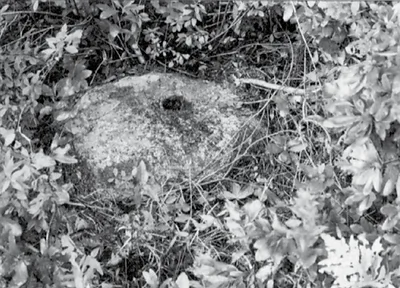
At 119 feet in the Chappell Shaft, the 1931 crew struck a granite boulder about five feet across. Beneath it lay fragments of wood, wood chips, spruce boughs and a limb of oak. The boulder had to be blasted before it could be removed. The shaft was sunk by William Chappell, the driller who had struck the supposed cement vault in 1897, with Frederick Blair, the holder of the treasure rights, keeping the record. It measured twelve by fourteen feet, lay slightly southwest of the Money Pit, and reached 155 feet, deeper than earlier searchers had excavated at the Money Pit itself.
The boulder belongs to the same run of deep finds as the anchor fluke at 116 feet, the axe at 123 feet, and the pick and miner's lamp at 127 feet. Further pieces of granite were recorded between 130 and 150 feet. Graham Harris and Les MacPhie, the geotechnical engineers who reviewed the records, estimate that a boulder of that size would weigh five to six thousand pounds, and read the oak underneath as a lever used to shift it or a wedge placed to stop it falling. In their view the original diggers would most likely have worked around a stone of that weight and left it in place, which would make the wood beneath it a trace of the first excavation. The surviving reports do not say where in the shaft the boulder sat, whether in the old Money Pit fill or in undisturbed ground at its edge, and there is no record that any of the wood was kept or dated.
Historical Context
Graham Harris and Les MacPhie, Oak Island and its Lost Treasure, third edition (Formac Publishing, Halifax, 2013), chapter 5, drawing on Frederick Blair's record of the 1931 excavation.
Where It Was Found
Found at Chappell Shaft (Shaft No. 21), 119 ft depth, slightly southwest of the Money Pit. Location: the original 1795 excavation shaft on Oak Island, Nova Scotia.