p>Sooner or later, almost every medieval theory about Oak Island meets the same objection: nobody would have put priceless sacred objects aboard a wooden ship and risked losing them in the Atlantic. It is an understandable reaction. But it rests on a curious assumption about the people involved. Medieval Christians repeatedly entrusted their most precious possessions to the sea, knowing perfectly well what could happen. For the military orders, arranging such a voyage was familiar work. Before asking whether they ever sailed to Oak Island, it is worth looking at the cargo they carried elsewhere, and the risks they were willing to take to get it there.
Worth a Voyage
1 min
A fragment of bone or a scrap of cloth could change a city's fortunes. Pilgrims came to pray before it, spent money while they were there, and carried its reputation home with them. To the faithful, a relic offered a tangible connection to a saint, or to Christ himself. To its custodians, it also brought income, influence, and prestige. Venice made the body of Saint Mark central to its identity. Constantinople guarded fragments of the True Cross as signs of imperial authority. Charles Freeman's Holy Bones, Holy Dust (2011) follows these objects through the struggles between popes and emperors, cities and kingdoms, monasteries and bishops. Reading those histories, the practical question soon becomes unavoidable: once you had secured a relic, how did you get it home?
For a new church, that question could hardly be put off. Under Canon VII of the Second Council of Nicaea, issued in 787, relics had to be placed in churches that lacked them. A bishop who consecrated a church without relics risked losing his office. The requirement reached far beyond Europe's great cathedrals. Consider Norse Greenland. A Catholic diocese was established at Gardar in 1124, and its first bishop, Arnaldur, began building a sandstone cathedral dedicated to Saint Nicholas. Writing in the fourteenth century, Ivar Bardarson, the bishop's agent from Bergen, described settlements with at least twelve parish churches, two monastic houses, and a cathedral. Their altars, too, called for relics. Supplying those distant churches meant carrying sacred objects from Scandinavia across the open North Atlantic. Greenland belongs in this story because it brings the argument out of the Mediterranean and into the ocean itself.
The People Who Could Get It There
1 min
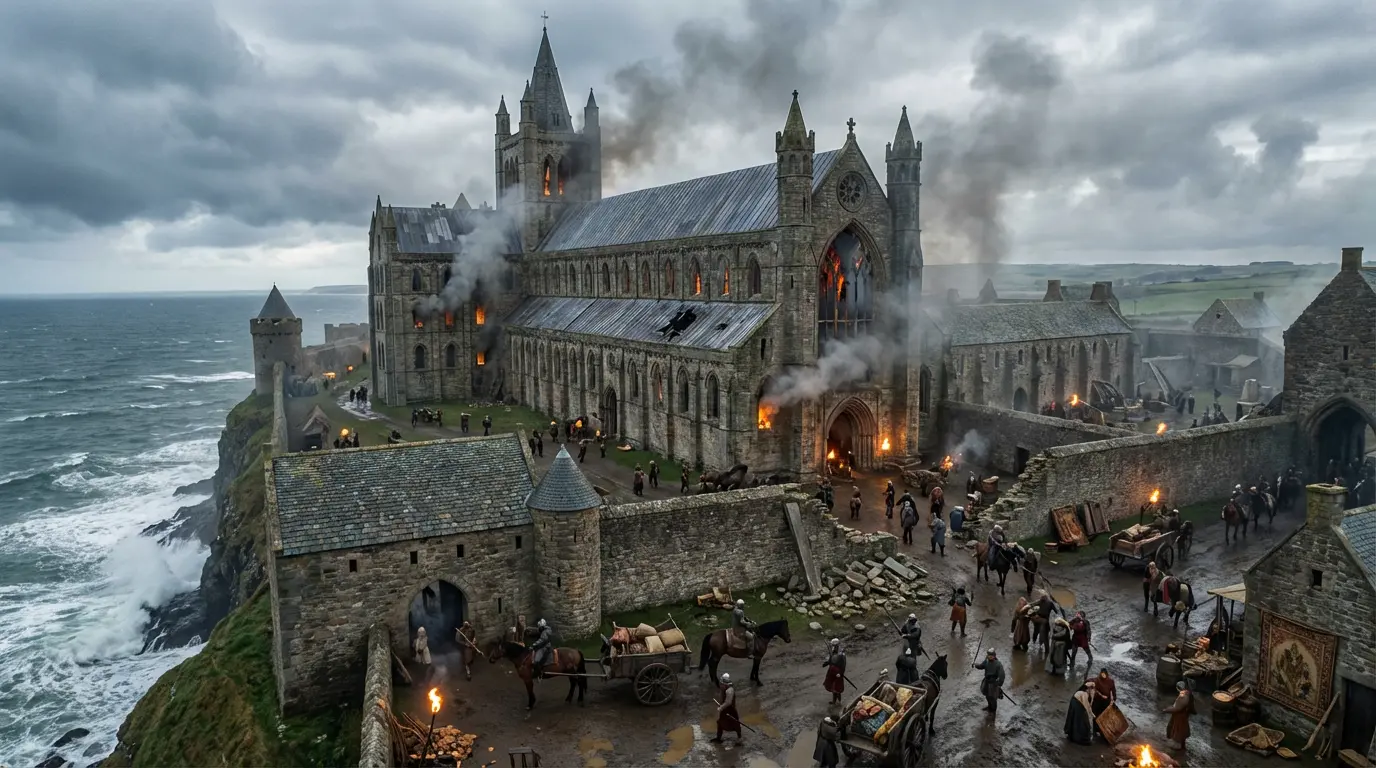
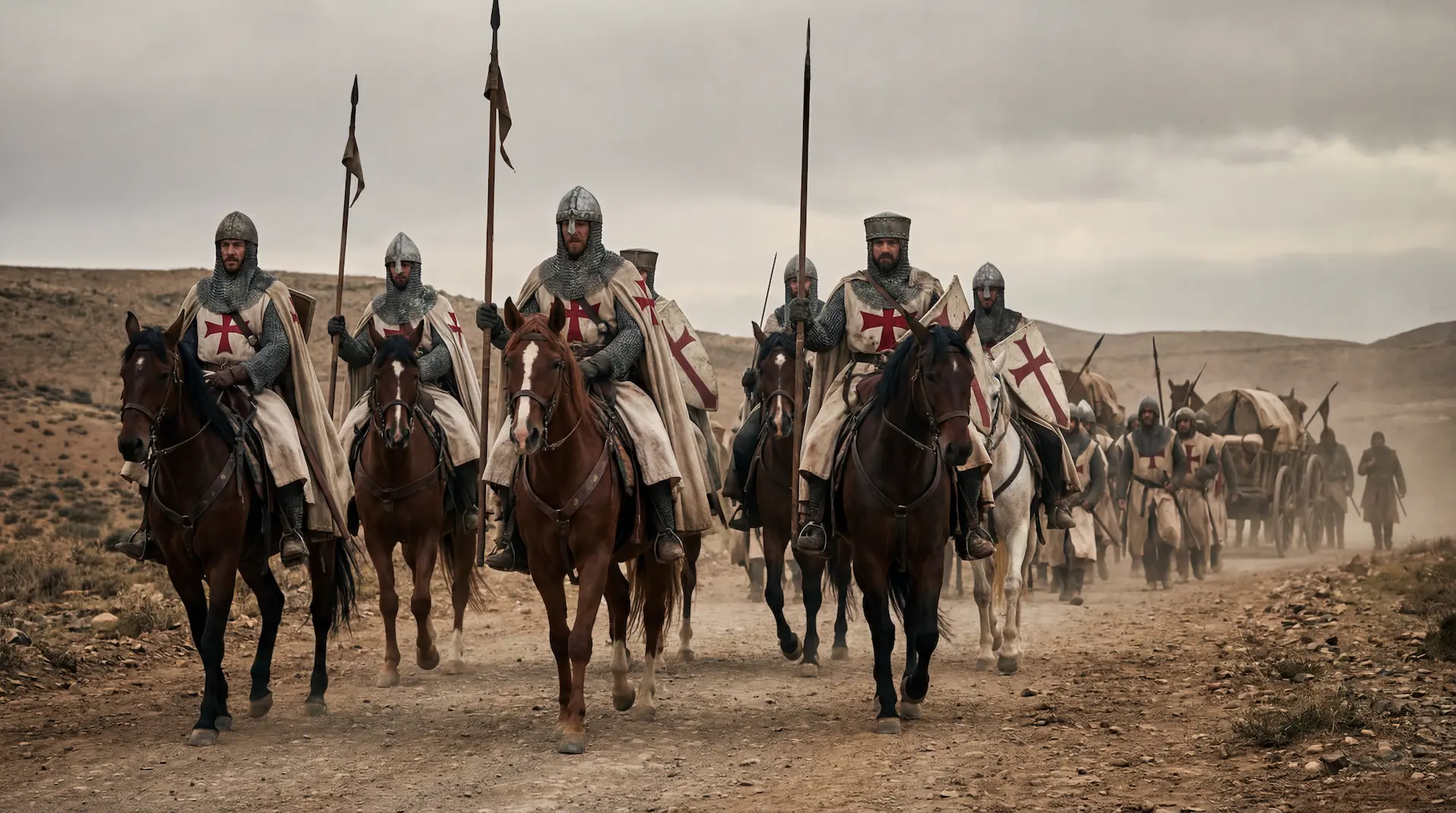
The military orders brought ships, money, armed protection, and contacts to that work. The Templars' financial network stretched from the Levant to the British Isles, while their vessels carried pilgrims, soldiers, bullion, and sacred objects through the Mediterranean. A valuable cargo needed more than space in a hold. Someone had to arrange the vessel, pay the crew, secure the departure, and make sure trustworthy people were waiting at the other end. The orders had houses, ports, and officers along the routes they used. They could draw on experience accumulated over generations of voyages.
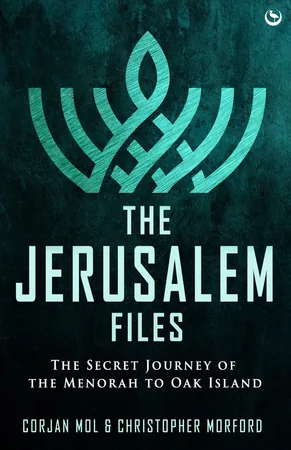
Some of their cargoes still invite a closer look. In 1254, the Templars helped Louis IX ship holy relics from Acre to southern France aboard the Montjoie, under the Templar captain Raymond des Anges. Two chroniclers described a cargo that included what they called "le cors de nostre seigneur Iesu Crist," the body of our Lord Jesus Christ. Christopher Eric Morford and Corjan Mol examine the evidence for that transfer in The Jerusalem Files. Twenty years later, during the mastership of William of Beaujeu, a vial said to contain drops of Christ's blood travelled from Acre to Norwich. That journey ran for roughly 3,500 miles, along the Mediterranean, through Gibraltar, and north into the Atlantic. The Bay of Biscay lay ahead, with its exposed waters and dangerous weather. Then there is the more unusual case of the Holy House of Loreto. According to the account associated with Vatican documents reported by the papal physician Joseph Lapponi in 1900, the Angeli family paid crusaders to dismantle and transport three stone walls from Palestine to Italy in 1294. Diplomatic correspondence published in 1985 refers to "the holy stones taken away from the House of Our Lady, Mother of God." This was three years after the fall of Acre. The Templars and Hospitallers had the ships and networks that could make such an operation possible, although that capability alone does not establish who carried the stones.
 The Knights Templar on Oak Island→
Vulnerable Voyages
2 min
None of this made the voyages safe. The Mediterranean itself demanded long passages out of sight of land: Sicily to Crete was roughly 500 miles of open water. Roger of Hoveden, writing about Richard I's fleet in 1191, described the direct route from Marseilles to Acre as an open-sea crossing. Sailors learned those waters through experience, knowledge later captured in portolan charts, but experience could only do so much. Heavy weather devastated a Byzantine fleet returning from Egypt in 1169. At Curzola in 1298, Venice lost 83 of its 95 galleys in battle against Genoa, with thousands of men killed or captured. Even a successful departure offered no assurance that a cargo would arrive: Malta's cultural heritage authority records Hospitaller tapestries seized by Ottoman raiders in 1527 while travelling between Italy and Nice. In the North Atlantic, the voyage that brought Erik the Red's settlers from Iceland to Greenland in 985 offers another measure of the uncertainty. Of 25 ships that set out, only 14 reached Greenland. Yet Norse sailors continued to supply those settlements for centuries. Joinville's account of Louis IX's fleet approaching Egypt in 1249 captures the same vulnerability on a different scale, with storms scattering the ships before they reached Damietta. The people sending sacred objects to sea lived with these dangers. They sent them anyway.
The distances help explain why an Atlantic voyage cannot simply be dismissed as beyond medieval ambition. La Rochelle to Nova Scotia is roughly 2,800 miles; from Bristol, roughly 2,500. Both are shorter in total distance than the journey from Acre to Norwich. That comparison has limits: a long route with ports along the way presents different problems from an ocean crossing. The Norse route through Iceland and Greenland offers a more relevant example of how sailors broke a westward journey into stages. Their cargo ships, the knarrs, carried supplies to communities on the western side of the North Atlantic. None of this puts a Templar ship off Nova Scotia. It does, however, give us a firmer starting point than the assumption that medieval sailors and their patrons would never have contemplated the risk.
Running With The Goods
2 min
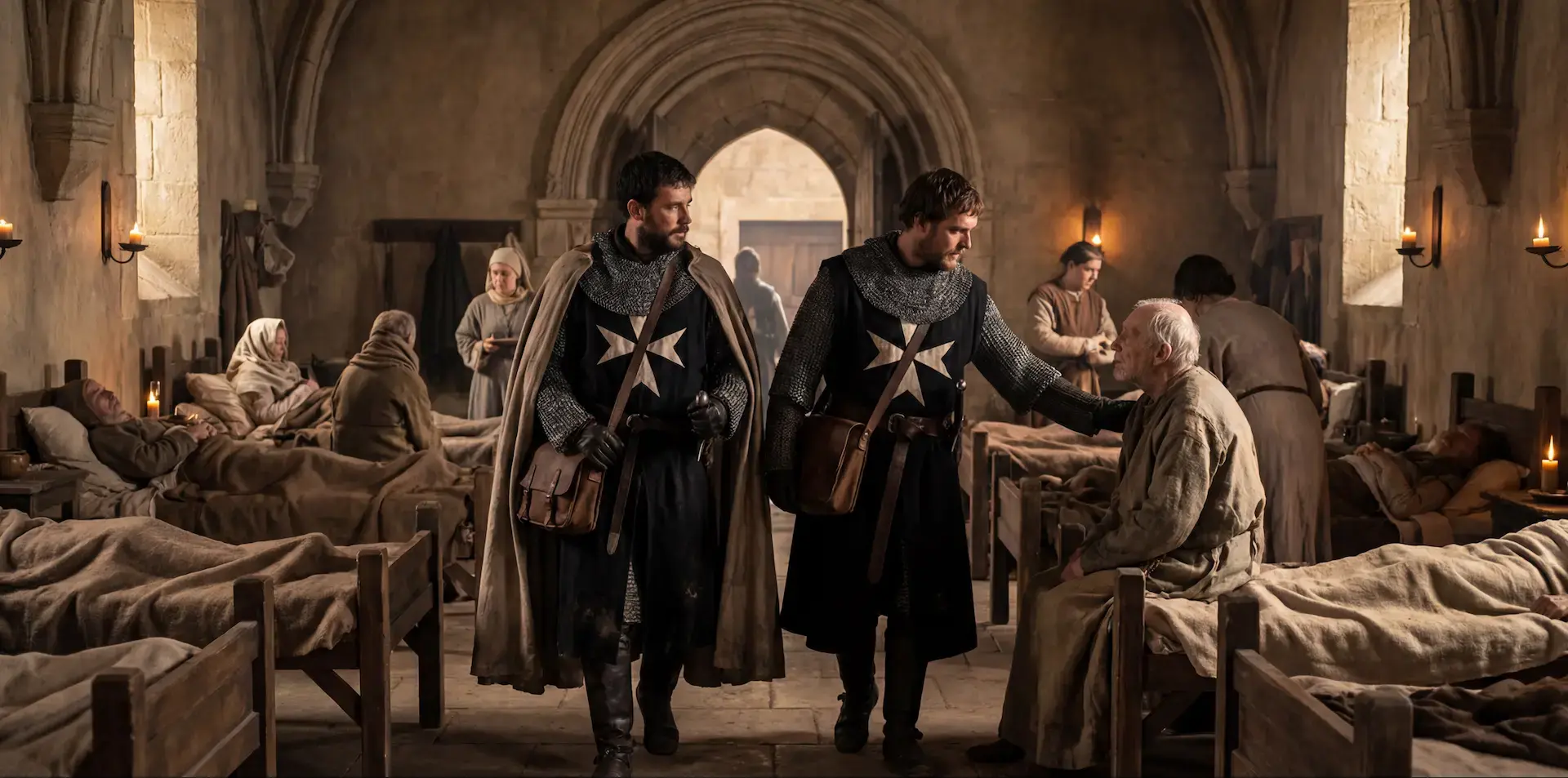
The Hospitallers' departure from Rhodes in 1522 makes the value of sacred cargo especially clear. Driven from the island by the Ottomans, Grand Master Philippe de Villiers de L'Isle Adam arranged to take the Order's relics with its archives and weapons. Among them were the Right Hand of John the Baptist, fragments of the True Cross, and the icon of Our Lady of Philermos, traditionally attributed to Saint Luke. For seven years, as the Order searched for a new home, these objects travelled with it around the Mediterranean. During its stay in Viterbo between 1524 and 1527, the Order deposited the Madonna della Carbonara, a twelfth-century icon bearing a distinctive four-dot cross. When the Hospitallers settled on Malta in 1530, their sacred relics were placed in the Church of San Lorenzo in Birgu, and a strong-room was built in Fort St. Angelo to protect them. Giacomo Bosio, the Order's historian, describes that chamber and its purpose. Even Malta was only another stop. After Napoleon seized the island in 1798, the principal relics passed to Russia and eventually to Montenegro. There, in 1997, the Australian Professed Knight Fra' Richard Divall located the Right Hand and the fragment of the True Cross in a monastery. Across exile, war, and the loss of successive homes, the Order kept finding ways to carry its sacred possessions with it.
 The Knights Hospitaller→
Seen together, these journeys make the old objection harder to sustain. For more than a thousand years, Christians moved sacred objects over great distances because having them, or keeping them, mattered enough to justify the voyage. The military orders were particularly well equipped for the task. They had crews to sail the ships, money to provision them, and people to receive the cargo. When circumstances forced them to move, they could put those arrangements to work again. A relic might outlast several generations of custodians and travel through several countries while remaining in the care of the same institution.
Many of the earliest Templars came from Norman families, whose recent history already connected northern Europe with Sicily, southern Italy, and the Holy Land. Long journeys were part of that inheritance. Whether members of the military orders ever carried sacred cargo farther west than the surviving record confirms remains an open question. Oak Island needs evidence of its own. But dismissing the possibility because the cargo was too precious, the sea too dangerous, or the task too demanding misses what these voyages tell us about the people who made them. To their custodians, the value of a relic could be the very reason to put it aboard a ship.
 Vikings→
Sources
1 min
- Charles Freeman, Holy Bones, Holy Dust: How Relics Shaped the History of Medieval Europe (Yale University Press, 2011);
- Christopher Eric Morford and Corjan Mol, The Jerusalem Files (Watkins, 2024);
- Canon VII of the Second Council of Nicaea (787);
- Ivar Bardarson, description of Greenland (fourteenth century); Landnámabók;
- Roger of Hoveden, Chronica;
- Jean de Joinville, Life of Saint Louis;
- the Vatican documents discovered by Joseph Lapponi (1900) and the diplomatic correspondence published in 1985 concerning the Holy House of Loreto;
- Giacomo Bosio, history of the Order of Saint John;
- Malta's cultural heritage authority;
- the Sovereign Military Order of Malta.