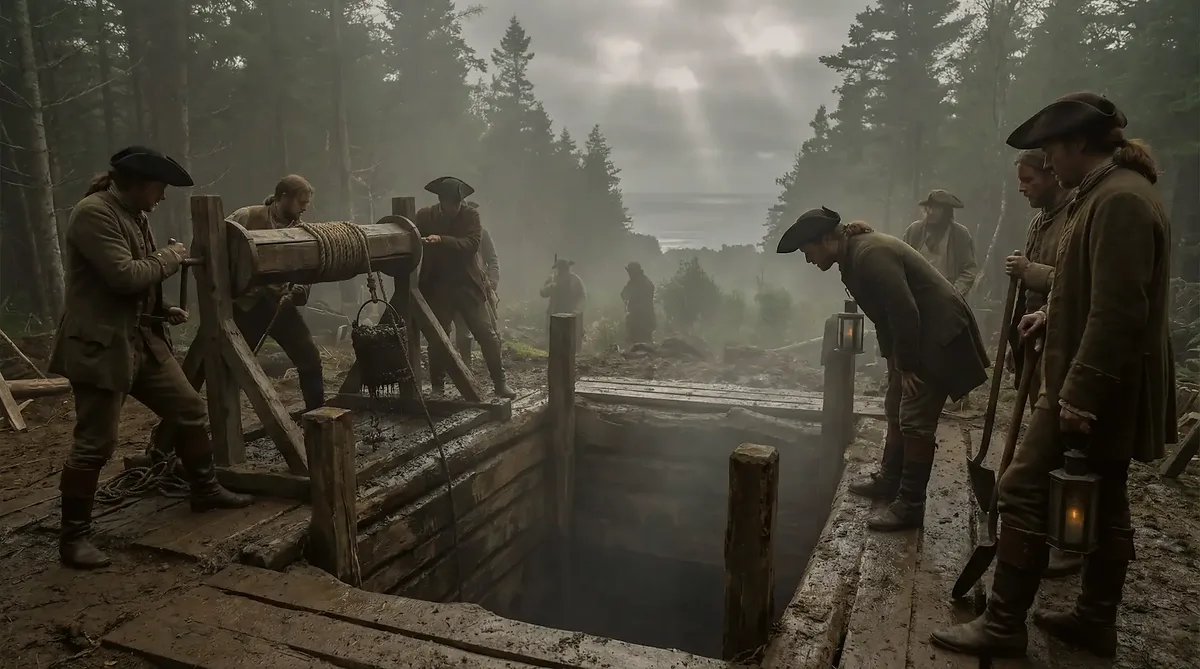
Of all the objects proposed as the contents of the Oak Island Money Pit, none carries more weight, both literal and symbolic, than the Ark of the Covenant. A gold-covered chest built to hold the stone tablets of the Ten Commandments, the Ark was the single most sacred object in ancient Israel. It served as the throne of God on earth, the point where the divine met the physical. Its disappearance from recorded history is not one event but two: the first in 586 BC, when Babylon destroyed Solomon's Temple, and the second in 1745, when Pope Benedict XIV ordered a claimed Ark removed from the papal cathedral in Rome and never shown again. That second disappearance occurred just fifty years before three boys on Oak Island discovered the Money Pit in 1795.
World's Best Known Box
1 min
The Ark was a rectangular chest built from acacia wood, measuring two and a half cubits long by one and a half cubits wide and high, roughly 130 by 80 by 80 centimetres. The wood was overlaid inside and out with pure gold. Four gold rings were fixed near its feet, through which gold-covered acacia poles were inserted for carrying. The poles were never to be removed. On top of the chest sat the mercy seat, a slab of solid gold the same dimensions as the lid. At each end, a golden cherub was hammered from the same piece as the cover, their wings stretching toward each other, forming a throne. God was said to speak to Moses from the space between the cherubim. Inside the Ark rested the stone tablets of the Ten Commandments, a golden pot of manna, and Aaron's rod that had miraculously budded. Estimates of the Ark's total weight range from 150 to nearly 300 kilograms, depending on the thickness of the gold overlay. It took four men to carry it on poles.
Disappearance
1 min
The Ark occupied the Holy of Holies in Solomon's Temple in Jerusalem for roughly four centuries. In 586 BC, King Nebuchadnezzar II of Babylon besieged the city, breached the walls, and burned the Temple to the ground. The Second Book of Kings records that Babylon carried away the Temple's vessels of gold and silver, but the Ark is never mentioned among them. Its absence from the inventory is the foundation of every theory that follows. Either the Babylonians took it and the record was lost, or the Ark was hidden before the city fell.
The most detailed account of deliberate concealment appears in 2 Maccabees 2:4-8, which states that the prophet Jeremiah, warned by God, carried the Ark to Mount Nebo and sealed it in a cave. When his companions tried to mark the path, Jeremiah rebuked them, declaring the place would remain unknown until God gathered his people again. The passage is considered deuterocanonical and its historical reliability is debated, but it established a tradition that the Ark survived the destruction of Jerusalem and was deliberately hidden rather than destroyed or captured.
When the Second Temple was rebuilt after the Babylonian exile, the Holy of Holies stood empty. The Talmud records that the Ark was not among the objects returned. By the time Roman legions under Titus sacked the Second Temple in 70 AD, the Ark had been missing for over six centuries. The Arch of Titus, still standing in the Roman Forum, depicts soldiers carrying the Menorah and the table of the showbread in triumph. The Ark does not appear.
Four Major Claims
1 min
Four major traditions compete for what happened to the Ark after 586 BC, and they are mutually exclusive.
The Ethiopian tradition, preserved in the Kebra Nagast (Glory of the Kings), holds that the Ark was taken to Ethiopia by Menelik I, the son of King Solomon and the Queen of Sheba, centuries before the Babylonian destruction. According to the Ethiopian Orthodox Church, the Ark rests in the Church of Our Lady Mary of Zion in Axum, guarded by a single monk who is the only person permitted to see it. No outside observer has ever been granted access, and the claim cannot be verified.
The rabbinical tradition maintains that the Ark never left the Temple Mount. The Mishnah records that King Josiah, foreseeing the coming destruction, hid the Ark in a chamber beneath the Temple. This tradition holds that the Ark remains under the Mount to this day, inaccessible beneath the Dome of the Rock. Excavation at the site is politically and religiously impossible.
The skeptical position holds that the Ark was simply destroyed in 586 BC, either by Babylonian soldiers or in the fire that consumed the Temple. No biblical source records its destruction, but no biblical source records its survival either. The silence is the evidence, and it points in both directions.
The fourth tradition, and the one most directly relevant to Oak Island, places the Ark in Rome.
The Lateran Ark of Rome
4 min
From the beginning of the twelfth century and for more than six hundred years, the canons of San Giovanni in Laterano, the papal cathedral in Rome, claimed that the actual Ark of the Covenant was part of their treasures. This is not legend. It is documented in the Descriptio Lateranensis Ecclesiae, a tract composed around 1100 and preserved in multiple medieval manuscripts across Europe. The claim was analysed in detail by Norwegian church historian Eivor Andersen Oftestad of MF Norwegian School of Theology in her 2019 study The Lateran Church in Rome and the Ark of the Covenant (Boydell Press).
According to the Descriptio, the high altar of the basilica covered the Ark of the Covenant, the rods of Aaron and Moses, the seven-branch candelabra, the tablets of the testament, and relics from the lives of Christ and the apostles. The theological justification was a concept Oftestad terms translatio templi: the transfer of the Temple from Jerusalem to Rome. The argument held that the Temple spoils were transported to Rome by the emperors Titus and Vespasian after the destruction of Jerusalem in 70 AD, as depicted on the Arch of Titus. The Lateran, as the first church built by Emperor Constantine and the seat of papal authority, claimed to be the legitimate heir of the Temple of Solomon.
The tradition was not confined to the Descriptio. William Durandus of Metz, in his thirteenth-century liturgical encyclopedia Rationale Divinorum Officiorum, independently confirms the claim and provides his own inventory of what the Ark contained: "the rings and staves of gold, the tables of the testimony, the rod of Aaron, manna, barley loaves, the golden pot, the seamless garment, the reed, a garment of St. John the Baptist, and the scissors with which the hair of St. John the Evangelist was shorn." Durandus also states that Constantine placed the Ark in the Lateran alongside "the golden candlestick and its seven branches," a reference to the Temple Menorah.
The canons did not merely claim to possess the Ark. They built their most solemn annual liturgy around it. The Ordo Officiorum Ecclesiae Lateranensis, the official liturgical book of the basilica, records that the high altar was constructed with a removable top. Once a year, on Holy Thursday, the canons lifted it off, exposing the interior where the Ark and the other Temple objects were kept. The pope arrived at noon to celebrate Mass and prepare the sacred chrism. During his homily, the altar top was carried to an adjacent chapel, and the pope then consecrated the Eucharist directly above the exposed Ark, he alone having a view of the interior, in deliberate imitation of the Jewish High Priest entering the Holy of Holies. After Mass, the opened altar was covered with a pallium and sealed at its four corners by the chancellor of the curia. The canons guarded it day and night until Holy Saturday, when the seals were inspected and the top replaced. Seven lamps burned throughout the exposure to mark the presence of the sacred objects. Whatever was inside that altar, the entire papal court treated it as real.
In 1308, a fire devastated the Lateran basilica. The lead covering the apse melted and hung in stalactites. But the bronze columns "of the temple of Solomon" survived intact, though tarnished. The clerics opened the high altar to rescue the treasures sealed inside. When the fire was out, the inhabitants of Rome crowded onto the Lateran square, demanding to see the relics that had been saved. It was the Archbishop of Pisa who showed them. He displayed the head of Saint Pancras, said to produce a drop of blood each time it was touched, the skull of Zacharias, father of John the Baptist, the Milk of the Virgin, the Circumcision of Christ enclosed in an ivory reliquary, the Tunic of Christ, sealed coffers bearing cardinal seals and containing ampoules of the Holy Blood, the coals and iron shovel from the martyrdom of Saint Lawrence, the linen Christ used to wash the feet of the apostles, the barley loaves from the feeding of the five thousand, the Table of the Last Supper, and the Ark of the Covenant. The account survives in a contemporary Latin poem, the Lateranensis basilice combustio tempore Clementis V rythmo descripta, preserved in a fourteenth-century manuscript (Bibl. Vallicellane, Ms. F. 61) and published by Philippe Lauer in Le Palais de Latran. After restoration, the Ark was not returned to the high altar but placed in the chapel of San Tommaso alongside the Table of the Last Supper and the rods of Moses and Aaron. A late fourteenth-century pilgrimage guide records that Jews also came to the chapel to venerate the Ark.
Eye Witnesses
3 min
Around 1170, the Spanish Jewish traveller Benjamin of Tudela visited the Lateran and confirmed two bronze columns taken from Solomon's Temple, each engraved with the inscription "Solomon the son of David." The Jews of Rome told him that every year on Tisha B'Av, the day commemorating the destruction of the Temple, the columns exuded moisture. Benjamin also recorded "the cave where Titus the son of Vespasian stored the temple vessels which he brought from Jerusalem." The Roman Jewish community thus confirmed the physical transfer of Temple objects to Rome, though mainstream Jewish tradition held that the Ark had been lost before the Roman conquest.
In 1647, the chapel of San Tommaso was demolished. The Ark and rods were transferred to the ambulatory of the apse, where votive lamps were installed in front of them and treatises composed to defend their authenticity. One was written by Famiano Nardini, the archaeologist and author of Roma Antica. After examining the chest in 1661, Nardini concluded that it resembled the one described in Exodus and that he could not dismiss it as a fabrication.
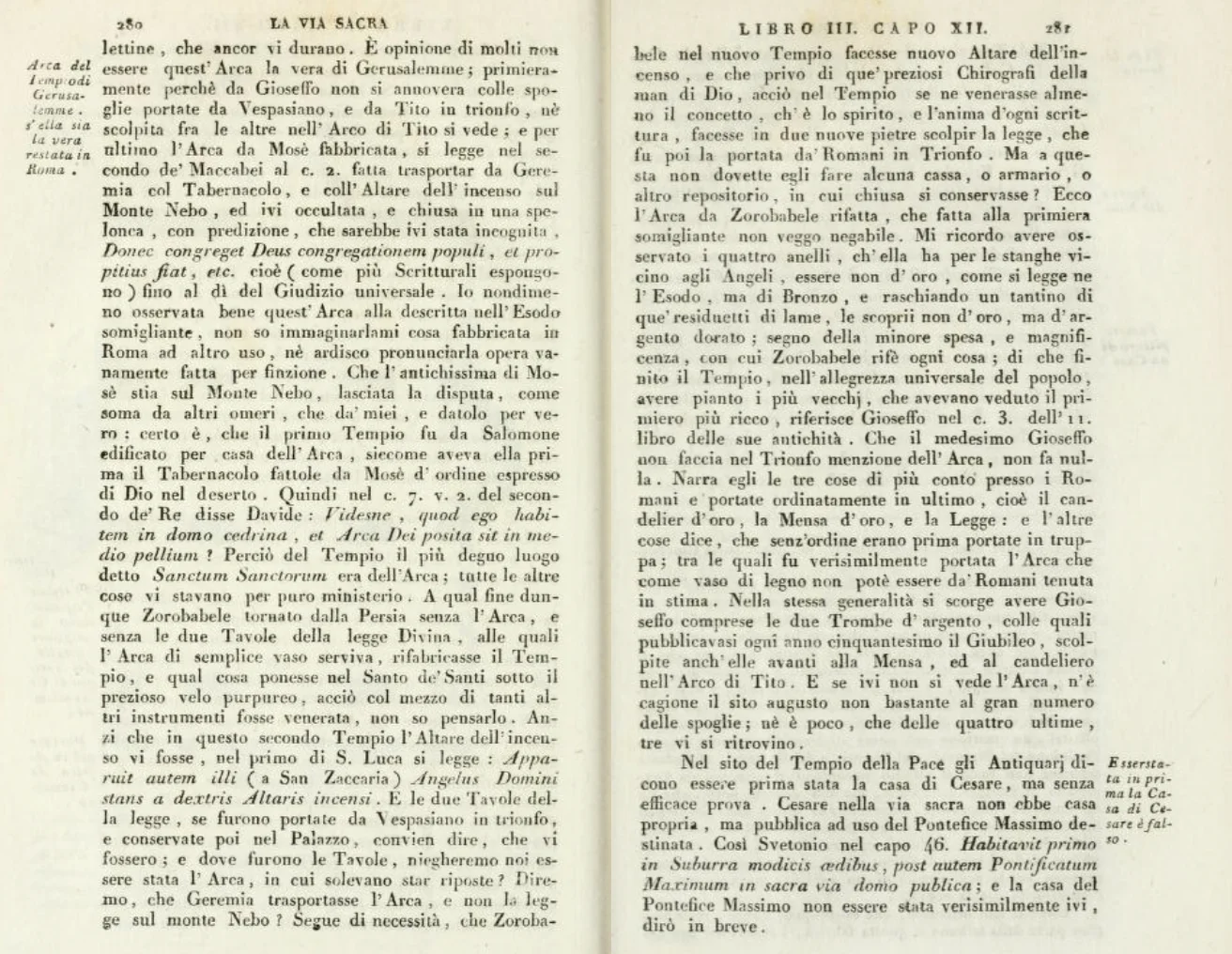
In 1656, during a visitation by Pope Alexander VII, the Ark was described as a decorated wooden chest covered with a cloth of silk, placed above a glass box through which the rods were visible.
Then, in May 1745, Pope Benedict XIV conducted a pastoral visit to the basilica. He examined the Ark and the rods, and reserved judgement overnight. The following morning he issued his decision. The table of the Last Supper could remain for veneration. The Ark of the Covenant, the rod of Moses, and the staff of Aaron were to be removed and never shown again. The decree was recorded in Latin: "amoveantur vero ea, quae asseruntur Archa Foederis, virga Moysis et Baculus Aaronis, et amplius non ostendantur." Let those things which are claimed to be the Ark of the Covenant, the rod of Moses, and the staff of Aaron be removed, and let them no longer be shown.
No physical trace of the Lateran Ark has been found after 1745. Oftestad wrote to the Vatican Museum in 2008 asking whether any remnants existed in their collection. They replied that neither the curator nor his colleagues were familiar with the tradition. A thirteenth-century stone tablet the Tabula Magna Lateranensis, however, remains bricked into the wall of the basilica to this day, stating that the Ark of the Covenant and the other Temple objects are underneath the high altar and that Titus and Vespasian caused them to be transferred from Jerusalem by the Jews.
The date matters. The Lateran Ark was ordered removed from display in 1745. The Money Pit on Oak Island was allegedly discovered in 1795. Fifty years separate the two events. Whether that gap is coincidence or connection depends on what one believes happened to the objects after the pope's decree.
Author and Templar expert Tony McMahon visited the Lateran palace in April 2025 and published some photos of the probable historic location of the Ark there.
The Templars and the Temple Mount
1 min
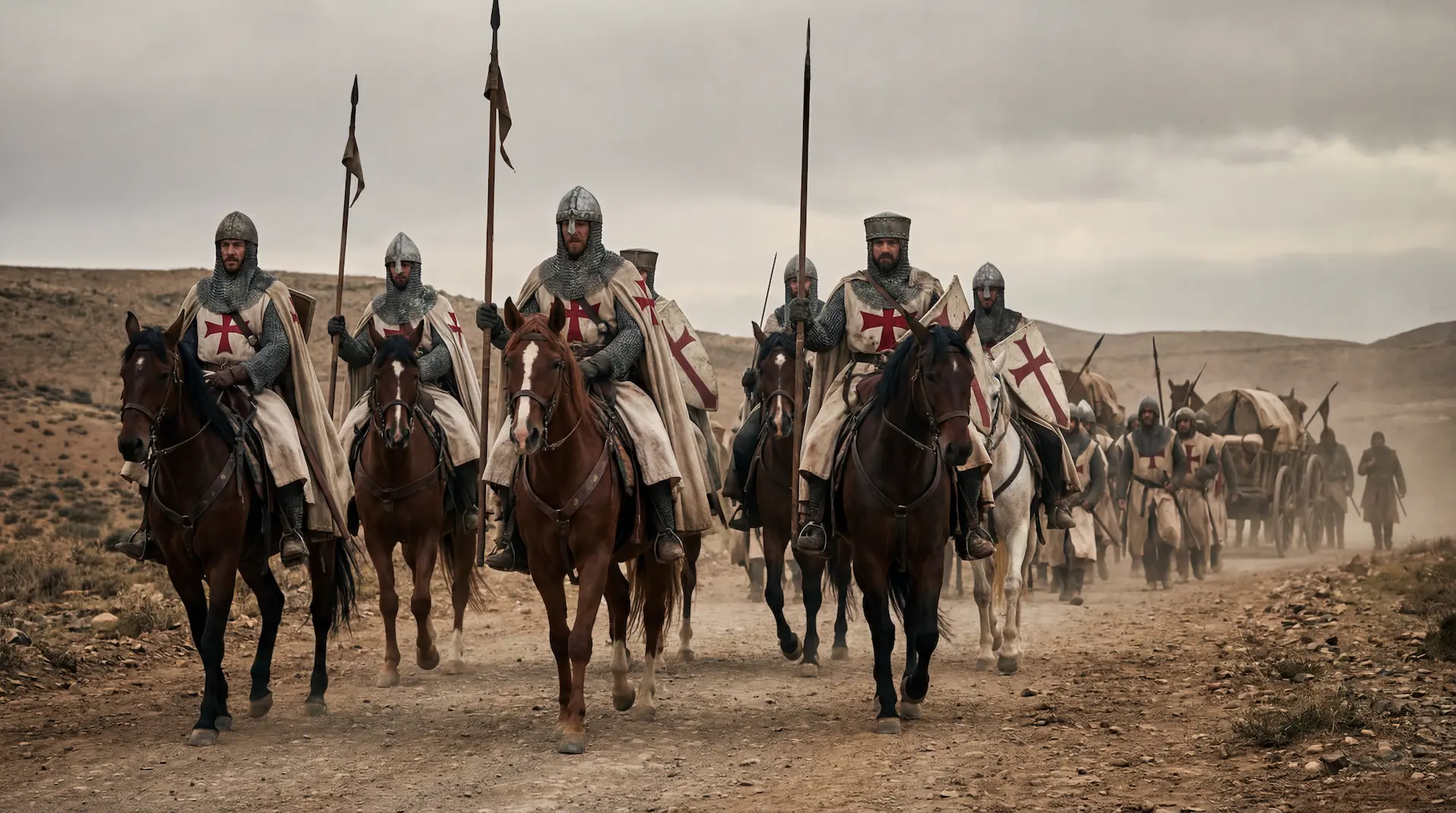
The Knights Templar were headquartered on the Temple Mount in Jerusalem from 1119 to 1291, occupying the Al-Aqsa Mosque and the structures beneath it known as Solomon's Stables. Their full name, the Poor Fellow-Soldiers of Christ and of the Temple of Solomon, declared the association. During precisely this period, the canons of the Lateran were actively promoting their claim to possess the Temple treasures through the Descriptio. Oftestad's research reveals that the canons of St. Peter's accused the Lateran canons of "Judaizing," of being like Jews and followers of Moses for claiming the Temple objects. The charge appeared in a polemical poem from the early thirteenth century.
What the Templars found beneath the Temple Mount remains one of the central unanswered questions of medieval history. The tunnels are real. In 1867, Lieutenant Charles Warren of the Royal Engineers mapped an extensive network of passages and shafts beneath the platform. Whether the Templars excavated these passages, expanded existing ones, or simply occupied them for storage and stabling is debated. The order was specifically accused during its trial between 1307 and 1312 of possessing and worshipping mysterious objects, including a bearded head known as Baphomet. Whether those accusations were fabricated by Philip IV of France to justify the seizure of Templar wealth, or whether the order held objects it refused to surrender, has never been settled.
The overlap between the Lateran claim and the Templar presence on the Temple Mount creates a question that Oftestad's research brings into focus but does not resolve. If the Lateran possessed (or believed it possessed) the Ark from around 1100 onward, the Templars, who were in direct contact with both the papacy and the canons of Jerusalem, would have known about the claim. Their own relationship to the Temple treasures, whatever it was, existed in tension with the Lateran tradition.
 The Knights Templar on Oak Island→
On the Show
2 min
The Ark of the Covenant runs through The Curse of Oak Island like a thread connecting disparate theories across more than a decade of episodes. In Season 1, Episode 4, "The Secret of Solomon's Temple," Norwegian writer and filmmaker Petter Amundsen arrives on the island to present steganographic ciphers he believes are hidden in Shakespeare's First Folio, with Temple treasures as the ultimate prize. In Season 2, Episode 3, "The Eight-Pointed Star," J. Hutton Pulitzer takes the theory in a completely different direction, proposing that Phoenician mariners carried the Ark to Oak Island between 582 and 596 BC along a route from the Holy Land through North Africa and Iberia. His case leans on shared symbols and the alleged tifinagh alphabet found on the 90-foot stone. Season 3, Episode 9, "Columbus Day," brings a third voice: researcher Jeff Irving, who argues the Ark was smuggled out of Jerusalem by the Knights Templar, taken to Scotland, and eventually transported to Oak Island by Christopher Columbus and associates connected to the order. The Templar link to the Temple Mount is explored across multiple seasons, most prominently in Season 2, Episode 7, "The Trail of the Templars," and Season 5, Episode 14, "The Templar Connection," where the discovery of the lead cross at Smith's Cove is directly tied to Templar carvings at the prison of Domme in France.
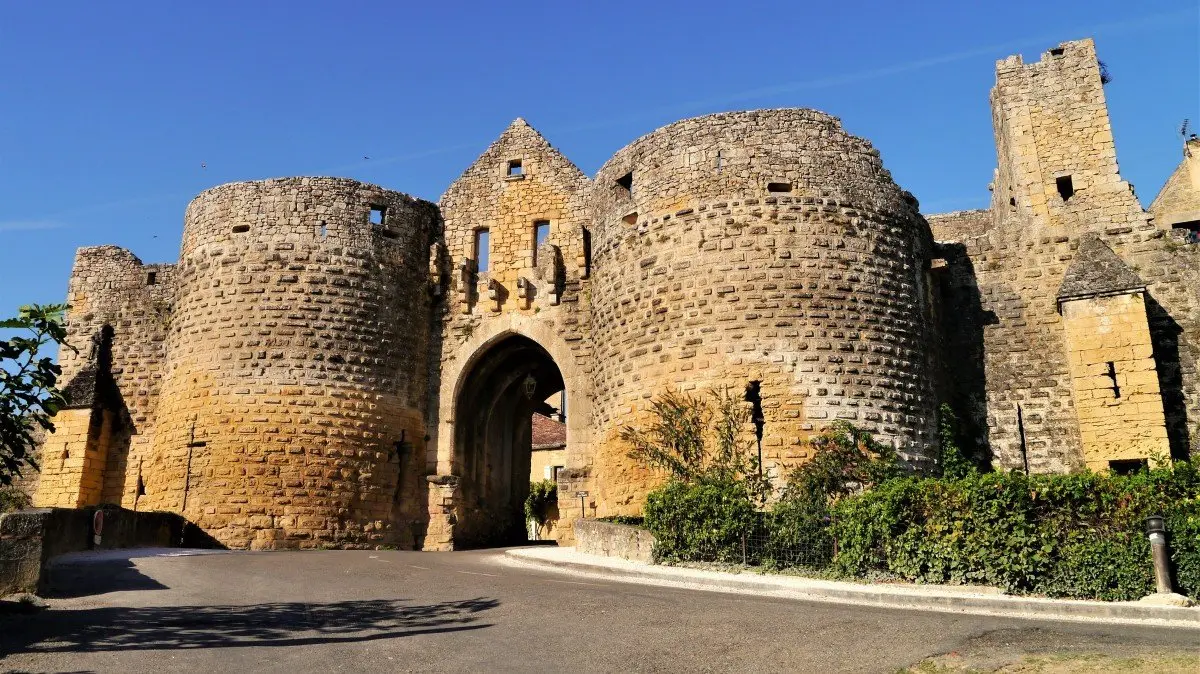 Domme Templar Prison→
In Season 9, Episode 21, "A Lot of Secrets," researcher and 32nd-degree Freemason Scott Clarke adds another layer by connecting the rhodolite garnet brooch recovered on Lot 8 to a Masonic Royal Arch High Priest breastplate, the ceremonial object modelled on the one worn by the high priest who guarded the Ark in the Temple of Solomon.
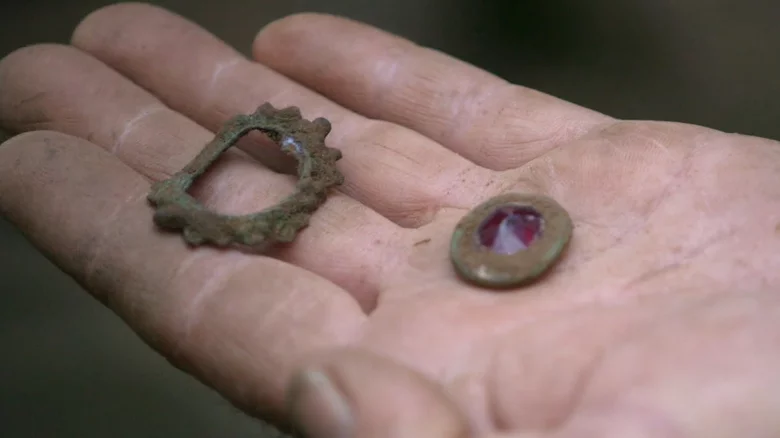 Jewelled brooch (rhodolite garnet)→
The most sustained case comes from researcher John Edwards, who first appears in Season 11, Episode 19, "Hi Ho Silver," with a theory built over 30 years of studying Templar-era symbols and Masonic ciphers. Edwards finds encoded references to a holy ark and an underground vault in the Royal Arch Ode, a 19th-century text recited during secret Masonic ceremonies, and in two rare volumes he acquired: The Whole Genuine Works of Flavius Josephus from 1812 and Holy Week from 1763. He extends Nolan's Cross into the Kabbalistic Tree of Life and calculates three possible burial locations on the island: the Yesod, the Da'ath, and the Tiferet. His research returns across subsequent episodes through Season 13, where the team investigates his coordinates on the ground.
From Jerusalem to Oak Island
1 min
The theory that the Ark reached Oak Island requires a chain of custody stretching across centuries. The strongest version of that chain runs through the Templars. On Friday, 13 October 1307, Philip IV ordered the mass arrest of every Templar in France. The order's leadership had advance warning. In June 1308, Templar Preceptor Jean de Châlons testified before the Papal Inquisition at Poitiers that Master of France Gérard and Hugues de Villiers had fled together with the entire treasure of Hugues de Pairaud, the Visitor (treasurer) of the Temple, with fifty horses and put to sea with eighteen galleys. The treasure left Paris. The fleet sailed. Neither was seen again. This is not folklore; it is recorded testimony given under oath before papal inquisitors, preserved in official church archives.
Where the fleet went has never been established. But the families aboard it can be traced. The Villiers bloodline runs from Gérard and Hugues de Villiers, who fled with the treasure in 1307, through ten generations to Nova Scotia. Isaac de Razilly arrived in Acadia on 8 September 1632, the Feast of the Nativity of the Blessed Virgin Mary, patronal feast of the Knights of Malta. His mother was Catherine de Villiers. The bloodline that boarded the galleys in 1307 was present when the French crown planted its flag in Nova Scotia three centuries later.
The military orders had the means to move sacred objects across oceans. In 1254, relics were shipped from the Crusader port of Acre to southern France aboard the vessel Montjoie. Transporting a chest across the Atlantic was not beyond their operational capacity.
Oak Island fits the requirements: an island, defensible, remote from any established power, protected by an engineering system designed to flood and reseal if breached. If the Templars possessed the Ark, or believed they did, the Money Pit is consistent with what a vault for that object would look like.
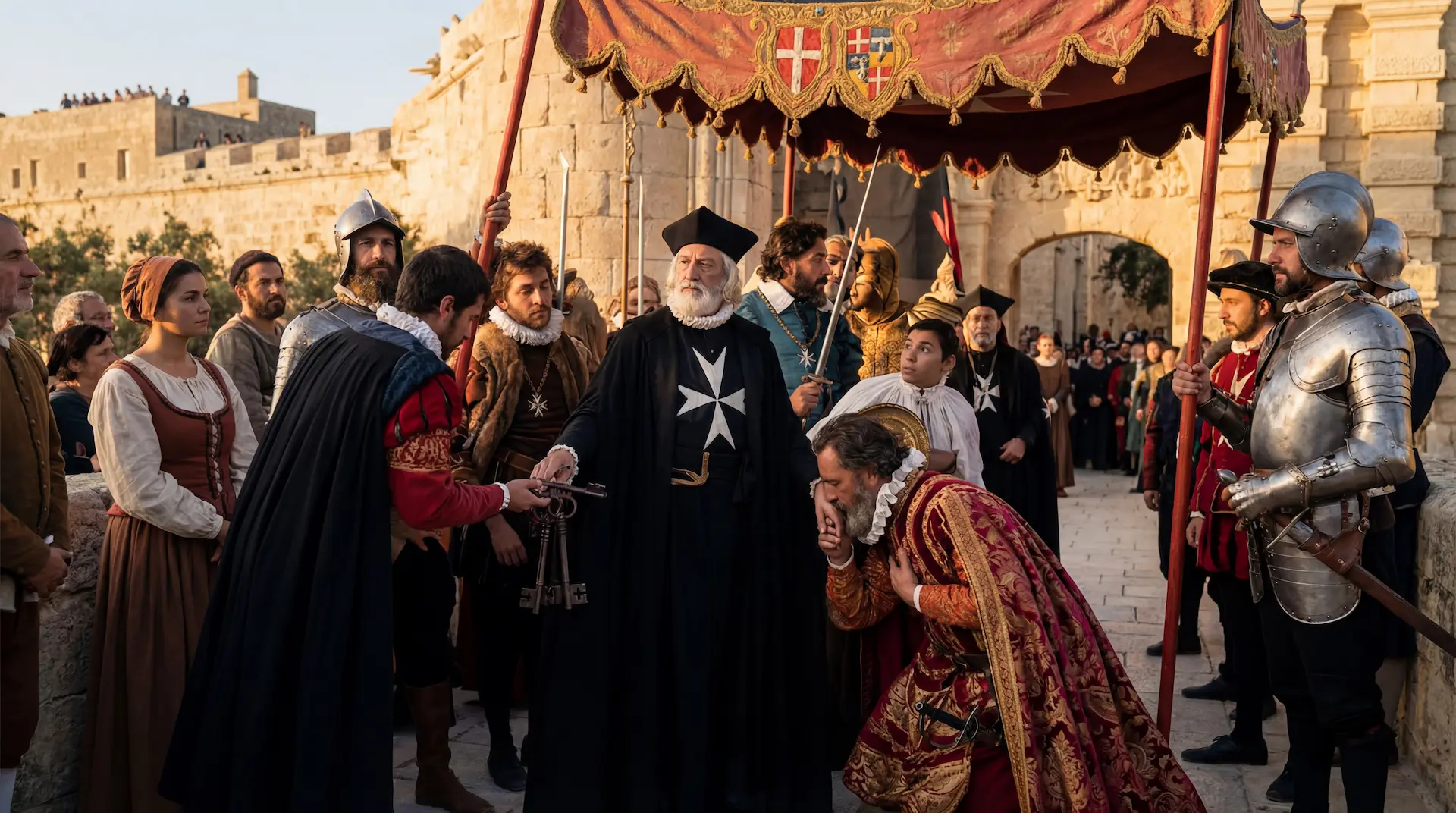 De Villiers: The Treasure Bloodline→
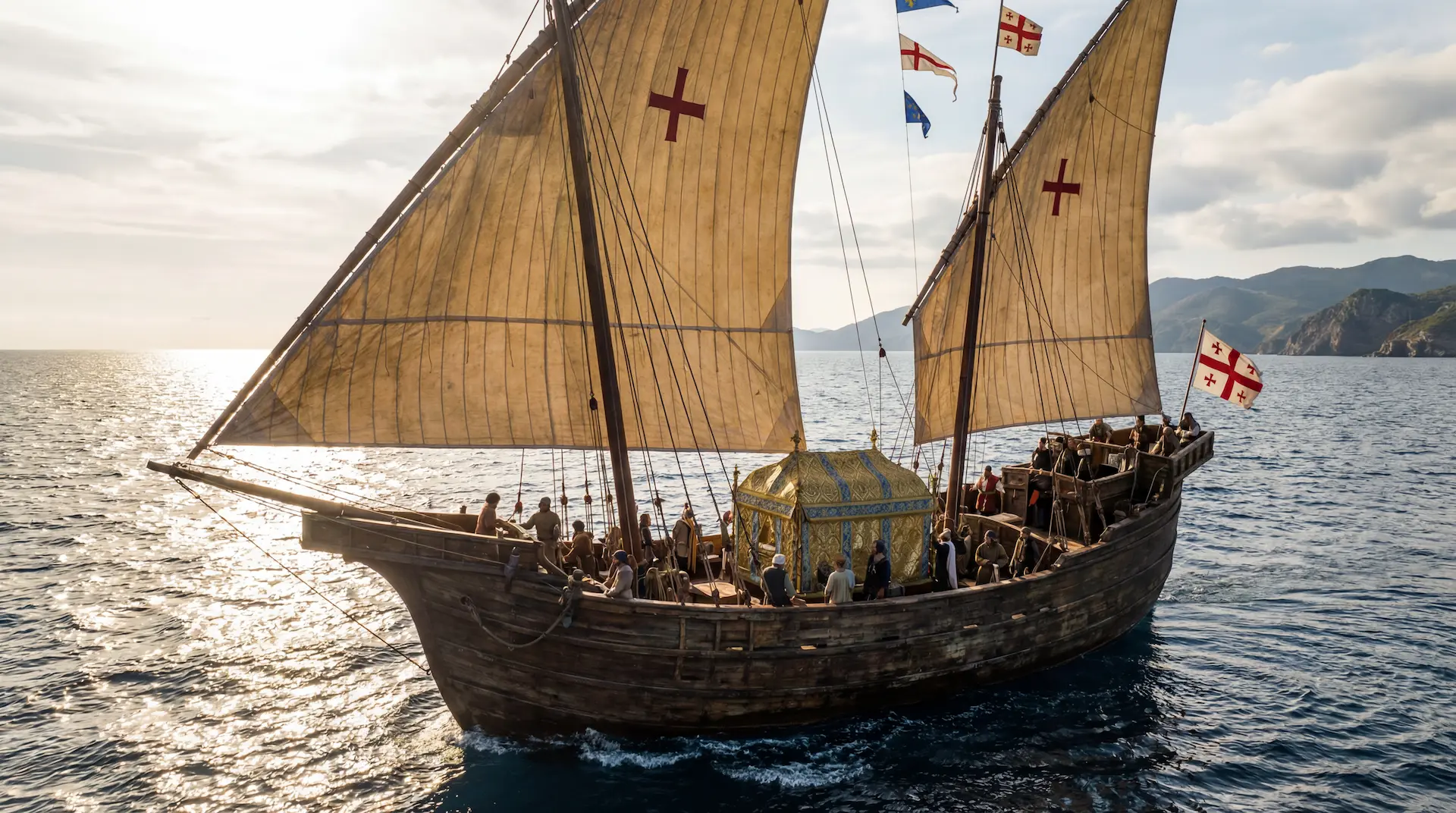 Sacred Cargo, Relics crossing Oceans→
The Evidence on the Island
1 min
No artifact recovered from Oak Island has been identified as the Ark of the Covenant or as a component of it. The theory rests on circumstantial evidence, all of which is consistent with medieval European activity on the island but none of which points exclusively to the Ark.
The bone fragments recovered from the Money Pit at a depth of approximately 160 to 170 feet in 2017 included remains of two individuals: one of European descent, one of Middle Eastern origin. Both date to several centuries ago. No established explanation accounts for Middle Eastern human remains at that depth on a Nova Scotian island with no recorded settlement before the eighteenth century.
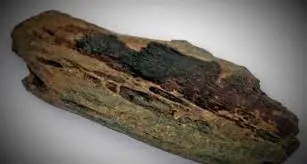 Human bone fragments (2 individuals)→
The lead crossfound at Smith's Cove in 2017 has been traced through lead isotope analysis to medieval mines in southern France and dated to between 1200 and 1600 AD. The coconut fiber from the Money Pit returns radiocarbon dates between 1036 and 1374 AD across three independent samples tested by two laboratories. Both findings place activity on Oak Island squarely in the medieval period, when the Templars were at the height of their power and the Lateran was actively promoting its claim to the Temple treasures.
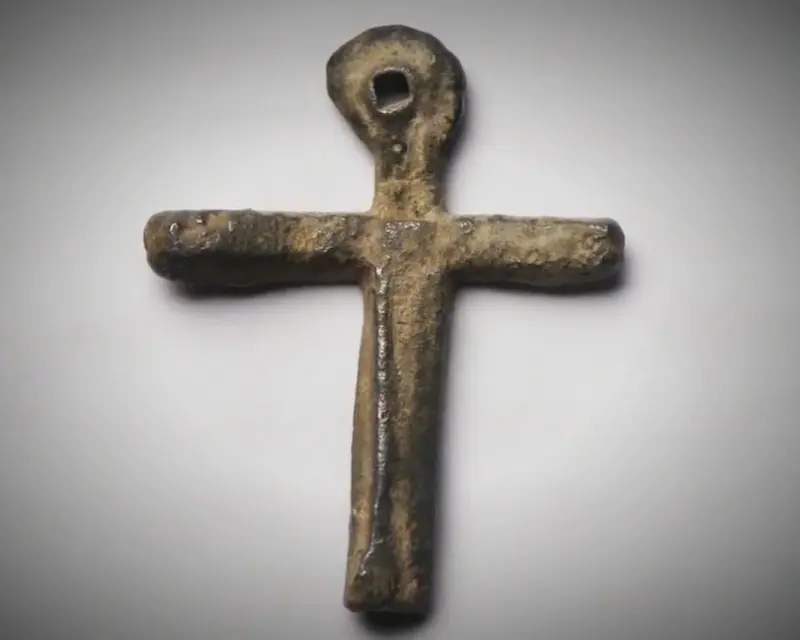 Lead cross→
The scale of the engineering itself is an argument. The flood tunnel system, the layered platforms of oak logs, the coconut fibre drainage material imported from the tropics: whoever built the Money Pit invested resources comparable to a military or state-level operation. The construction is disproportionate to a pirate cache or a colonial bank vault. It is consistent with the protection of something considered irreplaceable.
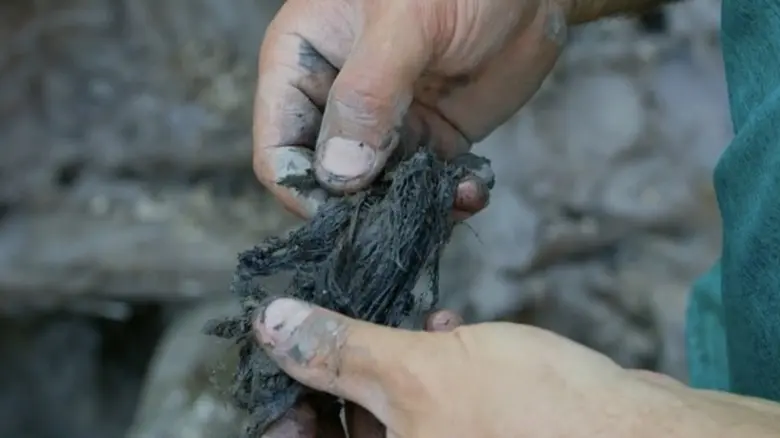 Coconut fibre (Money Pit)→
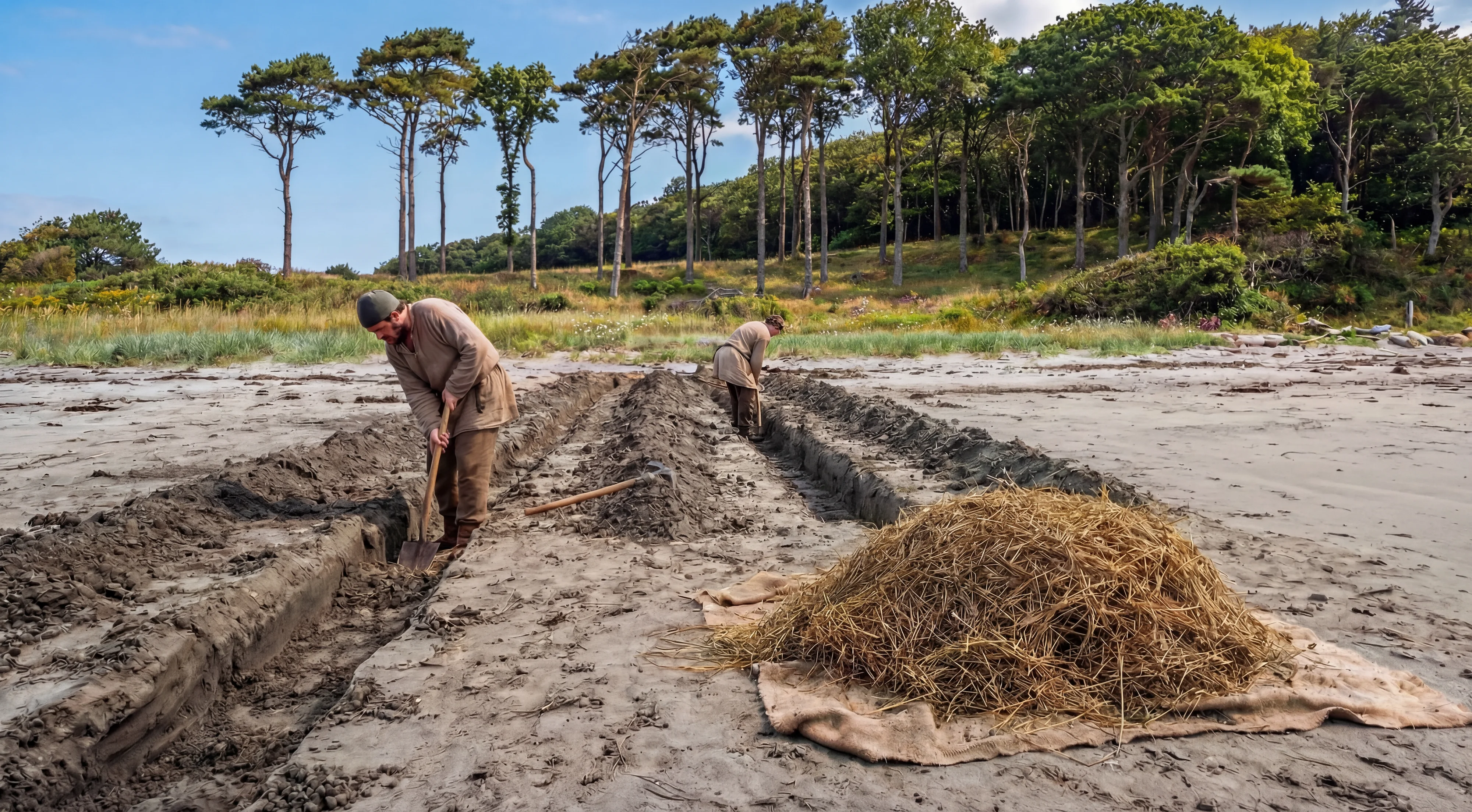 Oak Island Flood Tunnels and Box Drains: The Water Trap→
Story Ark
1 min
The Ark of the Covenant disappeared from documented history in 586 BC. A claimed Ark was venerated at the papal cathedral in Rome from around 1100 until 1745, when Pope Benedict XIV ordered it removed and never shown again. Fifty years later, the Money Pit was discovered on Oak Island. The Knights Templar occupied the Temple Mount for nearly two centuries during the period of the Lateran claim, and when the order was suppressed in 1307, its fleet and its treasure vanished. Documented family connections link the suppression to the early colonisation of Nova Scotia. Medieval artifacts confirm European activity on Oak Island centuries before any recorded settlement, and human remains of Middle Eastern origin were recovered from the deepest levels of the Money Pit.
None of this identifies the Ark as the object buried on Oak Island. The physical evidence confirms medieval presence. It does not confirm what was brought there or why.
The contribution of Oftestad's scholarship is a complication that most treatments of the Oak Island mystery have never addressed. If the Lateran possessed the Ark from the twelfth century onward, others did not. The canons defended their possession in writing. Others did not.
However, if Oak Island was already a known location for depositing treasure in certain circles, one possibility remains, remote and requiring rigorous research to establish. The last recorded disappearance of the Ark, explicitly ordered removed and never to be shown again by Pope Benedict XIV in 1745, and with no trace of it found since, occurred just fifty years before three boys on Oak Island discovered the Money Pit.
Sources
2 min
- The 13th-century stone tablet Tabula Magna Lateranensis (1291), bricked into the wall of the Lateran basilica, stating "This Ark, with the candelabrum and the things described, Titus and Vespasian caused to be carried by the Jews from Jerusalem to the City, as can be seen to this day on the triumphal arch which is next to the Church of Santa Maria Nova, placed as a victory memorial and perpetual monument by the Senate and People of Rome."
- The table of the Last Supper, enshrined above the sacrament altar of Pope Clement VIII. Still on display.
- Tony McMahon's substack.
In archives:
- The Descriptio Lateranensis Ecclesiae survives in roughly 20-21 exemplars across 17-18 manuscripts. The key one is Reg. lat. 712 in the Vatican Library (Biblioteca Apostolica Vaticana). Others are in the Lateran Archive (ACL A 70), Brussels (Bibliotheque Royale, MS 9828), Paris (BNF lat. 5129 and BNF lat. 6186), and Cambrai (Bibliotheque Municipale, MS 802).
- The Ordo Officiorum Ecclesiae Lateranensis, the official liturgical book of the basilica, documents the annual Maundy Thursday ritual in which the high altar's removable top was lifted to expose the Ark, the pope celebrated Mass above it alone, and the altar was sealed at four corners and guarded until Holy Saturday with seven lamps burning.
- The 1745 papal visitation records are in the Archivio Segreto Vaticano, S.C. Visita Apostolica 98, no. 3 and 5: the Relatio (1 May 1745) and the Decreta (2 May 1745) containing Benedict XIV's removal order.
- The 1656 visitation by Pope Alexander VII, which describes the Ark as a decorated wooden chest covered with silk cloth, is in the same archival series: S.C. Visita Apostolica 98, fasc. 1, fol. 32v.
- The 1308 fire account, Lateranensis basilice combustio tempore Clementis V rythmo descripta, is published in Lauer's Le Palais de Latran.
Published and accessible:
- William Durandus of Metz, Rationale Divinorum Officiorum (13th century), independently confirms the Lateran Ark tradition and lists its contents including the golden candlestick and its seven branches. Multiple published editions, including Neville Blakemore Jr. (Fons Vitae, 2007).
- Benjamin of Tudela's Itinerary (c. 1170), multiple published editions
- Nardini's Roma Antica (1661, republished 1818)