The Geologist
1 min
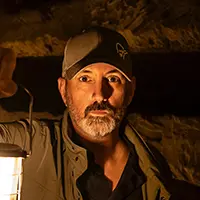
Robert R. Dunfield was a petroleum geologist from Canoga Park, California, a graduate of the University of California at Los Angeles, and the operator of his own oil geology consulting business. He first learned of Oak Island at the age of eleven, reading an article in the Denver Post. That childhood fascination became a lifelong preoccupation. By his late thirties, Dunfield had accumulated enough professional experience in excavation and subsurface geology to believe he could solve what two centuries of treasure hunters had not. He was a registered geologist, California Certificate No. 1036, and later served as president of Hope Bay Mines Ltd., a company with silver and gold mining interests in the Northwest Territories and El Dorado County, California. He was not, as some accounts have suggested, a wealthy man from Beverly Hills. He had used the address of investor Jack Nethercutt's Beverly Hills home on some business documents, which created a misleading impression of personal wealth.
The Restall Connection
1 min
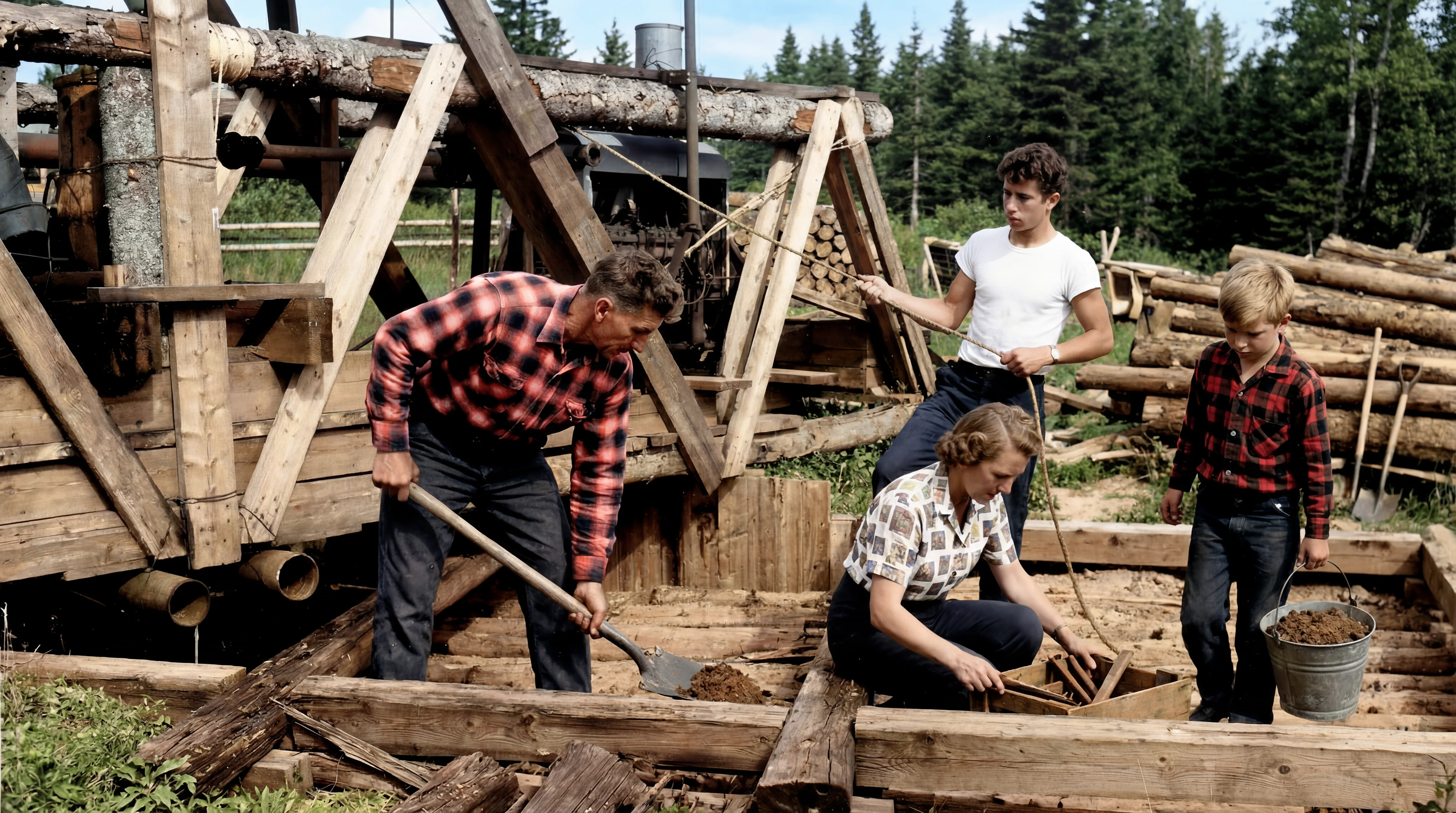
Dunfield arrived in Nova Scotia in July 1965, while Robert Restall was still conducting his search on Oak Island. He had invested money in the latter stage of Restall's operation, specifically to explore Restall's theories about the flood tunnel at Smith's Cove, and had corresponded with both Restall and island owner Melbourne R. Chappell. According to a September 1965 interview in the Edmonton Journal, Dunfield was with Restall just a few days before the August 17 tragedy that killed Restall, his son Robert Jr., Cyril Hiltz, and Karl Graeser. Within two weeks of the accident, Dunfield purchased the controlling interest in the treasure rights from Mildred Restall. Mrs. Restall, her surviving son, and daughter retained a small percentage. Three other investors held major shares: Jack Nethercutt of Beverly Hills, G.R. Laperle of Bakersfield, and Dan Blankenship of Miami, Florida. Dunfield held approximately 37 percent of the venture, which was initially budgeted at $35,000.
 The Restall Tragedy→
Preparations
1 min
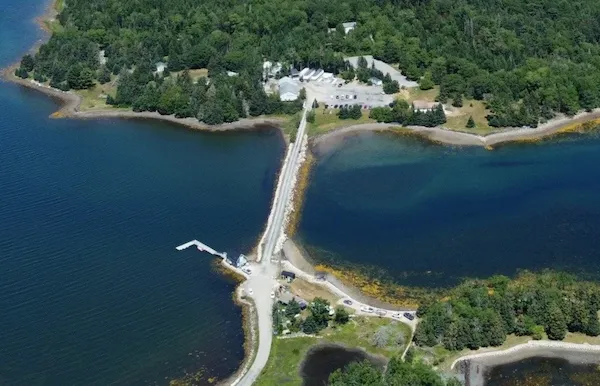
Dunfield began work in August 1965 by barging two bulldozers to the island. The machines skimmed twelve feet of soil off the drumlin where the Money Pit was located and pushed tons of clay onto the beach at Smith's Cove in an attempt to block the flood tunnel. This bulldozing exposed what observers agreed was some of the cribbing of the original Money Pit, but it did nothing to stop the inflow of water. Dunfield then turned to larger measures. In ten days in early October 1965, his crew built a causeway connecting Oak Island to Crandall's Point on the mainland. The structure was approximately 650 feet long (sources vary, with some reporting 700 feet), and newspaper accounts give conflicting figures for the fill required, ranging from 7,000 to 15,000 cubic yards. It was intended as a temporary, one-lane road of earth and stone, designed to carry the heavy crane that no available barge could support. Dunfield told reporters the causeway would come down and the channel would be deepened within three weeks. It never did. The causeway remains in use to this day.
The first consequence of the causeway was hostility from local fishermen, who for two centuries had used the sheltered passage between Crandall's Point and Oak Island to reach the deeper waters of Mahone Bay. Dunfield had forced them into the open Atlantic, adding time and risk to every trip. A second, unintended consequence was a flood of tourists. Over a thousand people attempted to visit the island in the weeks following the causeway's completion on October 17, 1965, and had to be turned away for safety reasons.
 The Causeway→
The Excavation
2 min
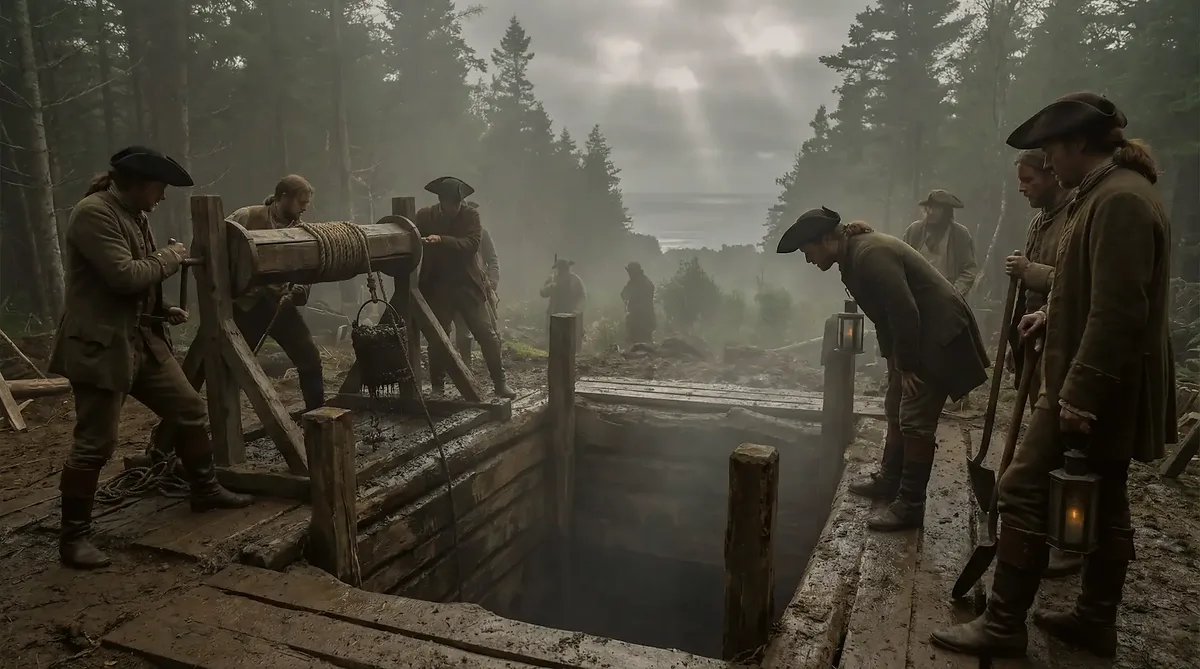
On October 18, Dunfield hauled a 70-ton crane across the causeway. The machine, rented from a steel firm in New Glasgow, Nova Scotia, had a 90-foot boom and a clam bucket capable of removing approximately 800 cubic yards per hour. He did not go directly to the Money Pit. Instead, he ran two shifts of up to a dozen men at the south shore, where they excavated a trench 200 feet long and up to 20 feet deep, parallel to the shoreline, in an effort to cut off the underground water channels that had defeated every previous expedition. During this work, Dunfield's crew discovered a refilled shaft eight feet in diameter with no cribbing, which had no match in any existing record and was believed to predate the known search expeditions.
By early November, the crane moved to the Money Pit itself. Dunfield began excavating a pit that eventually reached approximately 50 feet in diameter, with a plan to widen it to 100 feet. The first crane's month-long contract expired in early December, and it was replaced by an 80-ton machine from a Halifax firm, delivered by rail from Moncton, also equipped with a 90-foot boom. In his own 1976 account to author D'Arcy O'Connor, Dunfield described the equipment as a 2½ cubic yard P&H clam. Newspaper reports gave varying specifications, likely confusing the two different cranes.
Progress was constant but battered by setbacks. Cables snapped, the water pump and generator broke down, rain caused the clay walls to slide, and working time averaged only 4.2 hours out of every 10. Melbourne Chappell later alleged that many of the crane's broken cables had been cut with hacksaws, and accused local fishermen of sabotaging the operation in retaliation for the causeway. Robert Dunfield II, the geologist's son, who was seven years old and living with the family in Chester during the operations, later recalled that "the Orton digger had been sabotaged" as well.
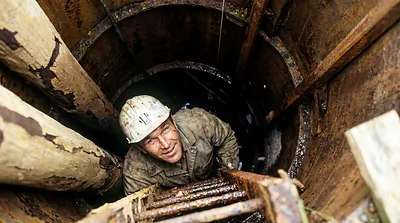
Despite these difficulties, the excavation produced findings. Dunfield's crew uncovered pick marks on the clay walls of the Money Pit, confirming the exact location of the original shaft. They found old timbers and cribbing from previous expeditions, hand-hewn logs identified by provincial forestry official Lloyd Hawboldt of Truro as hemlock (a species not native to Oak Island), pieces of porcelain dishware at depth, evidence of what Dunfield called "fanwise drains," and tunnels he attributed to the Halifax Company's 19th-century operations. Foreman James Keizer, 32, of nearby Robinson's Corner, told the Globe and Mail that he had found 18th-century dishes buried under five feet of clay on the shore, and that Dunfield had discovered a large rock with the initials "DH" worn into it. Dunfield sold exclusive still-photo rights to Life magazine, and a closed-circuit television camera was lowered into the pit in early December, producing images that led to revised depth estimates.
The Christmas Cave-In
1 min
By mid-December 1965, the pit had reached approximately 140 feet, approaching Dunfield's first objective of 155 feet. Then came the pivotal setback. According to Dunfield's account to United Press International on December 27, the crew had been "within 18 feet of our objective" when the crane operators refused to work on Christmas Day or Boxing Day. Dunfield warned them the hole would fill in. During the two-day pause, rain and sliding earth collapsed the walls. Sand and silt poured into the pit, reducing the depth from over 130 feet back to approximately 112 feet. The hole had to be cleared out three times as further slides continued. Robert Dunfield II later recalled this as one of the most stressful moments of his young life: his father "aged 10 years in only two years" on Oak Island.
On January 3, 1966, Dunfield ordered the pit refilled with soft soil. The original Money Pit, the 1863 shaft, and the Chappell Shaft had all collapsed together, leaving a single 80-foot-wide opening at ground level. He shifted to a different approach.
The Drilling Program
1 min
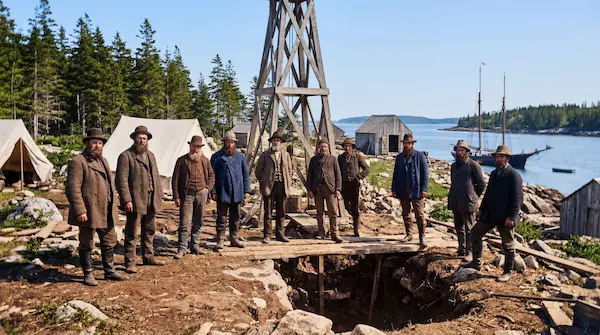
In January 1966, Dunfield had a large oil-drilling rig hauled to the island and bored four six-inch-diameter holes to a depth of 140 feet (some sources say 190 feet). At approximately 139 to 141 feet, the drill broke through a hard layer into a cavity below. Dunfield described the hard layer as approximately two feet thick. Below it, the cavity extended to somewhere between 182 and 184 feet, where the drill struck what he identified as cast iron. The drill brought up roughly 1,000 pounds of material, which Dunfield described as either concrete or natural carbonate. He sent samples to the University of Southern California in Los Angeles for spectrographic analysis. A separate piece of metal was sent to a personal contact in Montreal for examination. Dunfield refused to reveal the USC results publicly, but according to author Scott Clarke, "when Dunfield saw them, he intensified the digging."
The cavity Dunfield drilled into may have been the same one located in 1955 by Texas oil driller George J. Greene, who had pumped more than 100,000 gallons of water into it in an attempt to determine its nature. All the water seeped away. Dunfield told reporters he had found concrete-like material at the cavity level across an area of nine square feet. R.V. Harris, the Halifax barrister and author of The Oak Island Mystery, visited the island on February 27, 1966, and recorded notes from his meeting with Dunfield. Harris wrote that "drilling showed treasure chamber in four stories, 153 ft. down, gypsum walls," and that Dunfield was "looking for entrance to Treasure Chamber" somewhere on the island's surface.
 The Money Pit→
Secondary Excavations
1 min
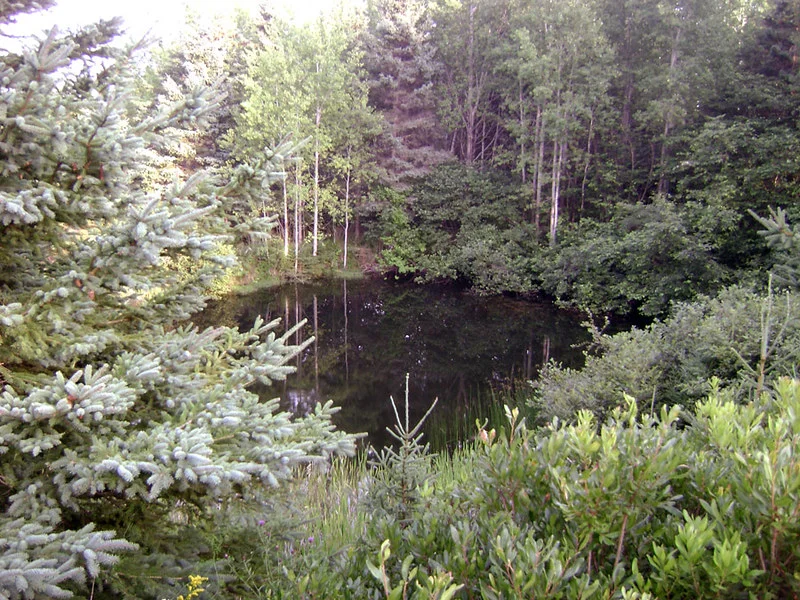
While the drilling continued, Dunfield also excavated the Cave-in Pit, reaching over 100 feet in depth. At 68 feet, his crew found old timbers, two with planking. Further digging to 52 feet in another direction produced no results, and the work stalled when a crane bucket became lodged at 68 feet. He also excavated a pit south of the stone triangle. On the south shore, he deepened the shaft he had discovered during the initial trenching, reaching 40 feet. After Dunfield's departure, Dan Blankenship and David Tobias would later deepen this same shaft to 90 feet, finding at 60 feet a hand-wrought nail and what appeared to be a very old washer.
 Cave-in Pit→
Dunfield's Geological Assessment
2 min
What sets Dunfield apart from most Oak Island operators is his professional geological analysis of the site. His conclusions, laid out across several letters in 1966 and 1976, represent the first systematic geological assessment of the Money Pit area by a trained earth scientist.
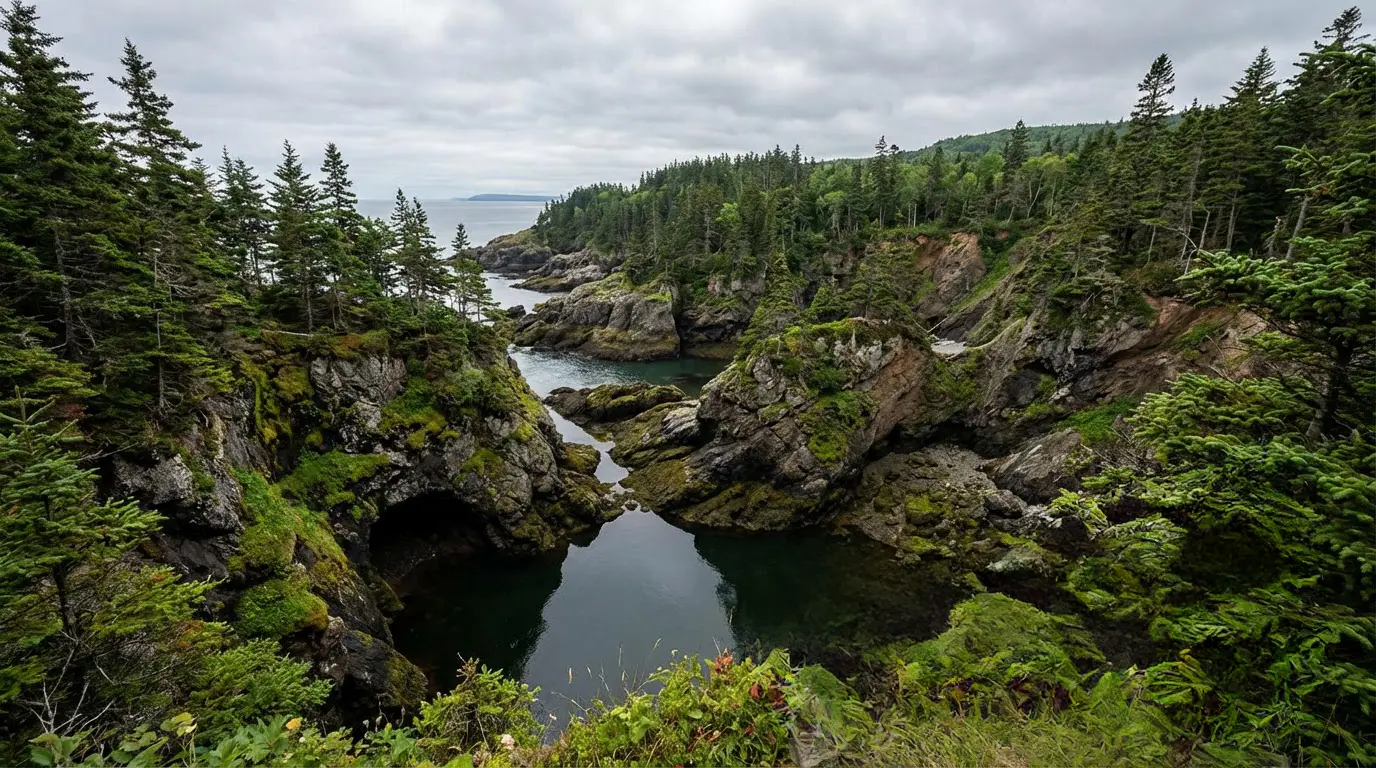
Dunfield determined that Oak Island is a formation of glacial deposition, consisting of clay, till, and typical glacial material, overlying what he identified as the Windsor and Halifax geological formations. The clay, he noted, has a shear angle of nearly zero degrees, which is what allowed him to dig an open pit without catastrophic collapse of the walls, at least under dry conditions. At 140 feet, he encountered the Windsor Formation, a layer of hard limestone. Below the limestone lay the cavity, which he considered a natural feature consistent with limestone geology found throughout the world.
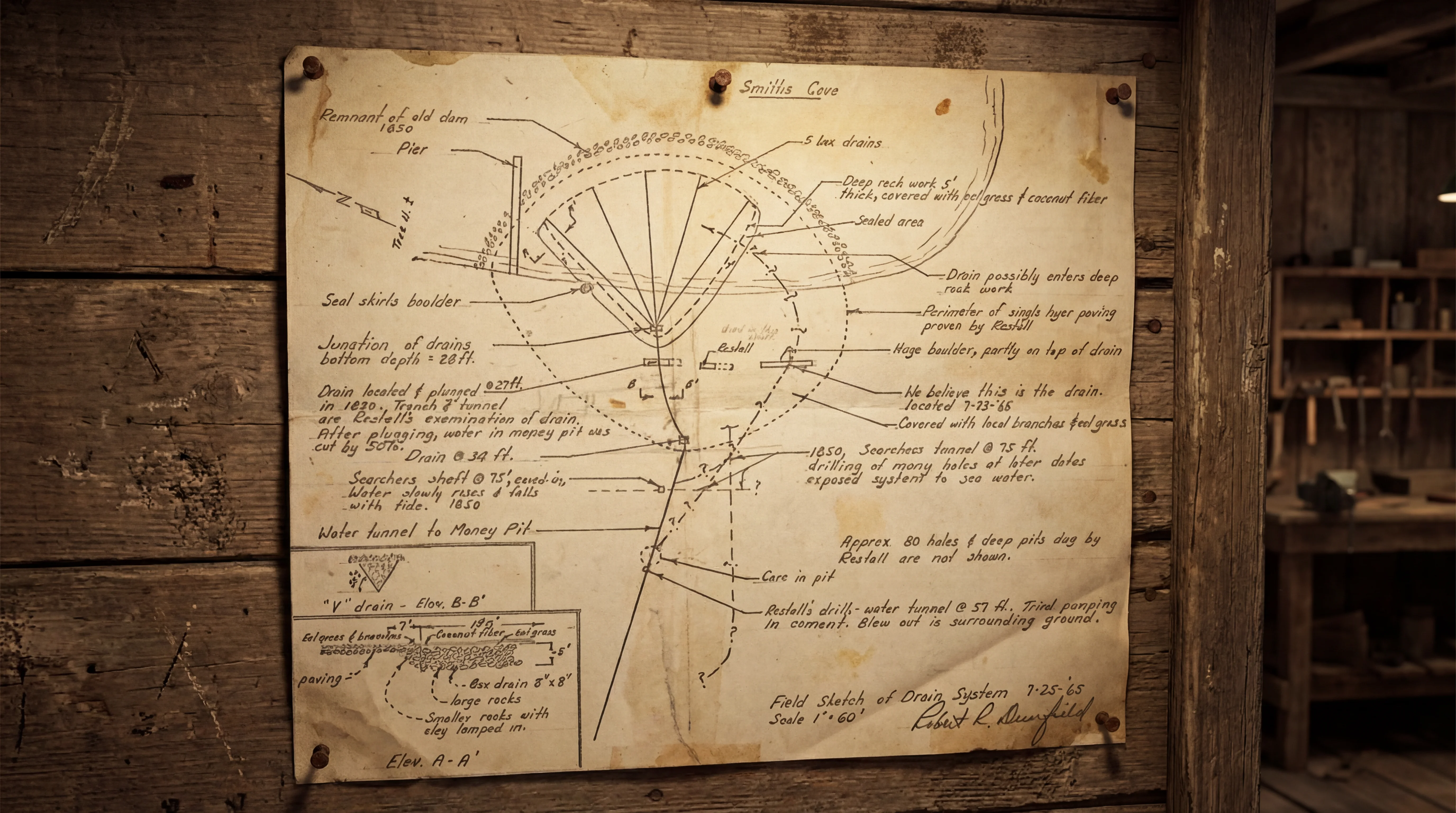
His assessment of the flooding problem was direct and consequential: "Flood tunnels to the money pit are ruled out owing to the presence of the Windsor formation at 140 feet in depth," he wrote to R.V. Harris on November 7, 1966. "During our excavation of the money pit we noted no water (except surface drainage) entering above 140 feet." He concluded that the drainage system at Smith's Cove involved only a very short flood tunnel restricted to that immediate area, and that the so-called "cement" reported by earlier searchers was "nothing more than limestone."
Dunfield's interpretation evolved during his time on the island. In February 1966 newspaper interviews, he described the gypsum he found as "primitive cement" used by whoever buried the treasure. By November 1966, he had reclassified it as a natural geological feature. By 1976, writing to D'Arcy O'Connor, he was emphatic: the cement was limestone, the cavity was natural, and the flood tunnels did not reach the Money Pit.
He did not, however, dismiss the possibility of buried treasure. While he would have classified the deep cavity as natural, he acknowledged that "if something is buried on Oak Island, the limestone could have been a surprise to any depositors and used to their advantage." He pointed to specific items of wrought iron and wood recovered by Triton Alliance that had been "carefully dated and fall into the pirate era," calling them "man-made and foreign to glacial deposits." His final professional judgment was measured: "a preponderance of evidence suggests underground work done by men many years in the past." He also confirmed that the coconut fiber found on the island had been analyzed and identified as coir, the fibrous material between the coconut shell and outer husk, which was historically used as dunnage in early shipping. And he stated that the stone triangle was "definitely original," though he was uncertain about when the drilled rocks near it had been made.
 The Natural Formation Theory→
The Destruction
1 min
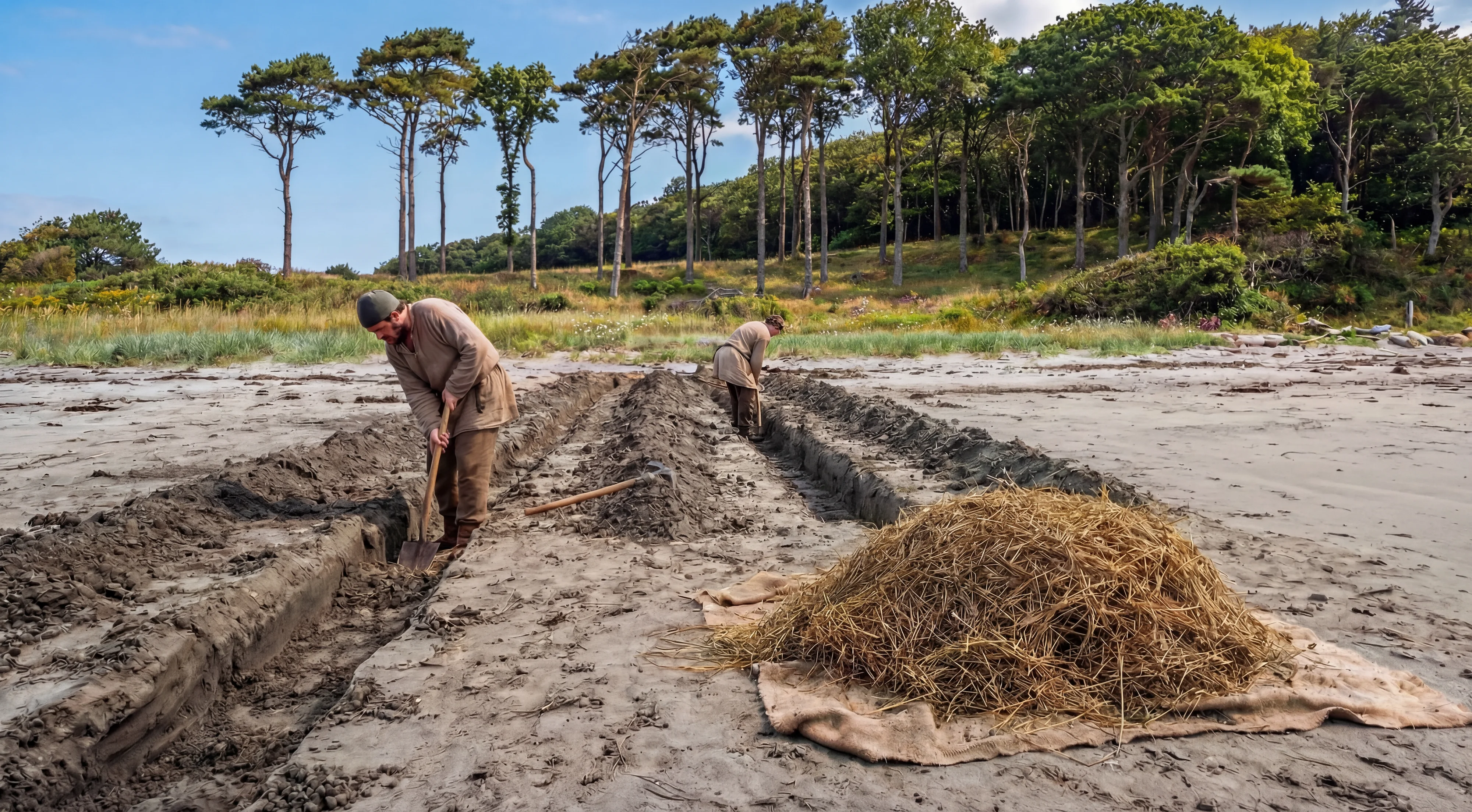
The damage Dunfield inflicted on Oak Island was severe and, in several cases, irreversible. The twelve feet of soil removed from the Money Pit drumlin erased surface features that had survived since the original deposit. The finger drains at Smith's Cove were broken apart and buried. The drilled boulder nearest to the cove disappeared and was never recovered. The south shore trench, which widened during the rainy season, swallowed the stone triangle whole. Nova Scotia surveyor and historian William Crooker described Dunfield's work as "nuking the island" and argued that "a vast amount of visual history was lost." The Lunenburg Progress-Enterprise had predicted it in November 1965: "When the search is over Oak Island won't bear any geographical resemblance to the island that was."
The Cave-in Pit was left a shapeless hole filled with water. The east end and south shore of the island were, by contemporary accounts, devastated. Chester's Municipal Council, joined by other Lunenburg County organizations, petitioned the Nova Scotia provincial government to declare Oak Island a national historic park and prevent Dunfield from returning. The government ultimately chose to acquire nearby Grave's Island instead.
 Oak Island Flood Tunnels and Box Drains: The Water Trap→
Departure and Aftermath
1 min
Dunfield made one final attempt to redig the Money Pit in February 1966, announcing a plan to excavate a 100-foot-diameter pit to 184 feet. "If we can't make it this time, we will leave it to someone else," he told reporters. Rain and sliding earth defeated him again. In March 1966, he left for California, telling the press he was "not finished on Oak Island" and would return "when the weather is better" to investigate the beach sites. He never returned.
His lease with Mel Chappell expired in August 1966. He negotiated to purchase the island with several associates but failed. In November 1966, he informed R.V. Harris that the lease had been awarded to David Tobias of Montreal, who asked Dunfield to serve as project manager. Dunfield accepted, but the arrangement produced no further fieldwork on his part. He remained a shareholder in Triton Alliance, the company Tobias and Dan Blankenship formed in 1969.
Dunfield's total expenditure on the operation was $131,000, a figure he confirmed to D'Arcy O'Connor in 1976, correcting the $120,000 widely reported in newspapers. Dan Blankenship had invested approximately $21,000 in the 1965-66 effort. The initial budget of $35,000 had been exceeded by nearly four times.
In 1975, nine years after leaving Oak Island, Dunfield was diagnosed with Lymphocytic Lymphoma. His oncologist gave him six months to live. He refused to accept the diagnosis, sought second opinions, and underwent intensive chemotherapy. He lived five more years, though his health declined steadily. His passion was flying, and he continued to pilot aircraft when well enough, but the FAA eventually revoked his license. Robert R. Dunfield died quietly in his sleep in September 1980, at the age of 54, from a heart attack. The cancer had spread to his blood and elsewhere in his body. His wife, Alene Dunfield, died in March 2000.
Assessment
1 min
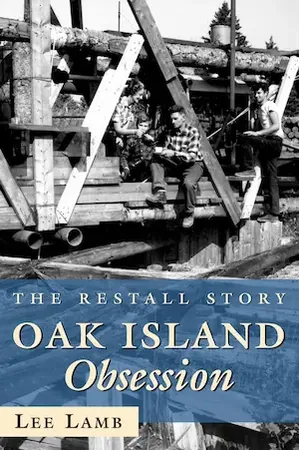
Robert Dunfield's seven months on Oak Island remain among the most contentious chapters in its history. Randall Sullivan, writing in 2018, called him "the great malefactor of the Oak Island story." His son Robert Dunfield II, in a 2004 email exchange with D'Arcy O'Connor, argued that the characterization was unfair and that his father "was not the villain as previously described elsewhere." D'Arcy O'Connor, whose three books on Oak Island represent the most thorough published accounts, wrote that Dunfield deserved credit for rediscovering the site of the original Money Pit and for helping stem the flow of water from the south shore flood tunnel.
The case for Dunfield rests on three contributions: he relocated the precise position of the Money Pit (verified by M.R. Chappell), he discovered the south shore flood tunnel, and he built the causeway that has served every subsequent expedition. He also produced the first geological survey of the site by a credentialed professional, identifying the Windsor Formation and challenging the assumption that man-made flood tunnels reached the Money Pit from distant beaches. His analysis of the coconut fiber and the stone triangle added verified data to the evidentiary record.
The case against him is that these contributions came at a cost that cannot be recovered. The stone triangle, the finger drains, the drilled boulder, and the original surface topography of the Money Pit area are gone. Whether the information Dunfield gained was worth what was lost is a question the available evidence cannot settle. What the primary sources do establish is that Dunfield was neither the reckless opportunist of popular caricature nor the misunderstood hero his family believed him to be. He was a trained geologist who applied industrial methods to an archaeological problem, produced real data, and left real damage behind.
 Stone Triangle, the Oak Island Sextant→
Sources
1 min
Letters, notes and records
- Robert R. Dunfield to R. V. Harris, letters of 13 December 1965, 15 December 1965, 3 September 1966 and 7 November 1966. R. V. Harris papers, Nova Scotia Archives, MG1 Vols. 383 to 384.
- R. V. Harris, notes of his meeting with Robert R. Dunfield on Oak Island, 27 February 1966. R. V. Harris papers, Nova Scotia Archives.
- Robert R. Dunfield and D'Arcy O'Connor, correspondence, June to October 1976, including Dunfield's letters of 7 August and 21 October 1976 on the excavation, the Windsor Formation, the coir analysis, costs and investors.
- Robert Dunfield II and D'Arcy O'Connor, letters and emails, 30 October 2003 to 4 February 2004, on his father's career, illness and legacy.
- Hope Bay Mines Ltd., company brochure, with Robert R. Dunfield as president.
Newspapers and wire reports
- Staff report. Interview with Robert R. Dunfield on the Oak Island venture and its investors. Edmonton Journal, 29 September 1965.
- Staff report. Interview with foreman James Keizer. The Globe and Mail (Toronto), 30 October 1965.
- Staff report. Lunenburg Progress-Enterprise, November 1965.
- United Press International. Robert R. Dunfield on the Christmas cave-in, 27 December 1965.
- Staff reports on the Dunfield operation, Chronicle-Herald and Mail-Star (Halifax), October 1965 to August 1966, including "Dunfield Calls Halt," "Dunfield To Start Re-Digging Today," "Dunfield's Return To Oak Island Is Delayed For Now," "Dunfield May Buy Part Of Oak Island" and "Brine Could Be Solution To Oak Island Treasure."
Books
- Clarke, Scott. Oak Island Odyssey: A Masonic Quest. Halifax: Nimbus Publishing, 2023.
- Crooker, William S. Oak Island Gold. Halifax: Nimbus Publishing, 1993. Chapter "Nuking the Island."
- O'Connor, D'Arcy. The Money Pit. New York: Coward, McCann & Geoghegan, 1978.
- O'Connor, D'Arcy. The Big Dig. New York: Ballantine Books, 1988.
- O'Connor, D'Arcy. The Secret Treasure of Oak Island. Guilford, Connecticut: Lyons Press, 2004.
- Sullivan, Randall. The Curse of Oak Island: The Story of the World's Longest Treasure Hunt. New York: Atlantic Monthly Press, 2018.