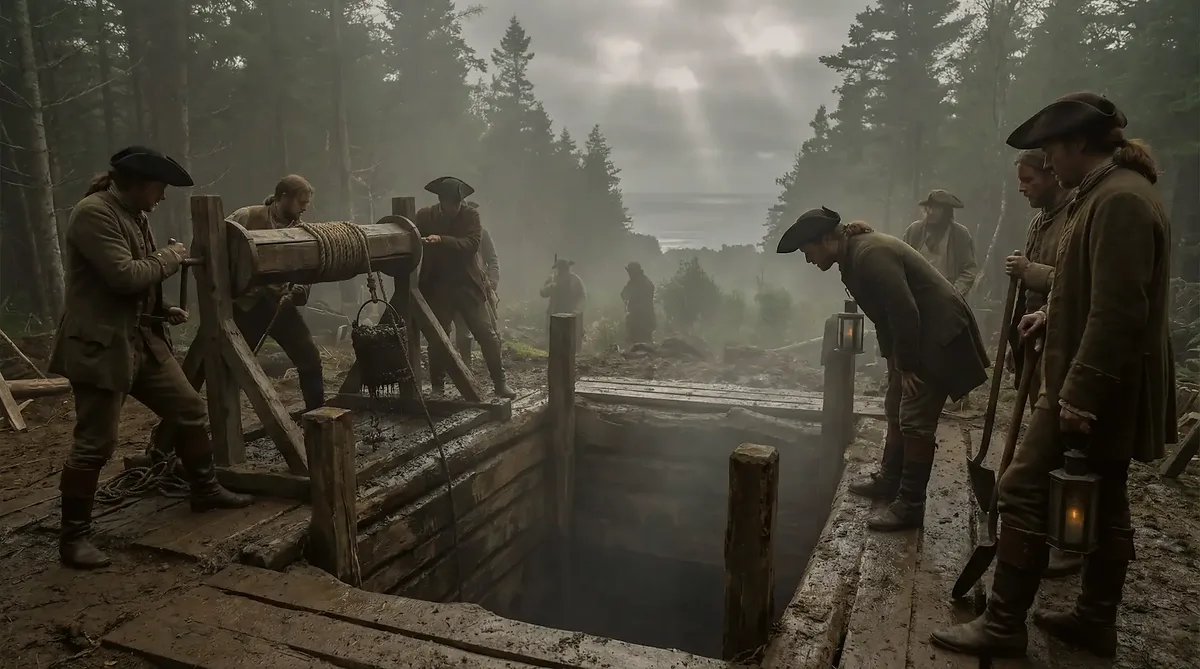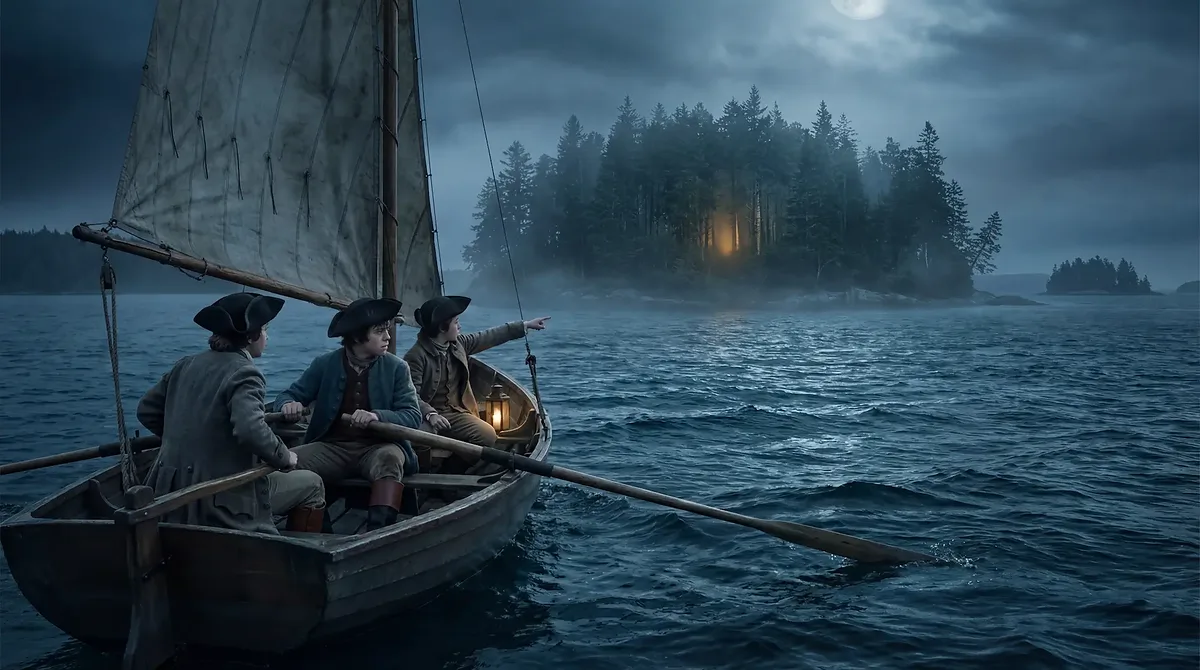
The story that most people know goes something like this: in 1795, a teenage boy named Daniel McGinnis rowed out to an uninhabited island in Mahone Bay, Nova Scotia, where he stumbled upon a mysterious circular depression beneath an old oak tree. He fetched two friends, they dug, and what they found launched the longest treasure hunt in history. It is a clean, compelling origin story. It is also, in several important respects, wrong. The primary sources disagree on who Daniel McGinnis was, how old he was, what he found, who helped him, how deep they dug, and whether the island was even uninhabited. The real story is more complicated than the legend, and considerably more interesting.
Who Was Daniel McGinnis?
3 min
R. V. Harris, the Nova Scotia lawyer who served as legal advisor to Oak Island treasure hunters for decades and whose 1958 book The Oak Island Mystery first brought the story to a wide audience, was blunt about the difficulty. McGinnis was "an enigma," Harris wrote. "His age in 1795 is unknown. His origin and parentage is unknown." What Harris could establish from parish records, land deeds, and surviving family accounts was limited, and what later researchers have added has only deepened the confusion.
The family name itself is unstable. In the earliest records it appears as McInnes, then MacInnes, McInnis, and finally McGinnis, a transition that seems to have occurred before the end of the eighteenth century. Harris wrote that McGinnis "came from New England and took up land on Oak Island." Judge Mather Byles DesBrisay, whose 1870 History of the County of Lunenburg contains the first account of the discovery to appear between hard covers, called him one of the "first settlers" on Oak Island and noted that he was the father of Mrs. Thomas Whitford of Chester and the grandfather of James McInnis. In DesBrisay's account, McGinnis, Smith, and Vaughan all "emigrated from New England to Chester."
The conventional version of the story holds that McGinnis was roughly sixteen years old when he found the Pit, a claim that rests primarily on the recollections of Anthony Vaughan as recorded in the mid-nineteenth century. Harris accepted this general picture, describing Vaughan as "then only a lad of thirteen years," which, if the two were close in age, places McGinnis in the same range. Randall Sullivan, researching his 2018 book The Curse of Oak Island, traced a plausible genealogy: McGinnis may have been the son of Donald Daniel McInnes, a Scottish-born loyalist who served in the Revolutionary War under General Angus McDonald and Lord Cornwallis, commanded a gunboat in Charleston, South Carolina, and received a Crown grant of one hundred acres near Chester around 1784. If the father was born around 1759, a son born around 1779 would have been sixteen in 1795. Supporting this timeline, Daniel McGinnis married Maria Barbara Saller at St. James' Anglican Church in Lunenburg on September 8, 1795, and their son Johan was baptized in Chester on July 26, 1797. Marriage at sixteen was not unusual in the period; his companion John Smith had married at fifteen.
Researcher Les Clarke, drawing on land records brought to light by Paul Wroclawski, has argued a very different case. Clarke found genealogical records indicating that Daniel McInnis was born in 1758 in Scotland, which would have made him thirty-seven in 1795. Clarke also discovered that McGinnis owned four lots on Oak Island before the supposed date of the discovery: lot 28, purchased in March 1788; lot 21, in May 1790; lot 27, in May 1791; and lot 1, in September 1794. He built his home on lot 21, the foundation of which is still visible near the modern-day War Room. Clarke has pointed out that Jothan McCully's 1862 account, the earliest published description of the discovery, says McGinnis told "two men" about the pit, not two boys. If Clarke's identification is correct, the story is not about a teenage adventure but about a settled landowner who found something unusual on his own property and brought in his adult neighbours.
No consensus exists on McGinnis's age. Sullivan acknowledged Clarke's evidence but favoured the younger identification on circumstantial grounds, noting that the ages of Smith (nineteen in 1795) and Vaughan (thirteen, according to Harris) make better sense alongside a teenager than alongside a thirty-seven-year-old farmer. Clarke countered that the earliest accounts describe McGinnis telling "two men," and that the "two men" may have been Anthony Vaughan Sr., who was forty-five in 1795 and had himself owned six lots on the island, and John Smith, who was two months from turning twenty and already married for five years.
Oak Island in 1795
1 min
The popular version of the story assumes that Oak Island was uninhabited when the discovery was made. This is almost certainly false. John Smith, born in Boston on August 20, 1775, appears to have moved to Oak Island with his family around 1786, when he was eleven. He married Sarah Floyd on September 28, 1790, and on June 26, 1795, he purchased lot 18, the plot of land where the Money Pit was located, from a Chester merchant named Caspar Wollenhaupt for five pounds. Harris noted in passing that it was "perhaps significant" that Smith made this purchase so promptly. If Clarke's land records are correct, McGinnis himself had been buying lots on the island since 1788.
The Vaughan family also had deep roots in the area. Anthony Vaughan Sr. had come to Nova Scotia from Massachusetts in 1768 as part of the Shoreham Grant, a Crown dispensation of 100,000 acres to seventy-three grantees from various New England towns. The Vaughans operated a lumber mill on the mainland directly across from Oak Island and by the 1780s owned multiple lots on the island itself. Whether Anthony Vaughan Jr., the one associated with the discovery, was living on the island or on the mainland in 1795 is uncertain; most early writers place the Vaughan family on the mainland, but their economic activity on the island was well established.
The 1951 account published by the Nova Scotia Bureau of Information described all three as having been "on a shooting trip to Oak Island from the neighboring mainland." Frederick Blair, the most significant figure in the Oak Island treasure hunt from the 1890s through the 1950s and by many accounts its most dedicated researcher, wrote that McGinnis had been "partridge hunting." Other accounts say he was cutting trees for Smith or Vaughan. McCully's 1862 letter said he "went to Oak Island to make a farm." The simple answer is that nobody knows why McGinnis was in that particular spot on that particular day.
What McGinnis Found
3 min
The primary sources offer four distinct descriptions of the scene that caught McGinnis's attention, and no two of them agree.
The earliest published account is McCully's 1862 letter to the Liverpool Transcript. McCully, who had been a member of both the Truro Company and the Oak Island Association and was writing from direct acquaintance with the surviving participants, described the scene as follows: McGinnis found the spot "from its being sunken, and from the position of three oak trees, which stood in a triangular form round the pit." The bark on each tree had "letters cut into it with a knife," facing the pit, and one tree stood so directly over the depression that "two large branches formed a crotch, were exactly perpendicular to the centre, and had a hole bored through, and an oak tree-nail driven in, on which hung a tacle block." In McCully's telling, the carved letters on the bark, the triangular arrangement of the trees, and the tackle block all feature together. There is no mention of old stumps, cleared forest, or young growth.
DesBrisay's 1870 account, based primarily on a December 20, 1863 article in the Halifax Colonist and other sources, paints a different picture. In this version, McGinnis found "a spot that gave evidence of having been visited by someone a good many years earlier." There had been "cuttings away of the forest, and oak stumps were visible." One surviving original oak had "a large forked branch extending over the old clearing," and to this branch, "by means of a treenail connecting the fork in a small triangle, was attached an old tackle block." In DesBrisay's account, there is no mention of three trees in a triangle or of carved letters on bark. The emphasis is on the cleared forest, the oak stumps, and a single surviving tree.
The 1893 Oak Island Treasure Company prospectus, written to sell shares but drawing on the recollections of Robert Creelman and other participants, introduces yet another set of details. Here the three men came to "a spot, of which the unusual and strange conditions at once engaged their attention." The ground had "every appearance of having been cleared many years before," and "red clover and other plants altogether foreign to the soil in its natural state were growing." Near the centre stood "a large oak tree with marks and figures on its trunk," and one of its lower branches, "the outer end of which had been sawed off, projected directly over the centre of a deep circular depression in the land about 13 feet in diameter." This is the only account that mentions red clover, the only one that says the branch had been sawed off, and the only one that specifies a thirteen-foot diameter for the depression.
Harris, synthesizing the available accounts in 1958, followed DesBrisay's version most closely but added detail from other sources. He described McGinnis finding that "the first growth of wood had been cut down and that another was springing up to supply its place," with "old stumps of oak trees that had been chopped down" visible among the younger growth. The forked branch, the treenail, and the tackle block were present as in DesBrisay, but Harris also noted from other accounts that there were "marks and figures on the trunk of the oak" and that the hollow beneath the tree was "a well-defined circular depression about thirteen feet in diameter."
Sullivan made the important observation that if the descriptions of oak stumps and young replacement trees are accurate, they almost certainly narrow the timeframe of the original work. Arborists consulted by the producers of The Curse of Oak Island confirmed that neither the stumps nor the younger trees would have been distinguishable if the clearing had occurred centuries earlier. The original excavation, by this reasoning, likely took place no earlier than the seventeenth century.
The Question of Samuel Ball
2 min
The identity of the men who helped McGinnis dig is not as settled as most accounts suggest. In the first edition of DesBrisay's History of the County of Lunenburg, published in 1870, the three discoverers of the Money Pit were named as Daniel McGinnis, John Smith, and Samuel Ball. It was not until the second edition, published in 1896, that Ball was replaced by Anthony Vaughan, with no explanation offered for the change.
Samuel Ball was a freed slave from South Carolina who had joined the British forces during the Revolutionary War after Lord Dunmore's 1775 Proclamation of Kemps Landing offered freedom to enslaved men who fought for the Crown. Ball arrived in Nova Scotia around 1783 and settled in the Mahone Bay area. He purchased his first lot on Oak Island on September 22, 1787, paying eight pounds, a considerable sum at the time. He eventually acquired nine four-acre lots on the island, making him its largest landowner. Harris described him as one of the "early residents" of Oak Island, "a coloured man, who came from South Carolina where he had been a slave to a master whose name he adopted," and added only that Ball was remembered as "a good man."
Ball's presence in the first edition of DesBrisay is difficult to dismiss. DesBrisay lived in Chester during his childhood, was personally acquainted with people involved in the Money Pit operations, and was a careful student of local history. Whether Ball was directly involved in the initial discovery or simply among the earliest to learn of it and participate in the digging is unclear, but the fact that DesBrisay named him as one of the three original discoverers, and that this identification stood uncorrected for twenty-six years, deserves more attention than it typically receives.
Ball's unexplained prosperity has long attracted speculation. In poll tax records he was listed as a farmer who raised cattle and sheep and worked as a logger and fisherman, yet he and his wife Catherine were able to afford a servant, to purchase additional lots on Oak Island, and to acquire a hundred acres on the mainland. His will, probated on January 5, 1846, shows that his mainland property adjoined "lands owned by Daniel McGinnis." Ball was also a witness to McGinnis's own will in 1827, evidence of a relationship that extended across decades. Sullivan attempted to trace Ball's descendants to learn whether, like the McGinnis family, they had passed down stories about the discovery, but the effort was unsuccessful.
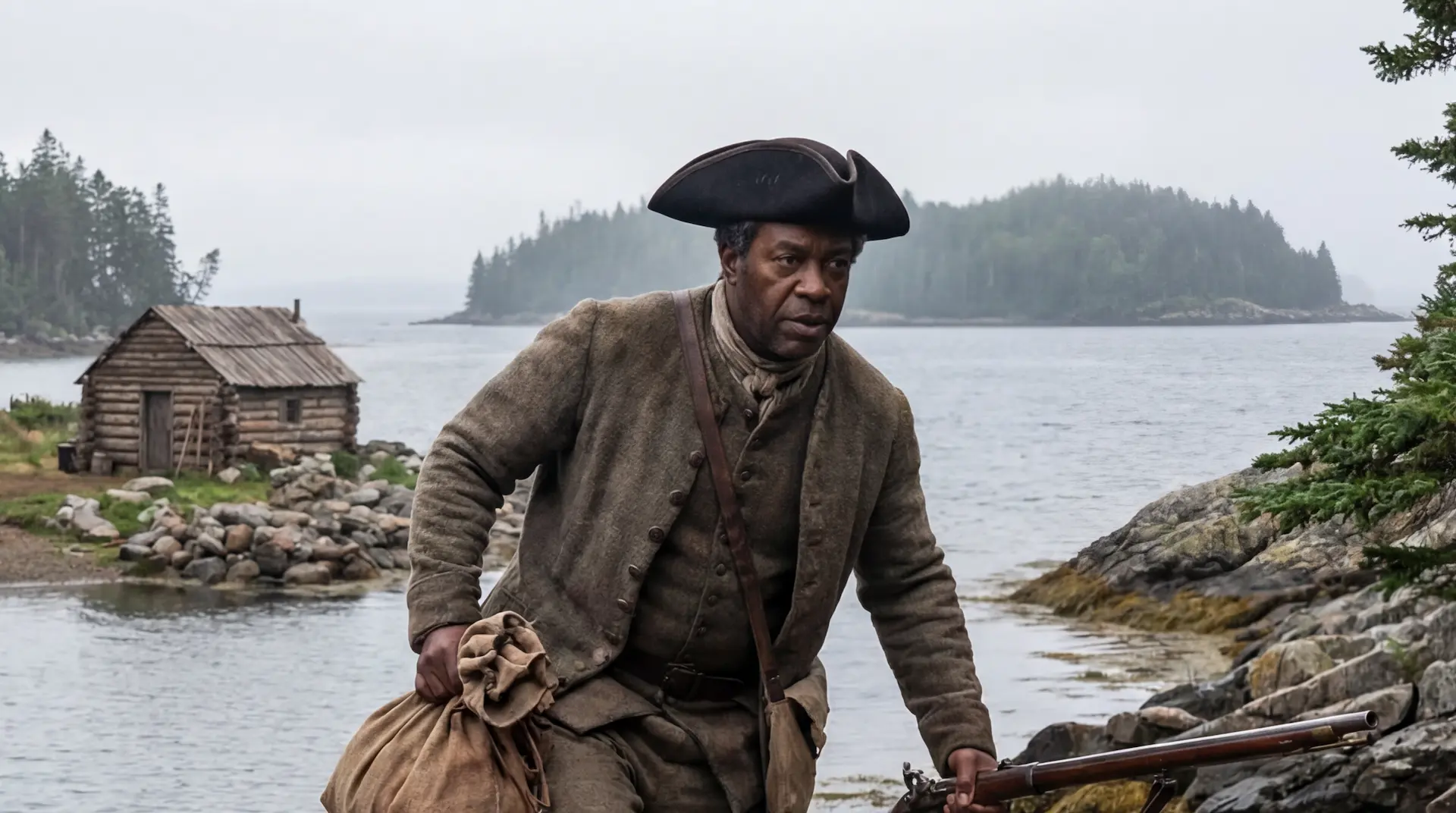 Samuel Ball, the Unlikely Oak Island Owner→
Smith and Vaughan
2 min
John Smith is the best documented of the three men traditionally associated with the discovery. Born in Boston on August 20, 1775, he came to Mahone Bay with his family as part of the Shoreham Grant immigration. He married Sarah Floyd on September 28, 1790, at the age of fifteen. His purchase of lot 18 on June 26, 1795, has been taken as evidence that the Money Pit was discovered in the spring or early summer of that year, the assumption being that Smith bought the property to secure access to the presumed treasure. Harris called this assumption "not unreasonable, but far from conclusive." Smith eventually acquired lots 16, 17, 19, 20, and 21, giving him ownership of the entire eastern end of the island. He built a house near the Money Pit around 1805, lived there for more than fifty years, and died on September 29, 1857. The inscribed stone pulled from the Pit by the Onslow Company was built into the back of his fireplace, where it was viewed by hundreds of visitors over the following decades.
Anthony Vaughan is more difficult to pin down. Harris gave his age as thirteen in 1795. The 1893 Treasure Company prospectus, which states that Vaughan "subsequently related these facts to Mr. Robert Creelman," described him as "only a lad of 16 at this time." Clarke has argued that the man McCully described telling about the pit was more likely Vaughan's father, Anthony Vaughan Sr., who was forty-five in 1795. The Vaughan family were descendants of Rowland Vaughan, residents of Rhode Island who came to Massachusetts in the seventeenth century; three Vaughan brothers settled in Chester between 1768 and 1772. Anthony Vaughan Jr. married Elizabeth Nelson of Truro in May 1803. Clarke discovered that Nelson was related to the Archibald family, providing the likely connection through which the Onslow Company learned of the Money Pit.
By every account, Vaughan was the chief source for the discovery story. In 1849, now sixty-seven years old, he related the details to Robert Creelman of the Truro Company. He also helped the Truro men locate the original shaft, which by then had been filled in. His recollections, filtered through Creelman and then through McCully's pen, form the backbone of every subsequent retelling. McGinnis himself had been dead since 1827. Smith's wife Mary was another source, but her direct contributions are poorly documented.
The First Excavation
2 min
On the sequence of events after McGinnis brought his companions to the site, the sources agree more closely, though discrepancies remain. Harris's synthesis, drawing primarily on the Colonist account and on DesBrisay, runs as follows. The three men visited the spot and attempted to remove the tackle block from the oak tree. It fell to the ground and broke apart, suggesting considerable age. They found the ground beneath the tree had "settled and formed a hollow." They also discovered the remains of an old road leading from the site to the western shore of the island, and concluded that whoever had buried something here had used this route to transport materials from their ship. At the eastern cove, at low tide, they found a large iron ringbolt set into a rock, which they took to be a mooring point.
They began to dig. After removing the surface soil for about two feet, they struck a tier of flagstones laid across the full width of the shaft. These stones, they later determined, were not indigenous to Oak Island but had been brought from the Gold River area, roughly two miles north on the mainland. Beneath the flagstones they found themselves in a well-defined shaft approximately seven feet in diameter (McCully gave the diameter as sixteen feet, but most other accounts say seven to thirteen feet). The walls were tough, hard clay, but the fill inside was loose and easy to remove. Pick marks from the original excavation were plainly visible on the clay walls.
At ten feet below the flagstones, they hit a tier of oak logs, six to eight inches in diameter, their ends firmly embedded in the walls of the shaft. The outer surfaces of the logs were badly decayed, suggesting they had been in place for a long time. The earth below the logs had settled nearly two feet. The three men removed the logs and kept digging. At twenty feet, they struck a second tier of identical oak logs. McCully's account says they found a third tier at thirty feet. DesBrisay's wording is less precise, saying they went "fifteen feet farther down" after the first tier of logs, which could mean they reached a depth of roughly twenty-five to twenty-seven feet. Harris followed DesBrisay's phrasing. The 1893 prospectus says they dug to thirty feet, finding "marks at each 10 feet."
At this depth, they stopped. The work was too heavy and too dangerous for three men with hand tools. Before leaving, they drove oak sticks into the mud at the bottom to mark their depth and covered the site with branches. They then sought help from their neighbours, but found no takers. Harris recorded the reasons: some people were "superstitious enough to credit the saying that when pirates concealed money they always killed a black man and buried him with it to guard it." Others simply thought the idea of treasure buried so deep was absurd.
The Search for Partners
1 min
The period between the initial excavation and the arrival of the first organized company is one of the least documented stretches in the Oak Island story. McCully's 1862 letter says it was "about seven years" before Simeon Lynds arrived. DesBrisay gives the interval as "about fifteen years," which does not square with the documented date of the Onslow Company's operations in 1804. The 1893 prospectus says "6 or 7 years." Harris, weighing the evidence, fixed the date of the Onslow Company's work as 1804.
During this gap, the three men farmed and waited. McGinnis married, had a son, and by most accounts was living on the island. Smith continued to acquire lots and establish himself on the eastern end. Vaughan returned to the mainland. Harris wrote that they "looked about them and sought help from others, but without success," and that the reluctance of their neighbours to assist left them unable to proceed on their own.
The connection to Simeon Lynds came, according to the most widely accepted version, through the Vaughan family. Harris recorded that the accepted story placed Lynds in Chester on a business visit, where he spent an evening with Anthony Vaughan's father and heard the story. Clarke's genealogical research offers a more specific link: Anthony Vaughan Jr. married Elizabeth Nelson of Truro in May 1803, and Nelson was related to the Archibald family, whose members would become the leading investors in the Onslow Company. Clarke proposed that the Vaughan-Nelson wedding in May 1803 was the occasion on which the Money Pit story reached the ears of Colonel Robert Archibald and his relatives.
What the Onslow Company Found
3 min
In the early summer of 1804, members of the newly formed Onslow Company loaded a small schooner with tools and provisions and sailed more than three hundred miles from Onslow to Oak Island. The investors included Colonel Robert Archibald, the government surveyor who had laid out the township of Onslow in 1780 and now served as justice of the peace; his son Captain David Archibald; and Sheriff Thomas Harris of Pictou County. These were men of standing who were putting their reputations as well as their money at stake.
On arrival, they were met by McGinnis, Smith, and Vaughan. The first task was to clear the Money Pit, which had caved in and formed what Harris, paraphrasing an early account, described as "the shape of a sugar loaf resting on its apex." When the debris was removed, the crew found the oak sticks that the three men had driven into the mud years earlier, still in place. This was taken as proof that nobody had disturbed the site in the interim.
As they dug below the point where McGinnis and his companions had stopped, the Onslow Company crew found what the three men had found above: oak log platforms at regular intervals, with their rotting ends embedded in the clay walls of the shaft. The pick marks of the original builders were clearly visible. But they also encountered new materials. The accounts differ on the exact sequence, and the differences between the McCully, DesBrisay, McNutt, and Vaughan versions are not trivial. Compiling the various sources, Harris listed the following: tiers of charcoal, putty, coconut fibre, and a layer of smooth beach stones with figures and letters cut into them. James McNutt, secretary of the Oak Island Association, whose 1863 manuscript survives only in fragments, placed these at specific depths: charcoal at forty feet, beach stones with carvings at fifty feet, manila grass and coconut fibre at sixty feet, putty at seventy feet, and the inscribed stone at eighty feet. McCully placed the inscribed stone at eighty feet as well. Vaughan's own account, according to Harris, said it was found at ninety feet.
The quantities of these materials were substantial. Hiram Walker, a ship's carpenter from Chester who worked on the dig, told his granddaughter Mrs. Cottnam Smith that he had seen "bushels of coconut fibre" pulled from the shaft. There was so much putty on one platform that it was later used to glaze the windows of local buildings. The coconut fibre would be confirmed in 1916 by the Smithsonian Institution as being from the husks of a coconut, a tropical plant that had no business being in a shaft on a Canadian island. Harris cited the Smithsonian's finding that the fibre was "especially resistant to the effects of sea water and under the conditions under which it was found may have been there for several hundred years."
The inscribed stone, a slab of what appeared to be dark Swedish granite, roughly two feet long, one foot wide, and ten inches thick, bore characters that none of the workers could decipher. It was placed in the back of John Smith's fireplace, where hundreds of people examined it over the following decades. A professor at Dalhousie College reportedly interpreted the inscription as reading "Ten feet below two million pounds lie buried," though most contemporaries were sceptical of this translation.
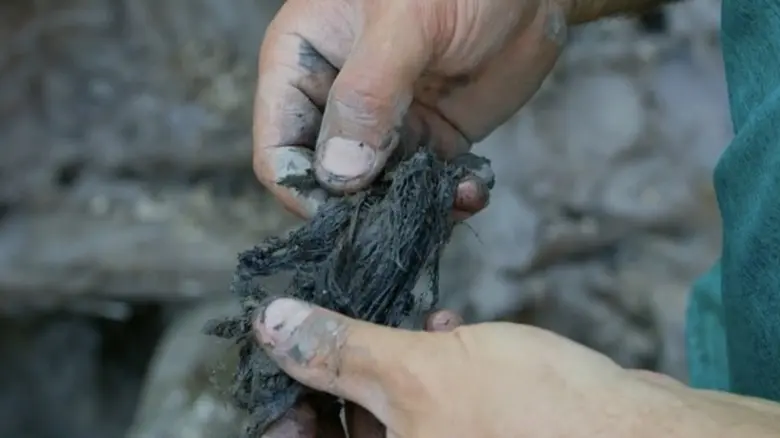 Coconut fibre (Money Pit)→
Below ninety feet, the earth became softer and water began to appear. At ninety-three feet, the crew was bailing one tub of water for every two tubs of earth. On their last evening of work, they probed the bottom with a crowbar and struck, at ninety-eight feet, a hard, impenetrable surface that spanned the full width of the shaft. They left for the night expecting to reach it in the morning. When they returned, the pit contained sixty feet of water, level with the tide in Mahone Bay. No amount of bailing could lower it. The water had defeated them, as it would defeat every company that followed for the next two centuries.
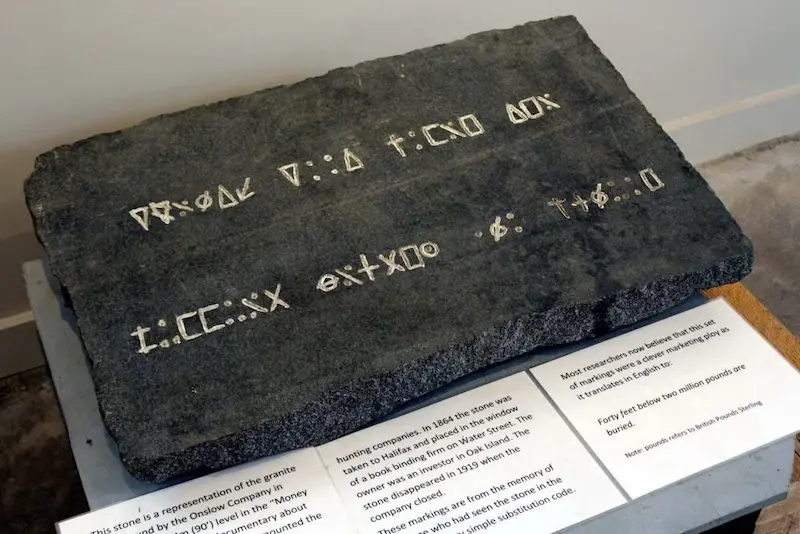 Inscribed stone (90-foot stone)→
McGinnis After the Discovery
1 min
Daniel McGinnis lived on Oak Island for the rest of his life. He married Maria Barbara Saller in September 1795, built a home on lot 21, and farmed. His son Johan was baptized at Chester in 1797. Harris noted that one of McGinnis's sons was also named Daniel, that another was named James, and that his grandson John McGinnis was born on Oak Island around 1865 and lived and died there. Multiple generations of McGinnises maintained a connection to the island and to the treasure hunt throughout the nineteenth century.
McGinnis died in early 1827. His will was dated January 4 of that year and probated on February 27. Anthony Vaughan was named as one of two executors. John Smith was a witness. So was Samuel Ball. The document confirms that all four men were still in contact more than three decades after the discovery of the Pit, and Ball's presence among the witnesses adds weight to the evidence of his involvement from the earliest days.
McGinnis was buried on Oak Island. No formal grave marker bearing his name has been positively identified, though a rock pile on the Money Pit drumlin contains a stone shard with letters that may be consistent with his name and dates.
The McGinnis Family Legacy
1 min
In 2007, a local historian named Danny Hennigar met Joyce McGinnis, a woman claiming descent from Daniel McGinnis, who showed him a heavy cross of braided, hand-hammered gold. She said the cross had been passed down through the oldest son in each generation, and that it was a remnant of treasure found at the bottom of the Money Pit in 1795. According to this family tradition, the three discoverers found three chests of treasure at about twenty feet and took one each. The cross, Joyce McGinnis said, was the one piece that Daniel had insisted be kept and handed down.
Joyce McGinnis and her two sisters visited Oak Island in 2015 and repeated this story for the cameras during the Season 3 finale of The Curse of Oak Island. Jewelers who examined the cross reportedly told the family that it could be as old as five hundred years. The story cannot be independently verified, and the claim that treasure was found and kept secret is at odds with the well-documented poverty of the three discoverers in the years immediately following 1795. If they had found even a modest treasure, the decade they spent trying to recruit investors to dig deeper would be difficult to explain. The family tradition may reflect a real heirloom of unknown provenance, or it may be an embellishment that grew in the telling across two centuries of retelling.
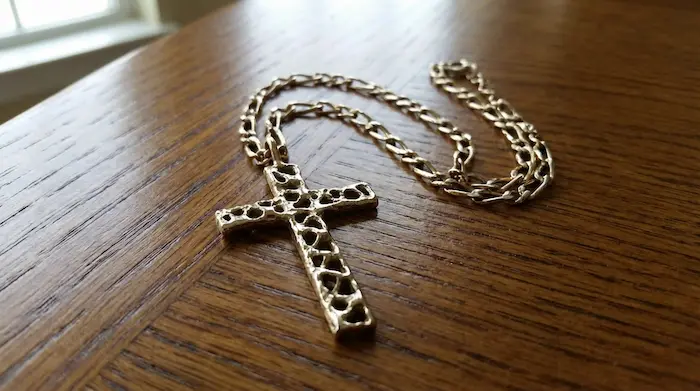 McGinnis Gold Cross→
How the Story Survived
1 min
The chain of transmission by which the discovery story reached the written record is worth understanding, because it determines what can and cannot be known with confidence. Daniel McGinnis died in 1827, more than two decades before any account of the discovery was committed to paper. John Smith died in 1857, by which time his daughter Mary had lived for sixteen years in the household of Judge DesBrisay, who would publish the first book-length account in 1870. Anthony Vaughan, the last surviving member of the original group, gave his detailed recollections to Robert Creelman in 1849, when Vaughan was sixty-seven years old and recalling events from more than half a century earlier. Creelman's notes were used by Jothan McCully for his 1862 letter to the Liverpool Transcript and, most likely, for the longer account published in the Halifax Colonist on or about January 2, 1864. James McNutt, secretary of the Oak Island Association, wrote his own account in 1863; it was never published, and only fragments survive.
Every surviving written account of the discovery therefore rests on the memories of an old man recalling events from his youth, filtered through at least one intermediary before reaching print. This does not mean the story is false. The physical evidence found by the Onslow Company in 1804, including the oak platforms, the pick marks, the flagstones, the coconut fibre, and the inscribed stone, confirms beyond reasonable doubt that someone excavated a deep shaft at this location before the arrival of European settlers in the Mahone Bay area. What it means is that specific details, particularly those on which the sources contradict one another, should be held lightly.
What Can Be Established
1 min
Harris, at the conclusion of his account of the discoveries made between 1795 and 1805, offered five conclusions that remain as sound as anything that has been established since. First, the Pit, including the oak platforms, was a man-made work. Second, the finding of charcoal, putty, coconut fibre, and the inscribed stone confirmed that the works were constructed with deliberation and resources that pointed to an origin far from Nova Scotia. Third, the Pit was constructed before 1749, when Halifax was founded, because works of this scale could not have been carried out after European settlement of the area without becoming widely known. Fourth, the magnitude of the undertaking suggested a deposit of substantial value. Fifth, the men involved in the early recovery attempts were persons of good reputation who invested their money and, in some cases, the balance of their lives in pursuing what they had found.
To these, modern research has added refinements. Sullivan's observation about the oak stumps and young trees narrows the probable construction date to the seventeenth century at the earliest. Clarke's land records complicate the identities of the discoverers and suggest the standard "three boys" narrative is, at minimum, an oversimplification. The first edition of DesBrisay's history raises the possibility that Samuel Ball was involved in the discovery from the outset, a possibility that has been insufficiently examined.
What remains unknown is almost everything else. The identity of the original builders, the contents of the shaft, and the purpose of the elaborate underground works on Oak Island are no closer to being established than they were in 1795. The discovery of the Money Pit was not the end of a mystery but the beginning of one, and after more than two centuries it has still produced more questions than answers.
Sources
5 min
Primary accounts (in chronological order of publication):
- Jothan Blanchard McCully, letter to the Liverpool Transcript, Truro, June 2, 1862. First published account of the discovery and early excavations. McCully was secretary of the Oak Island Association and a former member of the Truro Company. He participated personally in the 1849 boring operations and wrote from direct acquaintance with Anthony Vaughan and John Smith.
- "A member of the Oak Island Association," article in the Halifax Colonist, published December 20, 1863, and January 2, 1864. Probably written by McCully. The Colonist account gives the interval before the Onslow Company as "fifteen years" and is the principal source used by DesBrisay.
- James McNutt, manuscript account, 1863. McNutt was secretary and treasurer of the Oak Island Association. The manuscript was never published; only fragments survive. Contains details not found elsewhere, including the clover patch, beach stones with carvings at 50 feet, and figures and letters on a stone at 80 feet.
- Judge Mather Byles DesBrisay, History of the County of Lunenburg, Nova Scotia (first edition, 1870; second edition, 1896). First account of the discovery to appear between hard covers. DesBrisay lived in Chester during his childhood and was personally acquainted with people involved in the treasure hunt. In the 1870 edition, the three discoverers are named as McGinnis, Smith, and Samuel Ball. In the 1896 edition, Ball is replaced by Vaughan with no explanation.
- Oak Island Treasure Company prospectus (Boston, 1893). Public share offering document, $60,000 capital in $5 shares. Draws on the recollections of Robert Creelman, J. B. McCully, and Adams A. Tupper, all of whom were still living. Contains the verbatim statement of McCully's boring results and unique details including red clover, a sawed-off branch, and Vaughan's age given as sixteen.
Oral testimony and interviews:
- Anthony Vaughan, interview with Robert Creelman, 1849. Vaughan was approximately sixty-seven years old, recalling events from 1795. His account was the chief source for McCully's articles and, through them, for nearly all subsequent retellings. Vaughan helped the Truro Company locate the original shaft.
- Mary Smith, daughter of John Smith, who lived for sixteen years in the household of Judge DesBrisay. Her recollections contributed to DesBrisay's account, though the extent of her contribution is poorly documented.
- Hiram Walker, ship's carpenter of Chester, who worked on the Money Pit during the Onslow Company operations. He told his granddaughter Mrs. Cottnam Smith that he had seen "bushels of coconut fibre" pulled from the shaft.
- Adams A. Tupper, of Upper Stewiacke (later South Framingham, Massachusetts). Helped sink shaft No. 3 during the Truro Company operations. His eyewitness account is quoted in the 1893 prospectus.
Secondary sources, books:
- R. V. Harris, The Oak Island Mystery (Ryerson Press, Toronto, 1958; revised edition, 1967). Harris served as attorney to Frederick Blair and later to Melbourne Chappell, the two men who controlled the treasure hunt from 1895 to 1965. He drew on the vast collection of records and documents now held in the Oak Island file at the Nova Scotia Archives, Halifax. His account synthesizes all earlier sources and includes genealogical research on the Vaughan, Smith, and Ball families.
- Mark Finnan, Oak Island Secrets (Formac Publishing, Halifax, 1995; revised edition 2002). Detailed account of the discovery and early excavations, including the flagstone layer, coconut fibre identification, and inscribed stone.
- Lionel and Patricia Fanthorpe, The Oak Island Mystery: The Secret of the World's Greatest Treasure Hunt (Dundurn Press, 1995). Synthesizes the Onslow Company operations and provides analysis of the coconut fibre quantities, putty, and platform sequence.
- Les MacPhie, Oak Island: And the Search for Buried Treasure (Nimbus Publishing, Halifax, 2006). Compilation of scientific testing results including the Smithsonian Institution fibre analysis (1916) and Bureau of Plant Industries report (1937).
- Lee Lamb, Oak Island Family: The Restall Hunt for Buried Treasure (Dundurn Press, 2012). Accessible account of the discovery and initial excavation, with the detail that the three discoverers reached 32 feet before stopping.
- Randall Sullivan, The Curse of Oak Island: The Story of the World's Longest Treasure Hunt (Atlantic Monthly Press, New York, 2018). The most thorough modern investigation of McGinnis's identity, including the age debate, the McInnes-to-McGinnis name transition, the North Carolina loyalist connection, and Sullivan's interviews with the Nova Scotia Archives, South Shore Genealogical Society, and local historian Charles Barkhouse. Sullivan also documented his unsuccessful attempt to interview descendants of Samuel Ball.
- Les Clarke, Oak Island Odyssey (2023). Clarke's research, drawing on land records brought to light by Paul Wroclawski, established that McGinnis owned four lots on Oak Island before 1795 and argued that McGinnis was born in 1758 (age thirty-seven in 1795), not a teenager. Clarke also discovered the genealogical link between the Vaughan and Archibald families through Elizabeth Nelson's 1803 marriage.
Scientific and institutional reports:
- Smithsonian Institution, Washington, D.C., fibre analysis, 1916. Confirmed the fibrous material from Oak Island as coconut husk fibre, noting it was "especially resistant to the effects of sea water" and could have been in place "for several hundred years."
- Dr. Frederick L. Newton, Curator of Textiles, Smithsonian Institution, confirming report, 1930.
- Bureau of Plant Industries, Washington, D.C., fibre analysis, 1937. Reported the fibrous material as "unquestionably the fibro-vascular tissue of some plant" but could not identify it further. Confirmed it was not seaweed.
- Botanical Museum of Harvard University, fibre analysis, 1937. Reported the material as "readily distinguishable as manilla hemp," contradicting the Smithsonian identification.
Genealogical and land records:
- Paul Wroclawski, land ownership research (cited by Clarke). Established McGinnis's lot purchases: lot 28 (March 1788), lot 21 (May 1790), lot 27 (May 1791), lot 1 (September 1794).
- Families of the Western Shore (genealogical volume, cited by Sullivan). Contains the lineage from Donald Daniel McInnes to "Daniel Jr." who "found 'The Money Pit Site' in 1795."
- Church of Jesus Christ of Latter-day Saints archives. Record of the marriage of Donald Daniel McGinnis to Maria Barbara Saller at St. James' Anglican Church, Lunenburg, September 8, 1795.
- Chester parish records. Baptism of Johan James McGinnis, son of Daniel and Maria Barbara, July 26, 1797.
- Daniel McGinnis will, dated January 4, 1827, probated February 27, 1827. Anthony Vaughan named as executor; John Smith and Samuel Ball named as witnesses.
- Samuel Ball will, probated January 5, 1846. Shows mainland property adjoining "lands owned by Daniel McGinnis."
- John Smith, purchase of lot 18 on Oak Island from Caspar Wollenhaupt, June 26, 1795, for five pounds.
Government and institutional records:
- Nova Scotia Bureau of Information, official account of the Oak Island story, 1951. Described the three discoverers as being "on a shooting trip to Oak Island from the neighboring mainland."
- Henry S. Poole, government geological report, 1861. Visited the Money Pit area and described the shaft conditions.
- Charles Morris, Surveyor General of Nova Scotia, survey of Oak Island (designated Island No. 28), 1762-1765. Divided the island into thirty-two four-acre lots.
The Curse of Oak Island (TV series):
- Season 3, Episode 13 (finale, 2016). Joan, Jean, and Joyce McGinnis visit Oak Island and present the McGinnis family gold cross, claiming it was inherited from Daniel McGinnis and that the three discoverers found three chests of treasure at approximately twenty feet.
- Danny Hennigar, local historian, first documented the McGinnis family gold cross in 2007 after meeting Joyce McGinnis.