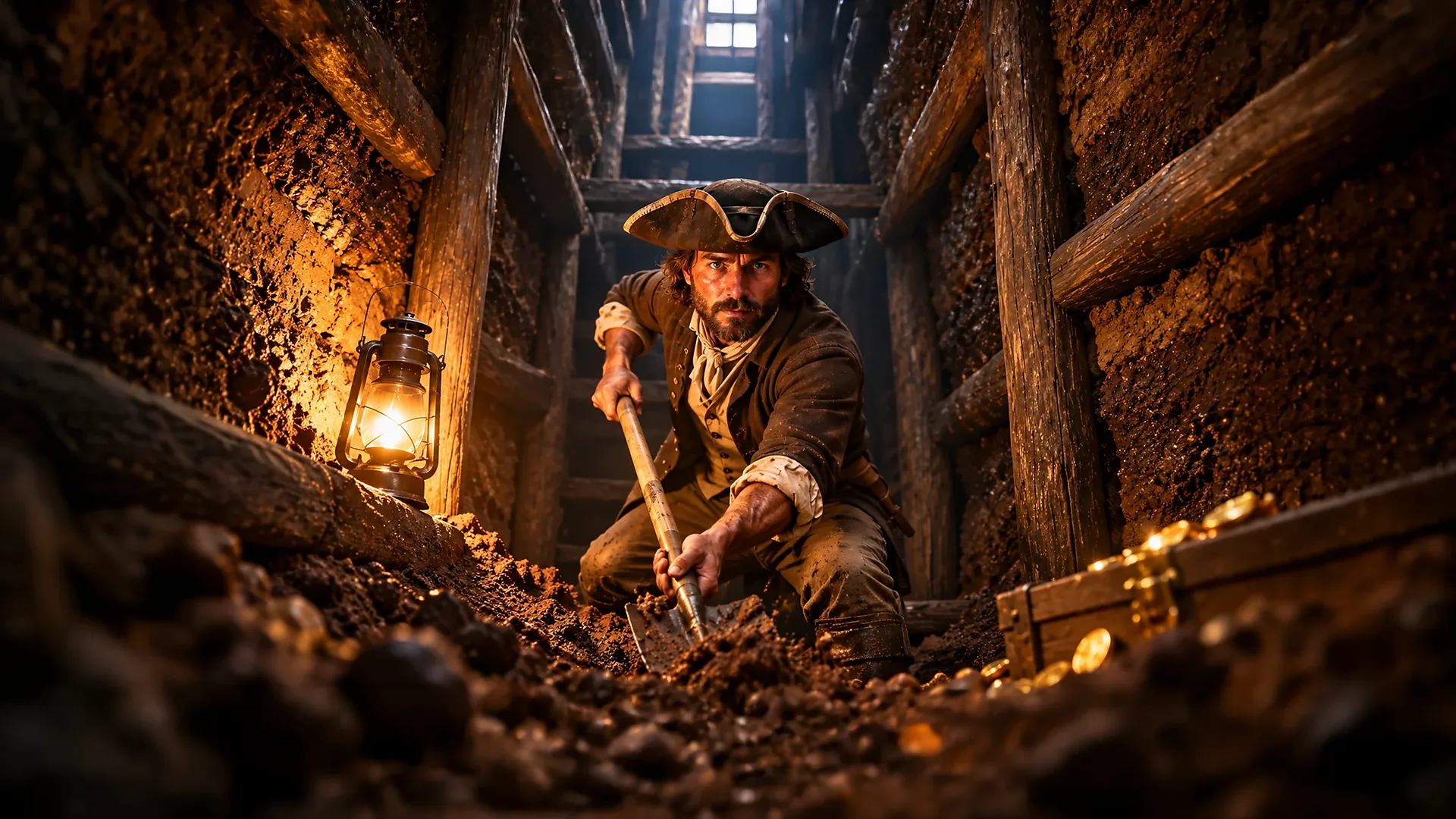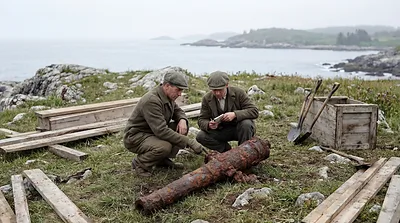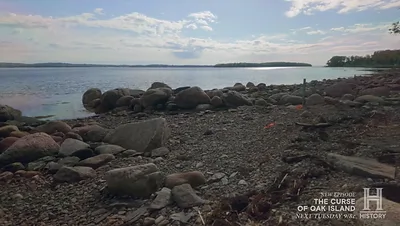
Gold and silver have both been measured on Oak Island. Since 2020, scientists working with the team have found the two metals in groundwater around the Money Pit, in old timber, on fragments of metal and in soil brought up from 200 feet down. The results have come from three universities and the island's own laboratory, and have helped guide six years of drilling. The source of those traces has not yet been established. This is the record of what has been found so far: what was tested, who tested it, what the result was and where it led the searchers next.
Has Gold Actually Been Found on Oak Island?
1 min
Yes. Laboratory tests have detected gold in groundwater from the Money Pit area, on recovered metal fragments and in old timber. Silver has also been detected in water and soil. These are measured results, but they have not established the existence of buried treasure or identified the source of the metals.
The First Silver Traces in the Money Pit
1 min
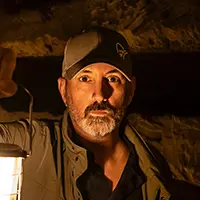
Dr. Ian Spooner did not come to Oak Island as a believer. He is a geoscientist at Acadia University in Wolfville, Nova Scotia, whose research includes metals in soil and groundwater, and he keeps a sailboat in Mahone Bay. By his own account, he had sailed past the island hundreds of times and regarded its legends as folklore. He turned the television series down more than once before agreeing to investigate the swamp.
In 2020, he put an idea to brothers Rick and Marty Lagina and their partner Craig Tester. Certain historical silver coins contained substantial amounts of copper and other metals alongside silver. If a large quantity of such coinage lay in wet ground, those metals might leave a detectable chemical signature in the surrounding groundwater. Gold was a different problem. It is far less reactive than silver or copper, so detecting it in groundwater requires particularly sensitive instruments.
Working with Dr. Matt Lukeman, a chemist at Acadia University, Spooner collected water from 12 flooded boreholes across the Money Pit area. Three wells, WS-1, WS-2 and WS-9, showed copper and zinc concentrations ten times those of the surrounding boreholes, along with detectable silver. Asked in the War Room whether the findings suggested a handful of silver or something more substantial, Spooner said the concentrations pointed towards a large deposit.
Another test helped shape that interpretation. Sediment collected from the bottom of borehole C-1, where an earlier camera inspection had shown gold-colored objects in a cavern, returned low metal readings. Spooner interpreted the difference between the water and sediment results as evidence that the dissolved metals might be coming from a buried source rather than the immediately surrounding soil. Marty Lagina called the finding the most important development in 220 years of searching.
When the Water Tests Found Gold Too
2 min
Gold had been reported from the Money Pit long before modern scientific testing began. In 1897, treasure hunters Frederick Blair and William Chappell, drilling at approximately 153 feet, reported finding traces of gold on their drill bit. The initial modern groundwater tests had concentrated on silver, copper and zinc. In 2021, Spooner turned to the Queen's Facility for Isotope Research at Queen's University in Kingston, Ontario, for a more detailed analysis.
Prof. Peir Pufahl, a co-director of the facility, described the work in an interview published by Queen's University. The laboratory used inductively coupled plasma mass spectrometry, or ICP-MS, a highly sensitive technique capable of measuring extremely small concentrations of elements in water. The laboratory measured 65 elements in samples collected from the Money Pit boreholes.
The results identified gold in water from four boreholes. F-4 had the highest concentration at 0.044 parts per billion, followed by E-8 at 0.024, C-1 at 0.017 and K-7 at 0.012. The laboratory set those figures beside two reference waters: seawater at 0.010 and river water at 0.005. The gold in F-4 was more than four times the seawater figure and almost nine times the river water figure.
F-4 also contained 101 parts per billion of copper, about seven times the seawater figure, and it was the only one of the four boreholes in which silver was detected, at 0.042. The gold-bearing boreholes corresponded with areas where earlier testing had detected silver.
| Metal | F-4 | E-8 | C-1 | K-7 | Seawater | River water |
|---|---|---|---|---|---|---|
| Gold | 0.044 | 0.024 | 0.017 | 0.012 | 0.010 | 0.005 |
| Silver | 0.042 | Not detected | Not detected | Not detected | 0.100 | 0.300 |
| Copper | 101.0 | 47.0 | 0.183 | 29.2 | 14.0 | 0.60 |
| Zinc | 131.3 | 47.1 | 0.899 | 30.3 | 90.0 | 40.0 |
Pufahl described the result to the university's newspaper as the first direct evidence of gold identified through the scientific testing undertaken during the television search. He identified two possible explanations. The gold could have originated from buried treasure, or it could have come from a natural geological source and entered the groundwater. He also explained that the laboratory uses comparable chemical fingerprinting techniques with industry partners investigating mineral deposits.
Spooner then examined the possibility of a natural source. He told the team that a geological deposit would have to be substantial to account for the concentrations measured in F-4 and proposed investigating the glacial till around the Money Pit. After that investigation, he reported that he had not identified a natural source capable of explaining the readings. The team responded by planning 20 new boreholes around C-1, collecting core samples at ten-foot intervals down to approximately 200 feet.
The First Gold Found on a Metal Fragment
1 min
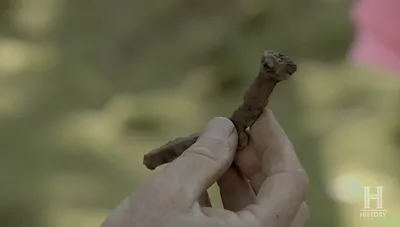
The new drilling produced something more tangible than a water sample. From borehole D-2, at a depth of approximately 90 feet, the team recovered a fragment of metal. Spooner examined it with an X-ray fluorescence analyzer, or XRF, which identifies elements present in the material being tested. The reading showed 0.068 percent gold, equivalent to approximately 680 parts per million.
Spooner used the image of a thimbleful of gold to describe the finding, while explaining that the metal could be present in the fragment itself or in sediment adhering to its surface. Two additional tests produced readings of approximately 700 parts per million. Wood recovered from the same borehole was radiocarbon dated to a range extending as early as 1488.
The metal fragment was subsequently examined using a scanning electron microscope at Saint Mary's University in Halifax. Among the grains adhering to the fragment, chemist Dr. Christa Brosseau identified a bright particle containing approximately 65 percent gold, 26 percent copper and 5 percent silver. She described the alloy as rose gold.
Two additional metal fragments recovered from the spoils of the nearby TF1 shaft produced XRF readings of 0.035 and 0.022 percent gold. The tests established that gold was present in material physically recovered during the Money Pit excavation. They did not determine the original purpose of the metal fragments or establish where the gold-bearing material had come from.
 Saint Mary's University→
Following the Metals Underground
2 min
By the following season, gold had been identified in water from 20 boreholes, and another 50 were selected for testing. Marty Lagina wanted to use the results to trace the metal back to its source. Groundwater movement made that difficult. The Money Pit area contains old shafts, tunnels, fractures and disturbed ground. Water carrying dissolved metals may travel some distance from the material it originally contacted. A high reading identifies where the metal-bearing water was sampled, not necessarily where the metal entered it.
To understand that movement, the team brought in hydrogeologist Dr. Fred Michel. Michel identified two distinct bodies of groundwater beneath the site. Samples from east of the Garden Shaft contained no detectable gold or silver, while samples to the north contained both metals, with the strongest concentrations between approximately 80 and 110 feet.
When the readings were plotted on a map, the richest area appeared roughly 10 to 15 feet west of the Garden Shaft. The zone measured approximately 70 feet by 25 feet. The team called it the Blob, with the most concentrated part becoming known as the Baby Blob.
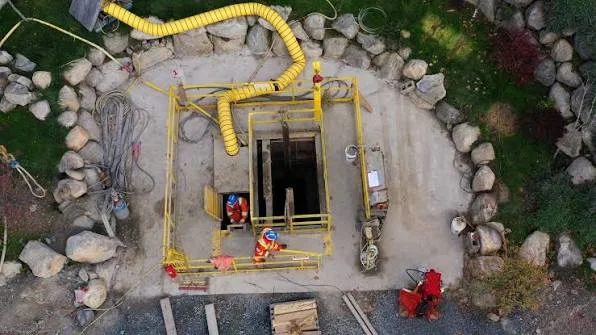
The Garden Shaft itself became a focus of the investigation. The approximately 80-foot shaft had long been associated with nineteenth-century treasure hunters, but timber recovered from it produced a date of 1735, predating the reported discovery of the Money Pit in 1795. Michel reported that water from the shaft contained some of the highest gold concentrations measured on the island. From the distribution of the readings, he suggested that the source might lie within approximately 15 feet of the shaft.
Results elsewhere on Oak Island were generally less striking. One exception was the stone well on Lot 26, whose construction had been associated with radiocarbon dates between AD 1028 and 1172. Silver was detected in its water, making it one of the few reported precious-metal groundwater anomalies outside the Money Pit area.
After studying the complete set of Money Pit results over the winter, Michel identified a larger zone of elevated gold and silver readings west of the Garden Shaft, measuring approximately 67 feet by 57 feet. The team named the area the Pie.
 The Garden Shaft→
Gold in the Timber of the Garden Shaft
1 min
The next significant findings came from wood. Borehole DN11.5, drilled into the Baby Blob, encountered an underground chamber approximately eight feet high at a depth of 90 feet. The drilling brought up a piece of timber.
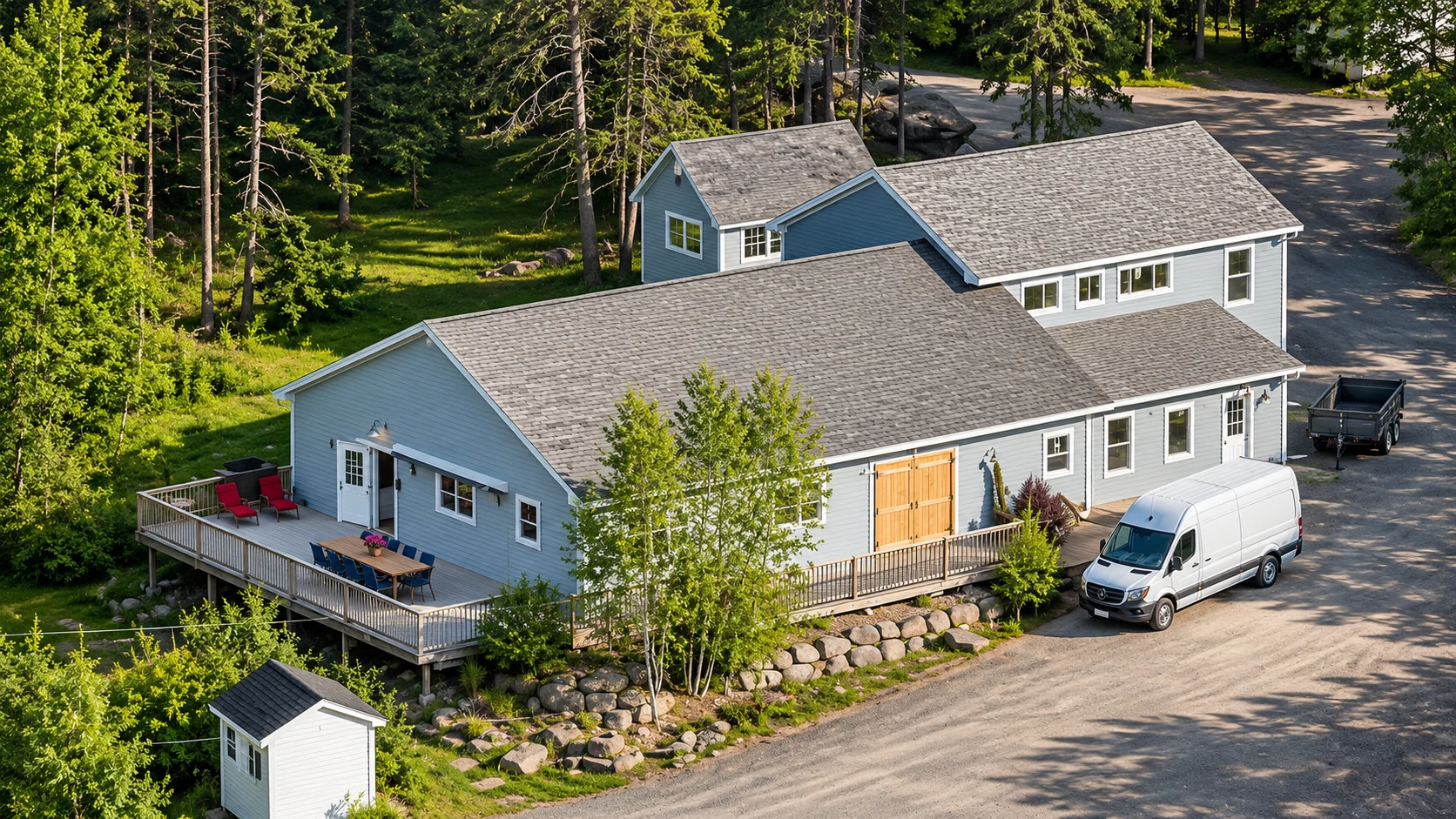
Emma Culligan, the archaeometallurgist operating the island's scientific laboratory, dried the sample and examined it using XRF. Alongside the elements normally present in wood, the instrument detected gold.
 The EvidenceInside the Oak Island Lab With Emma Culligan→
Rick Lagina immediately recognised the potential importance of the result. If buried wood had absorbed metals from surrounding groundwater, it might preserve evidence of the water's composition over time. He asked Tester to contact Marty about the discovery.
Another sample was collected from the inner lining of the Garden Shaft. Culligan examined it with the laboratory's mapping XRF instrument, which measures elemental composition across a surface point by point. The scan produced a gold reading of 0.11 percent. A subsequent result for the lining wood was reported as 0.13 percent gold, and another sample from the crane side of the shaft also showed gold. Rick Lagina asked for wood recovered from every borehole to be tested in the same way.
Unlike the groundwater tests, these were measurements made on solid material. The XRF readings identified gold at the examined surfaces, but did not by themselves establish how much gold was present throughout the timber or where it had originated.
Silver Found 200 Feet Beneath the Money Pit
2 min
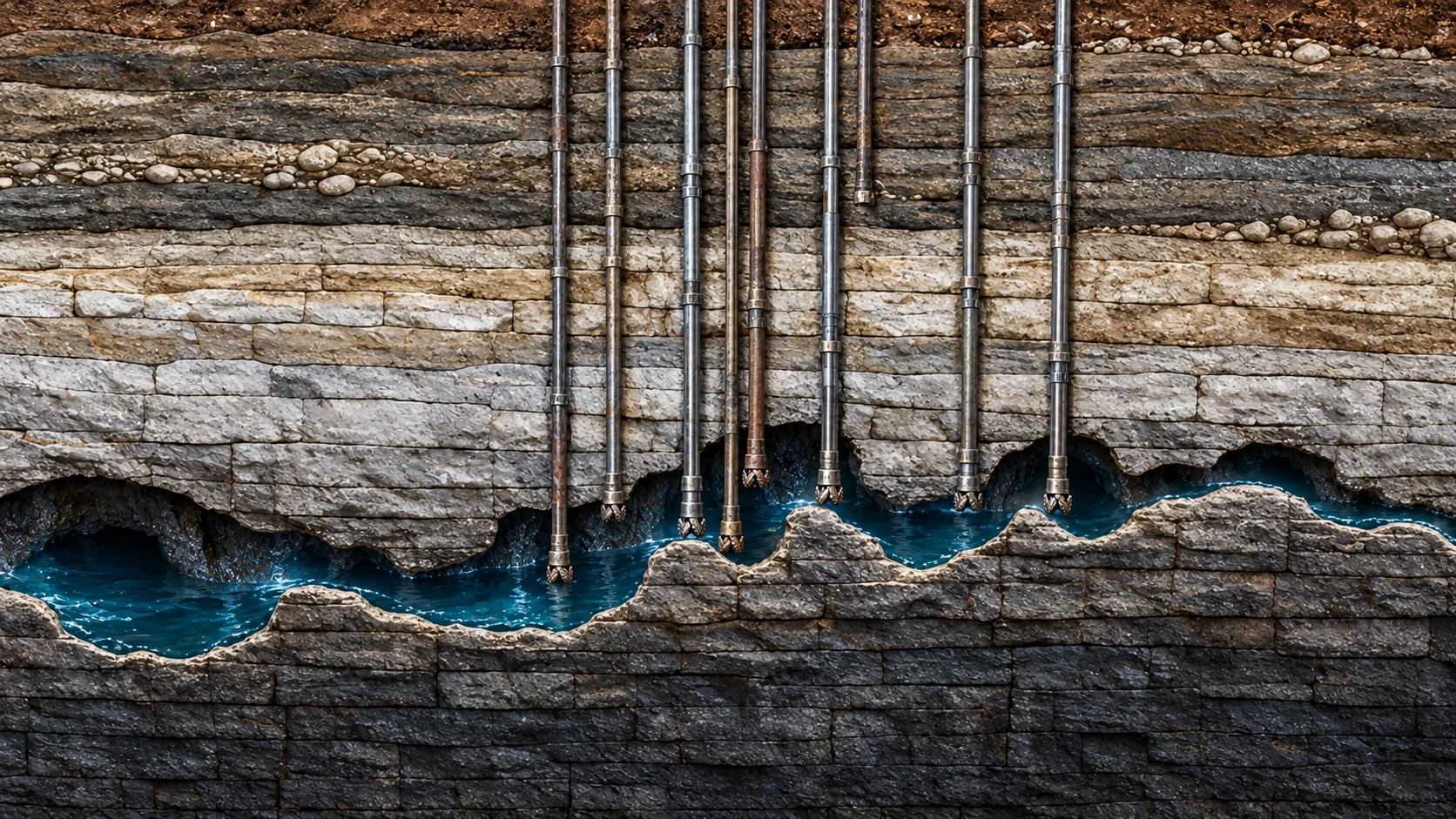
By the thirteenth season, the investigation had extended into deeper ground beneath the Money Pit. Below the excavated shafts and tunnels lies what the team calls the solution channel, a natural passage formed by the dissolution of bedrock and extending to approximately 230 feet. The team's working theory was that material originally buried in the Money Pit might have fallen into this channel when parts of the underground workings collapsed in 1861.
Spooner investigated the connection between the deeper channel and the shallower groundwater using a dye tracer. Red dye introduced at a depth of approximately 200 feet was subsequently detected in water drawn from a depth of just 105 feet, about a year later. Spooner interpreted the result as evidence that water could move from the deeper channel in the south towards the wells around the Garden Shaft to the north.
 The EvidenceOak Island's Solution Channel: The Void Beneath the Money Pit→
He also explained that drilling could influence the movement of water through the disturbed ground, pushing it down in one area and upwards in another. The findings offered a possible explanation for why gold and silver concentrations were strongest near the Garden Shaft even if the source lay deeper underground.
Further drilling produced soil samples from around 200 feet. Spooner and Culligan presented XRF results from two boreholes, I-9.5 and K-9.5, in which silver was identified in elemental form associated with clay particles. This differed from the earlier groundwater results, which measured metals present in water. The new readings concerned solid material recovered from deep beneath the Money Pit.
The researchers interpreted the silver as evidence supporting a non-natural source associated with the underground workings. They compared the trace-element results with the composition of the fourteenth-century Portuguese coin reportedly recovered during the Money Pit drilling of 1849 by foreman James Pitblado. The coin contained silver, zinc, copper and nickel, elements also discussed in connection with the deep soil samples. The compositional similarities were presented as supporting evidence, rather than proof that the clay particles and coin came from the same source.
Following the water and soil investigations, Spooner and Michel proposed another shaft at the location where their results indicated the greatest interest. The team named the proposed shaft MS-1, for Michel-Spooner.
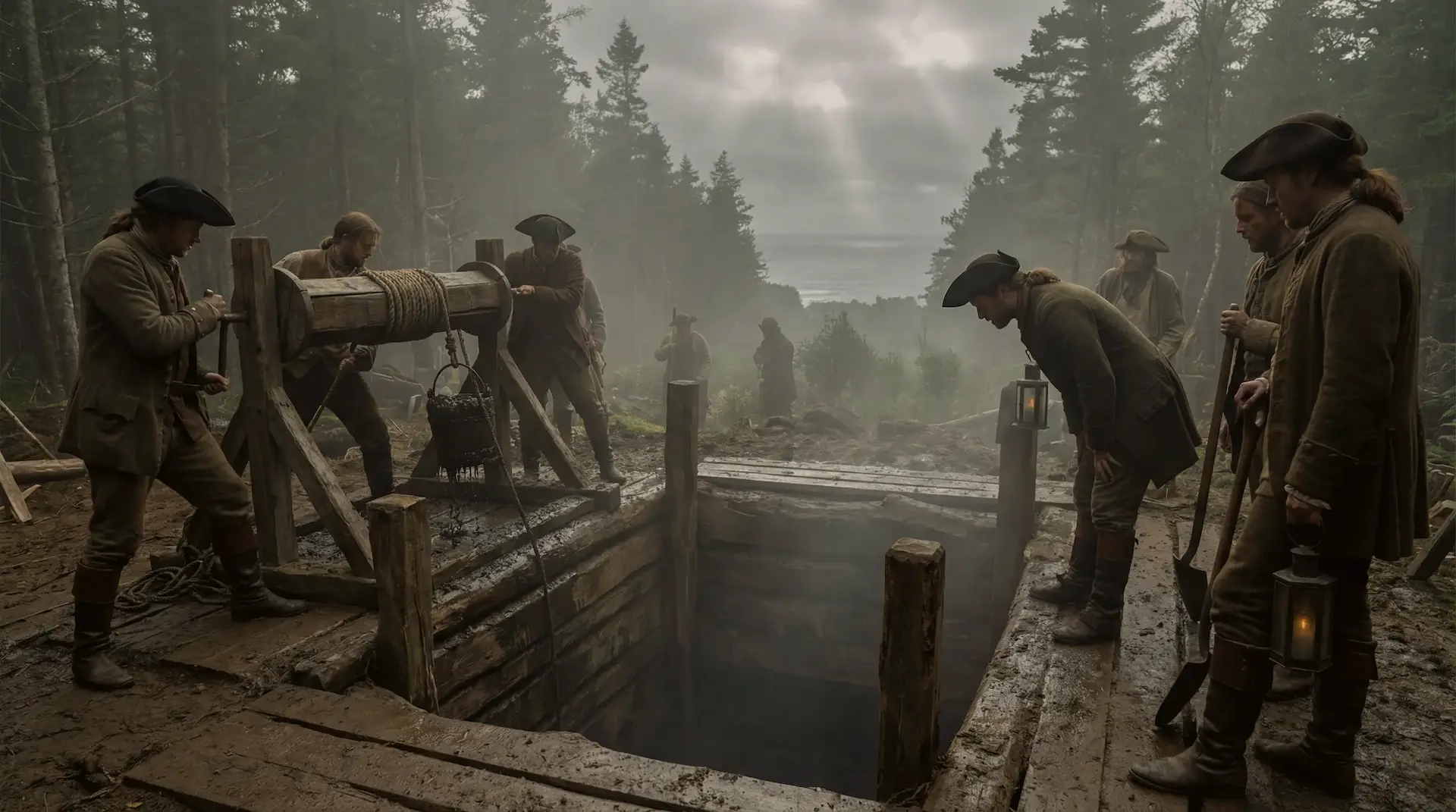 The MysteryThe Oak Island Money Pit→
Why the Search Turned to Old Wood
2 min
At Michel's suggestion, Spooner began examining buried timber more systematically. Wood can absorb and retain metals from surrounding groundwater. Its chemical composition may therefore preserve evidence of conditions it experienced while buried, making it a useful material to investigate alongside direct water samples.
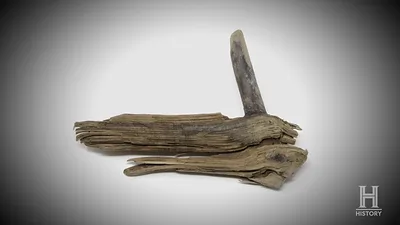
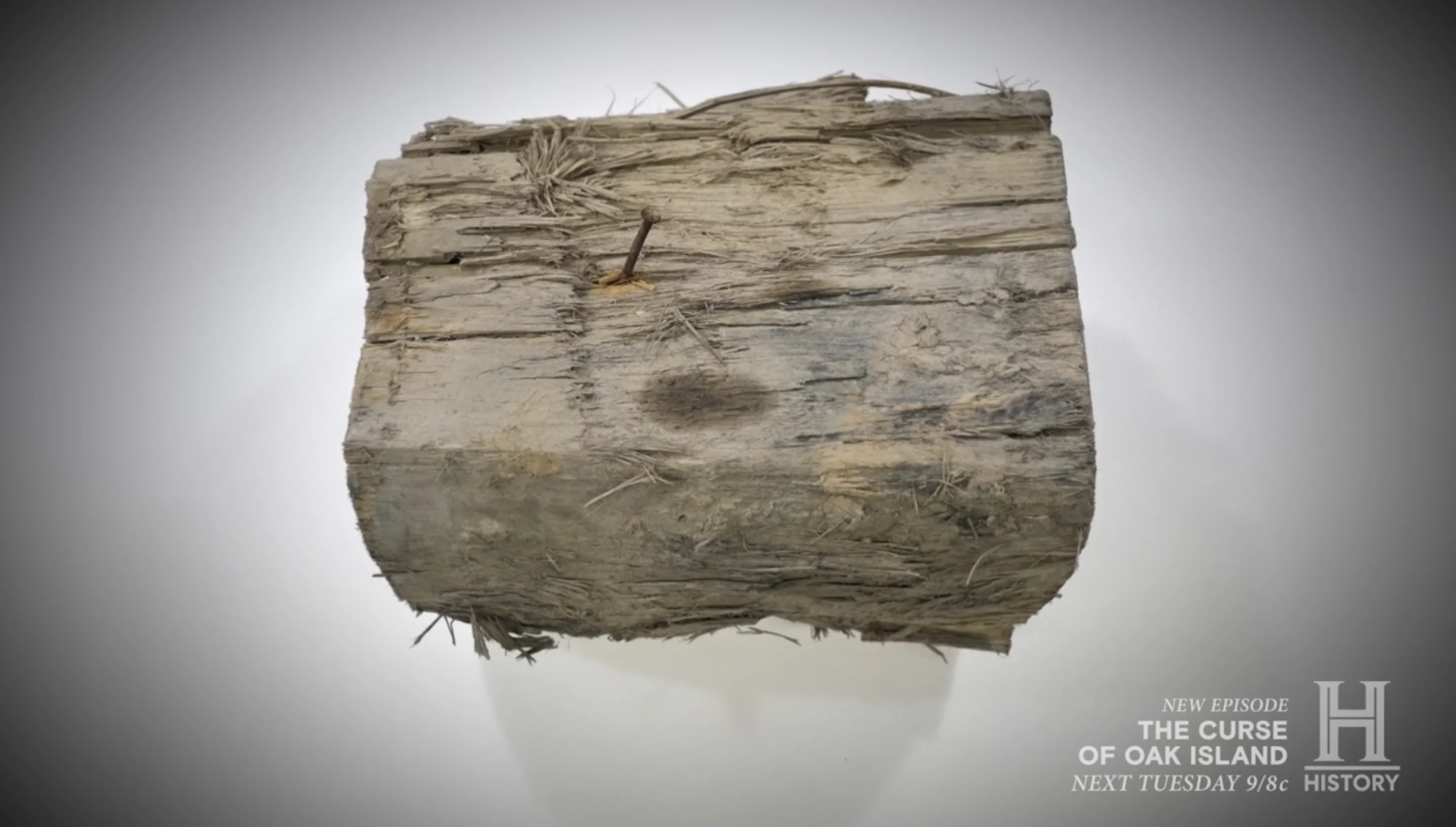
Fifteen timber samples from old shafts and tunnels in the Money Pit area were included in the testing programme. Wood recovered from Shaft 2A in 2024 produced the highest silver reading and the third-highest gold reading among those samples. Marty Lagina extended the programme to examine additional timber.
 Wood from 2A shaft→
The next reported result helped determine where the team would drill in the fourteenth season. In 2024, the RP1 caisson had intersected the remains of a tunnel excavated from Shaft 6 in 1861, at a depth of approximately 118 feet. RP1 had been positioned to investigate whether material from the Money Pit collapse might have entered that tunnel.
Tester later reported that a piece of wood recovered from the Shaft 6 tunnel had produced the highest gold reading of any timber sample tested in the programme. No numerical concentration was given. The first boreholes of Season 14 were therefore placed around RP1.
 Wood with the highest gold reading (Shaft 6 tunnel)→
One of those holes, L.25-11, recovered a solid piece of wood from 214 feet, near the bottom of the solution channel. The timber sank when placed in water, a characteristic that the late treasure hunter Dan Blankenship had associated with old wood.
Spooner examined the sample using a portable XRF analyzer and suggested that it had been exposed to metal-bearing water for an extended period. He said the result made him more comfortable with the possibility that the wood dated from between 1680 and 1700. That interpretation was not a direct scientific date for the timber. Its age would require independent chronological evidence. Part of the wood was sent for further gold and silver testing.
A second borehole, drilled near the presumed location of Shaft 6, encountered more timber between 136 and 144 feet, approximately 30 feet below the known bottom of the nineteenth-century shaft.
A Silver Reading Under the Lot 8 Boulder
1 min
Another silver result came from a different part of Oak Island. On Lot 8, a boulder weighing approximately 40,000 pounds had been found resting on a stone cradle. Spooner examined soil collected from beneath the structure during the following winter.
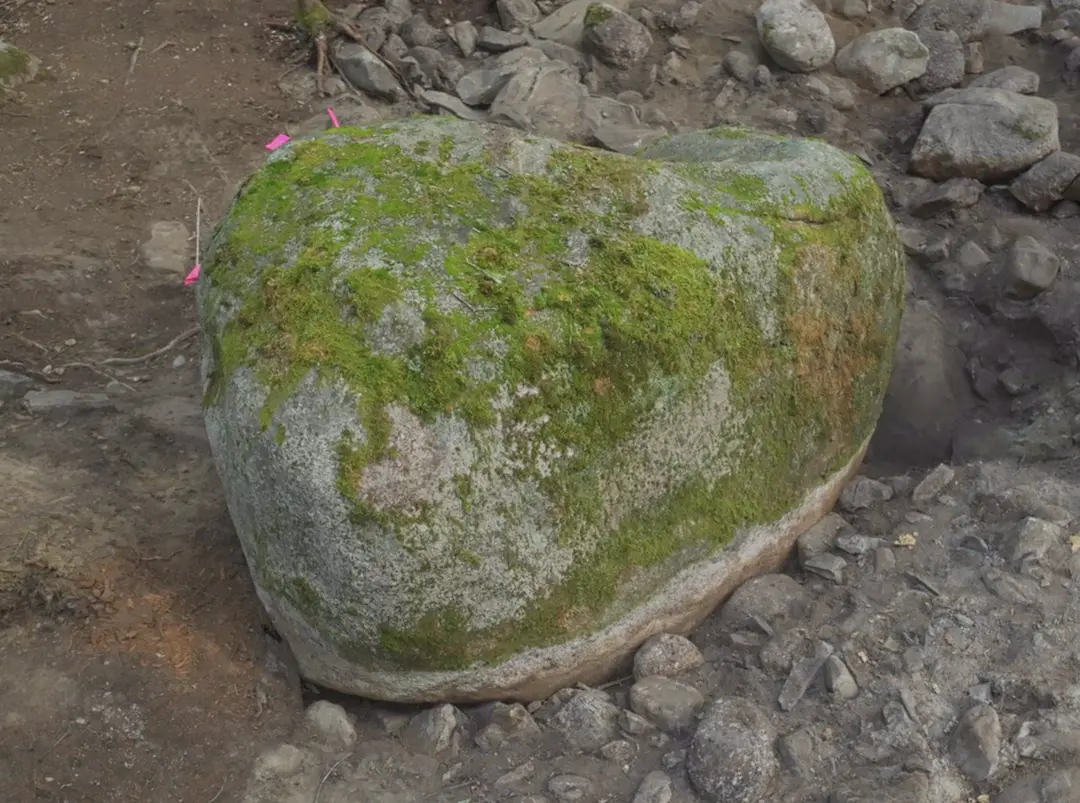 Lot 8 Giant Boulder→
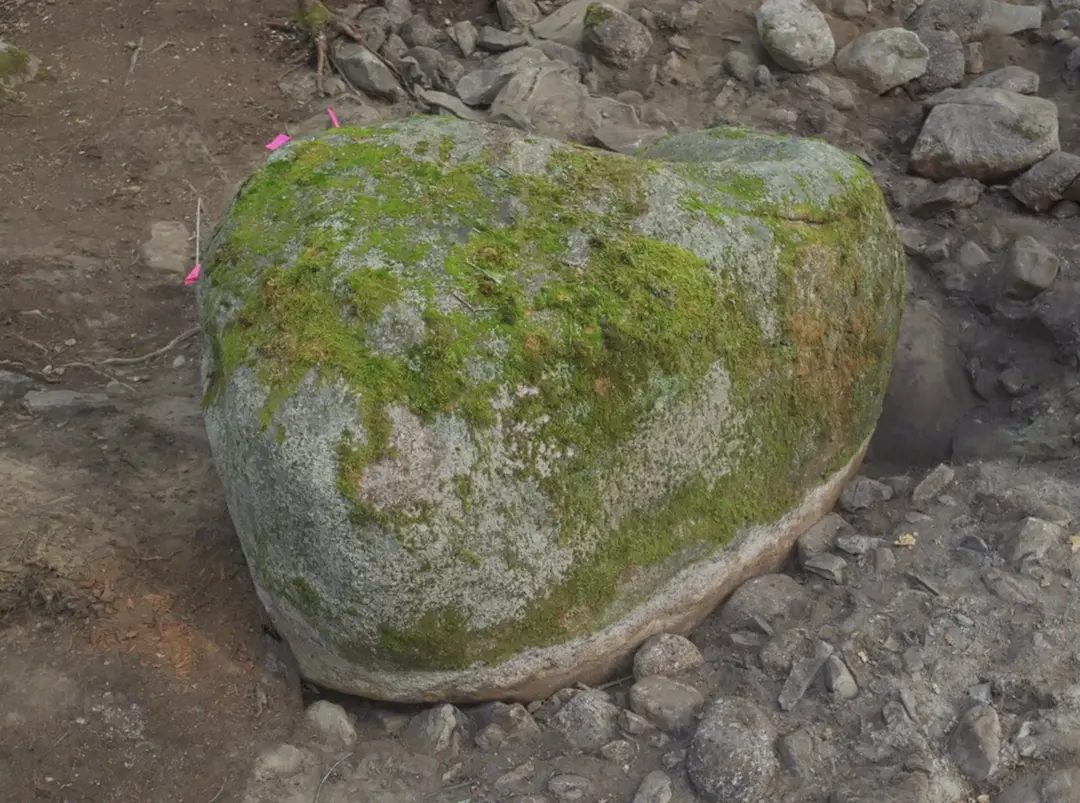 Large Boulder→
The organic layer produced a silver concentration of 0.56 parts per million, compared with a reported natural soil background of approximately 0.04 parts per million. According to Spooner, the reading was higher than any soil sample previously tested from the Money Pit or elsewhere on the island. He did not believe the local glacial till could account for the concentration and proposed that the boulder might have sealed or covered a source of silver-bearing material. Wood associated with mortar in the cradle was radiocarbon dated to a range between 1694 and 1726.
The team subsequently drilled cores beneath the structure to investigate whether a cavity or other feature lay below it. Drilling between approximately 10 and 30 feet encountered natural ground and bedrock beginning at around 13 feet, with no void identified. Samples of the gray soil recovered during the investigation were sent for further silver analysis.
The Lot 8 finding was separate from the cluster of gold and silver readings around the Money Pit. Its source had not been established by the reported testing.
How Mining Companies Use the Same Method
1 min
The groundwater investigation proposed by Spooner in 2020 has a recognised counterpart in mineral exploration. Water moving through rock and sediment can carry chemical traces of mineral deposits. By sampling groundwater across a region, geochemists can sometimes identify anomalies that suggest mineralisation hidden beneath the surface.
One well-documented example comes from Western Australia. In a study published in 2023, researchers including scientists from Australia's CSIRO examined the use of groundwater geochemistry for gold exploration in the northern Yilgarn Craton. The research drew on thousands of groundwater samples and included investigations at named gold deposits such as Agnew and Garden Well, near Laverton.
The researchers reported that elevated gold concentrations in groundwater could help identify areas of mineralisation, including deposits concealed beneath younger sediments. Some anomalies were recorded within approximately five kilometres of known deposits, illustrating both the usefulness of groundwater testing and the difficulty of determining a source from a single measurement.
Oak Island's investigations use a related approach on a much smaller scale. Spooner and Lukeman have tested hundreds of water samples from around the island. The main concentrations of precious-metal readings have been associated with the Money Pit area, although silver has also been reported at locations including the Lot 26 well and in soil beneath the Lot 8 boulder.
Spooner and his colleagues have interpreted the distribution of the readings, together with the historical excavation evidence, as supporting the possibility of buried metal associated with human activity. The groundwater measurements alone cannot distinguish treasure from every possible natural source. Their value lies in identifying patterns that can be investigated through further sampling and excavation.
What the Gold and Silver Tests Have Found
2 min
The scientific investigation has produced results from four principal kinds of material: water, metal, timber and soil. Each has been examined using different methods, at different times and for different purposes. The table below brings together the principal reported results, including the earliest historical account of gold in the Money Pit.
| First reported | Location | Sample | Result | Researcher or laboratory |
|---|---|---|---|---|
| 1897 | Money Pit, 153 feet | Drill bit | Traces of gold reported | Frederick Blair and William Chappell |
| 2021 | Wells WS-1, WS-2 and WS-9 | Water | Silver detected; copper and zinc approximately ten times the surrounding levels | Dr. Ian Spooner and Dr. Matt Lukeman |
| 2021 | Boreholes C-1, F-4, E-8 and K-7 | Water | Gold: 0.044 ppb in F-4, 0.024 in E-8, 0.017 in C-1 and 0.012 in K-7 | Queen's Facility for Isotope Research |
| 2021 | Borehole D-2, approximately 90 feet | Metal fragment | 0.068% gold, approximately 680 ppm | Dr. Ian Spooner |
| 2021 | Borehole D-2 | Particle adhering to metal | 65% gold, 26% copper and 5% silver | Dr. Christa Brosseau, Saint Mary's University |
| 2022 | TF1 shaft spoils | Two metal fragments | 0.035% and 0.022% gold | On-island XRF testing |
| 2023 | West of the Garden Shaft, approximately 80–120 feet | Water | Area of elevated gold and silver concentrations | Dr. Fred Michel |
| 2023 | Lot 26 stone well | Water | Silver detected | Dr. Ian Spooner |
| 2023 | Borehole DN11.5, approximately 90 feet | Wood | Gold detected | Emma Culligan |
| 2023 | Garden Shaft lining | Wood | Gold readings of 0.11% and 0.13% | Emma Culligan |
| 2026 | Boreholes I-9.5 and K-9.5, approximately 200 feet | Soil and clay | Elemental silver associated with clay particles | Dr. Ian Spooner and Emma Culligan |
| 2026 | Shaft 2A | Wood | Highest silver and third-highest gold readings among the fifteen reported timber samples | Dr. Ian Spooner |
| 2026 | Shaft 6 tunnel, recovered through RP1 | Wood | Highest reported gold reading in the timber programme; no numerical value given | Dr. Ian Spooner and the Oak Island team |
| 2026 | Lot 8, beneath the boulder | Soil | 0.56 ppm silver, compared with a reported background of 0.04 ppm | Dr. Ian Spooner |
Dates refer to when results were reported in the search, not necessarily when samples were recovered or analyzed. Measurements from different materials and instruments are not directly interchangeable.
Apart from the Lot 8 and Lot 26 results, the principal findings have come from the Money Pit area, the Garden Shaft and the solution channel beneath them. Water analysis identified the areas of greatest interest, metal and wood samples provided further measurements, and the later soil tests directed attention towards the deeper ground.
In November 2026, the team was drilling around RP1, close to the remains of the nineteenth-century Shaft 6 tunnel. Wood recovered from 214 feet had been sent for further testing. The results of that work were still to come.
Sources
1 min
The Scientists in Their Own Words
- Julie Brown, Q&A: Using science to uncover a potential gold mine, interview with Prof. Peir Pufahl, Queen's Gazette, Queen's University, November 2021.
- Queen's Facility for Isotope Research, Water Chemistry 2021, results slide presented to the Oak Island team.
- Blair Crawford, Still waters run deep, profile of Dr. Ian Spooner, Queen's Alumni Review, May 2026.
- Jerry Brown, report on the interview of Dr. Ian Spooner and Dr. Matt Lukeman by Jeff Freeman and Tom Burns on the JFree906 podcast, Monsters and Critics, August 2024.
Groundwater in Mineral Exploration
- N. Reid, C. Plet, R. Thorne, A. Hunt, J. Hille, R. Noble and D. Gray, Gold exploration using groundwater in Western Australia, Geochemistry: Exploration, Environment, Analysis, 2023.
- Mindat.org, Garden Well Gold Mine, Laverton Shire, Western Australia.