Oak Island's Solution Channel: The Void Beneath the Money Pit
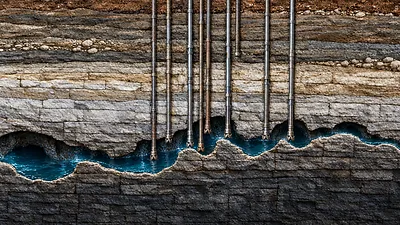
Oak Island's solution channel is a void of loose, water-filled rock beneath the Money Pit, traced...

Dug 1861 by Oak Island Association, 118 ft
Lateral tunnel at 118 ft flooded; Money Pit cribbing and platforms collapsed (bottom sounded at 102, previously 88). Artifacts washed in with the inrush.
Positions on the map are approximate; each dot marks the top of the hole.
 Coconut fibre (Money Pit) →
 Rows are in depth order; the column on the left is the hole, and a figure between rows is the stretch with nothing logged. Depths as reported by each source.
The Oak Island Association, formed by veterans of the earlier Truro Company, came to the island in the spring of 1861 with sixty-three workmen and thirty-three horses, Jotham McCully, who had directed the 1849 drilling, among them. Sullivan records that the men recribbed the Money Pit to 88 ft, then sank a dry shaft 25 ft east of it to 120 ft looking for the flood tunnel. George Mitchell, the superintendent, fell back on the old method: a shaft beside the pit and a tunnel in from below.
Crooker and Clarke, following McCully, put that shaft 18 ft west of the Money Pit; Finnan says about 18 ft south; Fanthorpe a few feet west; Sullivan folds it into the east shaft; and a sketch by Erwin Hamilton, the searcher of 1938 to 1943, places an 1861 shaft about 25 ft south. It went to 118 ft, deeper than any hole on the island before it, and a tunnel 4 ft high and 3 ft wide ran 17 ft from its bottom toward the pit. McCully wrote a year later that it entered the Money Pit a little below the lower platform and was driven on, unwisely, until the water started.
A horse gin could not keep up, and within three days water was seeping through the Money Pit floor. Mitchell rigged bailing casks over all three shafts and ran men and horses in shifts from Tuesday morning to late Thursday, bringing the water down to 82 ft. Then the tunnel choked with clay. Two men sent to clear it heard a crash above and ran ahead of a wall of mud; Crooker records seven feet of it in the shaft within three minutes. Sullivan has the final fall on Saturday, while the men were at supper: the bottom of the Money Pit dropped and the cribbing followed, plank by plank, until the pit was a ruin. Samuel Fraser, a foreman who had refused to go down after inspecting the tunnel, wrote in 1895 that 10,000 board feet of lumber went in and the water boiled like a volcano.
The mud carried things out. A digger quoted in the Novascotian that September described an oak stick three and a half feet long, black with age and worked with tools, which the Association cut into walking canes. There was the bottom of a small yellow-painted keg, a spruce slab with an auger hole, and in McCully's list oak chips, manila grass and coconut fiber. The measured bottom had gone from 88 ft to about 102 ft, and Crooker records the Association's reasoning: the two casks drilled through at 98 to 105 ft in 1849 had slid toward the tunnel to about 119 ft.
That fall the Association set up a steam pump. Crooker and Sullivan quote E. H. Owen of Lunenburg, writing in 1868: the boiler burst and one man was scalded to death. Clarke found the Association's own letter to a newspaper admitting only three men slightly scalded; the island memorial lists the dead man as Unknown. The sources tie the explosion to the pumping after the collapse, not to the shaft. Finnan alone dates the shaft and the collapse to the Truro Company a decade earlier.
The show treats Shaft 6 as a fixed point near the Money Pit. In Season 6 borehole S-6 met hand-cut oak, leather and chain at 101 to 111 ft; in Season 7 Hamilton's survey map guided caisson 8-A to ax-cut timbers; and in Season 12 the RP caissons cut the shaft's north corner and recovered a barrel stave the team linked to the keg of 1861.
The record supports a shaft and tunnel that undermined a pit already weakened by three earlier tunnels, and a collapse that dropped its contents 14 ft or more. What those contents were rests on the 1849 drill log and the fragments in the mud. Whether chests slid toward this tunnel, or there were none, the collapse closed the question without answering it.




As an Amazon Associate I earn from qualifying purchases.
Oak Island's solution channel is a void of loose, water-filled rock beneath the Money Pit, traced...

An equilateral triangle of beach stones on the south shore, first found in 1897, pointed due nort...
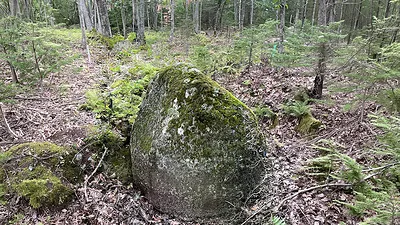
A professional surveyor found five ten-ton boulders forming a precise cross. Two men spent decade...