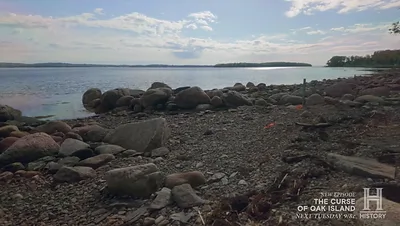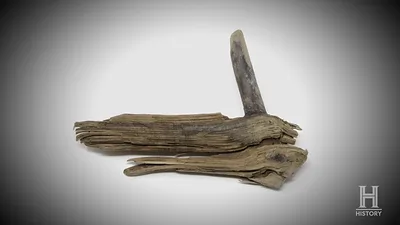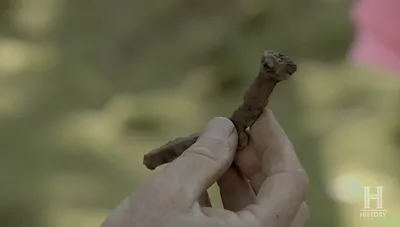
The coin that reached Emma Culligan's laboratory on Oak Island was only a quarter of a coin: a dark wedge of metal, cut long ago from something larger. Metal detection expert Gary Drayton had found it on Lot 4. It showed no date, no portrait and no lettering.
Culligan put it through two machines. The first identified silver and chlorine on the surface, evidence that the fragment had spent time in salt water. The second, a CT scanner capable of looking through corrosion, revealed faint engraving and four letters: GVLI.
They were the beginning of GVLIELMVS, the Latin form of William. The fragment was part of a shilling of King William III of England, struck in the 1690s, most likely in 1697.
 William III sixpence, 1697-1701 (Lot 18)→
In earlier years, examining a find like this would have meant sending it away for specialist analysis. Now much of that work can be done on Oak Island itself.
Since 2022, the island has acquired a scientific laboratory with three sophisticated X-ray instruments and an archaeometallurgist trained to use them. The facility can reveal inscriptions hidden beneath corrosion, examine the composition of centuries-old metals and help distinguish a potentially historic discovery from the debris left by earlier treasure hunters.
The machines cannot say who brought William III's shilling to Oak Island, or why it was cut into quarters. But they can answer questions that the searchers once had little hope of settling without outside help.
The Laboratory Changing the Oak Island Treasure Hunt
2 min
For most of the modern treasure hunt, scientific analysis meant sending finds away. Lead went to universities for isotope testing, wood went to specialist laboratories for radiocarbon dating, and results came back weeks or months later. On the island itself, the archaeologists and geoscientist Dr. Ian Spooner had an XRF analyzer, an instrument that identifies the elements in a metal surface, which they operated in a trailer beside the dig.
That began to change during the ninth season of The Curse of Oak Island, when a team from Bruker, an American maker of scientific instruments, installed a SkyScan 1273 CT scanner at the Oak Island Interpretive Centre.
The machine was designed to examine objects rather than patients. It could see beneath layers of rust and corrosion without cutting into the artifact, producing three-dimensional images of details that might otherwise remain hidden.
Two more instruments followed. The island now has a Bruker M4 Tornado, which maps the elements across an object's surface, and a D2 Phaser, which identifies crystalline materials such as those found in mortar, clay and stone.
The laboratory has its own name: Oak Island Materials and Archaeological Services, or OIMAS. A non-profit based at 5 Oak Island Drive in Western Shore, Nova Scotia, it describes itself as the only laboratory in Atlantic Canada offering all three kinds of analysis. It also calls itself, in its own words, "rurally based and all-female driven".
The biggest advantage is not simply what the machines can detect. It is where they are.
On a conventional excavation, an artifact may be collected, catalogued and sent away for analysis after the digging season has ended. By the time the laboratory report arrives, the trench may already have been closed. At Oak Island, many results can be obtained while work in the same area is still underway, allowing the team to use new information to guide further excavation.
The contrast is apparent when a discovery requires analysis that cannot be done on the island. Radiocarbon dating at Beta Analytic, the Florida laboratory used by the team, can take up to 14 business days at its standard rate, excluding shipping. Laser ablation results from a lead bag seal found on Lot 32 did not reach the team until the following year.
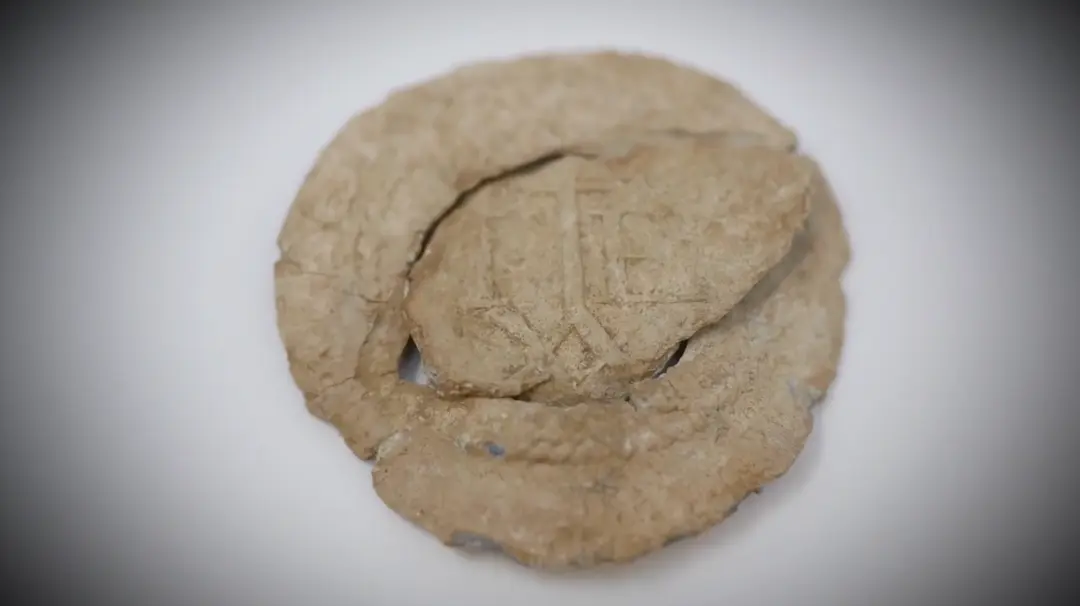 Lead Bag Seal - Norwich Cloth→
For the finds that can be examined at OIMAS, the wait can be considerably shorter.
Meet Emma Culligan, the Woman Behind the Machines
1 min
Emma Culligan joined the Oak Island team at the beginning of its tenth television season, in November 2022. Archaeologist Laird Niven, who leads the island's archaeological work, introduced her as the specialist who would operate the new CT scanner.
Culligan had studied both engineering and archaeology, a combination she described to the assembled team as "a niche I wanted to create for myself".
Her specialism is archaeometallurgy: the study of how people in the past produced, alloyed and worked metal. At Memorial University of Newfoundland, a professor steered her towards metallurgy. As she explained on The Curse of Oak Island & Beyond Podcast in May 2023, she subsequently spent years examining iron using a scanning electron microscope.
Her arrival on Oak Island was not entirely straightforward. According to Sky HISTORY, the show's British broadcaster, a friend connected with the production initially had her in mind for a position as a personal assistant. Niven saw her qualifications and put her in charge of the instruments instead.
She has remained with the team ever since, appearing throughout the fourteenth season of The Curse of Oak Island, which began in November 2026.
Her work complements Niven's. The archaeologist examines an object to identify its likely purpose: a latch, a button, a bag seal or a piece of hardware. Culligan investigates its materials, how it was manufactured and what those characteristics may reveal about its age.
An object that looks like an ordinary piece of corroded iron may contain evidence of a much older manufacturing technique. A button too worn to show its decoration may still carry an invisible pattern in the distribution of its metals.
 Ornate Floral Button→
Neither the appearance of an artifact nor its chemical composition necessarily tells the whole story. Combining the two gives the team a stronger basis for understanding what has been found.
What the Machines Have Found That the Eye Could Not See
2 min
The small copper-alloy disc found on Lot 5 offered little to identify it. Corrosion obscured its surface, making the details needed to date it difficult to see.
Inside the laboratory's CT scanner, however, a standing figure and workshop mark appeared on one side. On the other was a crowned bust with a sharp nose and pointed chin. Culligan attributed the coin to Claudius II, who ruled the Roman Empire from AD 268 to 270.
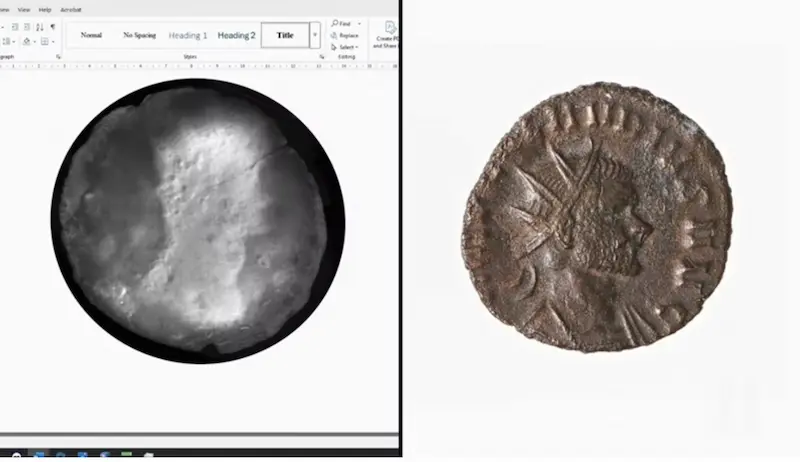 Roman coin (Claudius II), 268-270 AD (Lot 5)→
The scanner had not removed the corrosion. It had looked through it.
Bruker's SkyScan 1273 takes hundreds of X-ray images as an object rotates, combining them into a three-dimensional model that can be examined layer by layer. According to Bruker, it can resolve details smaller than three micrometers, far finer than a human hair.
The same instrument has revealed Roman numerals stamped into a musket fitting, the loops of knitted wool in a scrap of textile and a touch hole in a rusted iron tube from the western swamp, identifying the tube as part of a hand cannon.
There are physical limits to what it can accommodate. Bruker's specifications allow for an object approximately 20 inches long and 12 inches across, weighing up to 44 pounds. When an encrusted lump recovered from the shore proved too large for the scanner, the team had to remove the concretion with a hammer and chisel. Inside was a cast-iron stove door.
The second instrument, the Bruker M4 Tornado, examines an object in a different way. It uses X-ray fluorescence, or XRF, to identify the elements present on a surface. Unlike a handheld analyzer, it can scan point by point and produce a map showing where particular elements are concentrated.
That ability has revealed decoration no longer visible to the naked eye. When the laboratory examined a corroded button, an elemental map brought out a floral pattern concealed beneath the damaged surface.
Other objects can be assessed by comparing their chemical composition with known examples. The Pitblado coin, reportedly recovered during Money Pit drilling in 1849 by foreman James Pitblado and preserved by his family, was brought to the laboratory for examination.
Culligan measured its silver composition and found it consistent with known examples of the Portuguese tornês, a coin struck during the reign of King Ferdinand I in the fourteenth century.
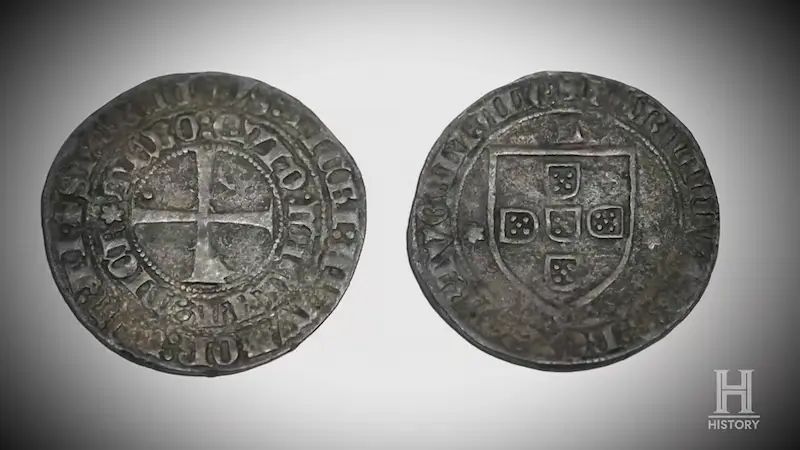 Portuguese Tornes, 1369-1371 (Pitblado coin)→
The third instrument, the Bruker D2 Phaser, uses X-ray diffraction, or XRD. Whereas XRF identifies the elements in a material, XRD identifies the crystalline substances those elements have formed.
That makes it particularly useful for examining mortar, concrete, clay and stone, where the minerals present can offer clues about manufacture and origin.
All three instruments can perform their analyses without cutting a sample from the object being examined.
The Science That Rules Out Treasure
2 min
Not every laboratory result points towards an ancient discovery. Some of the most useful findings establish that an object belongs to a much more recent period.
Oak Island has been occupied, farmed and repeatedly excavated for more than two centuries. Generations of residents and treasure hunters have left nails, tools, machinery, building materials and other debris. Separating those objects from potentially earlier activity is one of the laboratory's most important jobs.
A piece of concrete from Smith's Cove, for example, contained portlandite, a mineral associated with Portland cement. Its presence supported an identification with more recent construction rather than an ancient structure.
A piece of hammered silver contained aluminum, which Culligan interpreted as evidence of modern manufacture. Iron rod recovered from deep in the Money Pit was dated to the middle or later nineteenth century, linking it to the activities of earlier treasure hunters rather than the island's more distant past.
Chemical composition can also offer clues about the period in which a metal was manufactured.
One element Culligan frequently examines is manganese. Its deliberate use in iron production became more common during the nineteenth century because it helps counteract the brittleness caused by sulfur. The relationship between manganese and sulfur can therefore provide evidence about the methods used to produce an iron object.
She has also discussed the historical use of arsenic in copper alloys and the significance of phosphorus-rich iron, which she associates with certain English ores and earlier manufacturing techniques.
These are clues rather than precise dates. Metal composition depends on raw materials, manufacturing processes and recycling, and a particular elemental reading does not automatically establish when an object was made.
The laboratory's conclusions are often expressed as broad periods: eighteenth century or earlier, for example, or sometime between the Middle Ages and the mid-nineteenth century.
Even when an object's manufacturing period can be estimated, that does not establish when it arrived on Oak Island.
Culligan has developed a collection of reference readings that allows new finds to be compared with artifacts of known origin. When iron recovered from the Maine birthplace of William Phips, the seventeenth-century treasure hunter and colonial governor, was tested using the same equipment, she reported a match with a latch found in the stone feature on Lot 5.
Such comparisons can point towards similarities in materials and manufacture, though they do not by themselves establish that two objects shared an owner or a common journey.
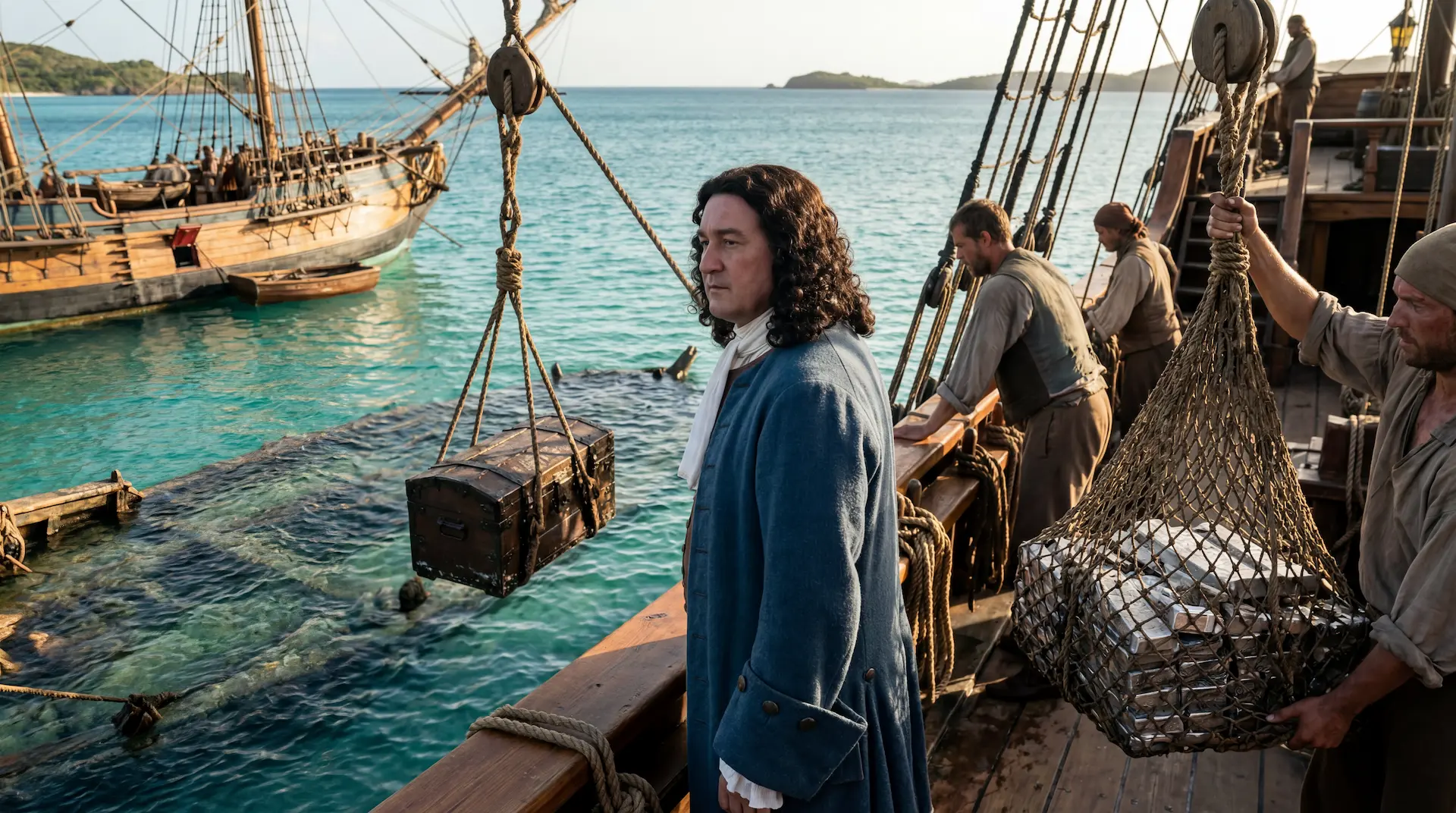 The TheoriesWilliam Phips, the Treasure of the ConcepciónA shepherd boy from Maine raised a sunken Spanish fortune and became governor of Massachusetts.→
Other results have generated more tantalising questions.
In 2023, XRF mapping of timber from the inner lining of the Garden Shaft, in the Money Pit area, produced a reading of 0.11 percent gold. A second sample returned 0.13 percent.
Rick Lagina responded by asking for wood from every borehole to be tested in the same way.
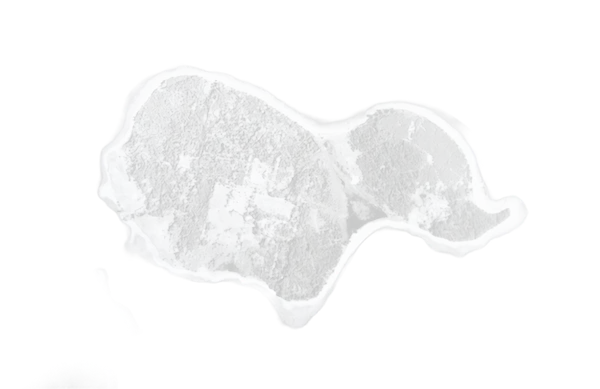 Wood from 2A shaft→Gold traces in water samples→
The readings established that the scanned areas contained a measurable gold signal. They did not establish the source of that gold or demonstrate the presence of buried treasure. Those questions require further evidence.
When a Mysterious Cross Turns Out to Be a Fence
2 min
OIMAS does not work exclusively on Oak Island discoveries. Its website offers analytical services to researchers, conservators and members of the public, and in 2026 the laboratory published two case studies that illustrate how easily an unfamiliar object can be misidentified.
One concerned a hollow iron ball, approximately eight inches across, found protruding from the ground near the shoreline in Shelburne County, Nova Scotia.
Its appearance invited questions about what it might once have contained or how it had reached the site.
The laboratory examined the ball with its CT scanner, tested metal scrapings and analyzed seven soil samples taken from the location.
The results showed welded low-carbon steel, salt contamination on the exterior and relatively clean metal inside. No trace of explosives was detected.
The laboratory concluded that the object was a marine buoy dating from around the middle of the twentieth century.
Another case began with a small cross found six inches beneath beach sand in Pender Harbour, British Columbia. Its finder wondered whether it might be a crucifix.
The CT scanner showed something considerably less mysterious: two lengths of round wire welded at right angles, with broken ends. The laboratory identified the object as a fragment of factory-made wire fencing.
The value of the analysis was not that it uncovered a remarkable historical object. It was that it replaced speculation with a testable explanation.
The laboratory has also undertaken more conventional archaeological research. At the Canadian Archaeological Association's annual meeting in May 2026, Culligan, OIMAS colleague Jillian Parsons and archaeologist Fiona Steele presented a study of two small clay figurines discovered on the bank of the LaHave River in Nova Scotia.
The finds came from an area near the fort established by the French commander Isaac de Razilly in 1632. Using all three instruments, the researchers examined the figurines' composition and firing characteristics.
The results were most consistent with earthenware of the seventeenth or eighteenth century, though the researchers left open the possibility of other origins.
These outside projects demonstrate the same principle that applies on Oak Island: scientific instruments can narrow the possibilities, but a conclusion must still be weighed against archaeological and historical context.
What Makes Oak Island's Laboratory So Unusual?
2 min
The facilities on Oak Island become more striking when compared with the laboratories serving some of the world's best-known archaeological excavations.
At Jamestown in Virginia, the first permanent English settlement in America, archaeologists have excavated continuously since 1994. Its conservation facilities are extensive, but specialist equipment has not always been available on site.
Before Jamestown acquired its own X-ray machine in 2009, corroded iron objects were sent to a NASA laboratory in Hampton or to Colonial Williamsburg for imaging. In 2024, the excavation announced new handheld XRF and laser-analysis equipment.
CT scanning has required outside assistance. In 2015, when archaeologists recovered a sealed silver box and a block of soil containing silver from graves in the fort's church, two staff members took the finds to Cornell University in New York. The box subsequently went to General Electric for a more powerful scan.
Ferryland in Newfoundland, an English colony founded in 1621, has produced more than a million artifacts. It maintains an on-site conservation laboratory for cleaning, stabilizing and cataloguing finds, while specialist metal analysis, including research into slag from its seventeenth-century blacksmith's forge, has been carried out at Memorial University in St. John's.
At Vindolanda, the Roman fort beside Hadrian's Wall in England, researchers have used portable XRF to examine soils, with further laboratory analysis undertaken at Teesside University.
Pompeii has maintained an Applied Research Laboratory since 1994, with portable equipment for use around the archaeological park and collaborations with around 20 universities and research institutes.
In Canada, comparable techniques are available at selected universities and at the Canadian Conservation Institute in Ottawa. The institute serves many museums and projects, and warns that applications for scientific services may be declined when laboratory workloads are too high.
These institutions have different responsibilities and access to broader networks of expertise. Oak Island's distinctive advantage is the combination of CT scanning, elemental mapping and X-ray diffraction at the excavation site itself, operated by a specialist working directly with its archaeological team.
That arrangement makes it possible to examine a find while the circumstances of its discovery are still fresh and, when necessary, to use the results to inform the continuing search.
The Questions Science Still Can't Answer
1 min
For all its equipment, the Oak Island laboratory cannot answer every question put to it.
Some problems require techniques unavailable on the island. To investigate the geological source of lead, researchers examine its isotopic composition, which can sometimes be compared with known ore deposits.
That work has been undertaken at the University of New Brunswick, where earth sciences professor Dr. Chris McFarlane operates a laser ablation laboratory. The technique removes a minute quantity of material for analysis, leaving a mark too small to be readily visible.
McFarlane's laboratory was responsible for isotope measurements on the lead cross recovered from Smith's Cove.
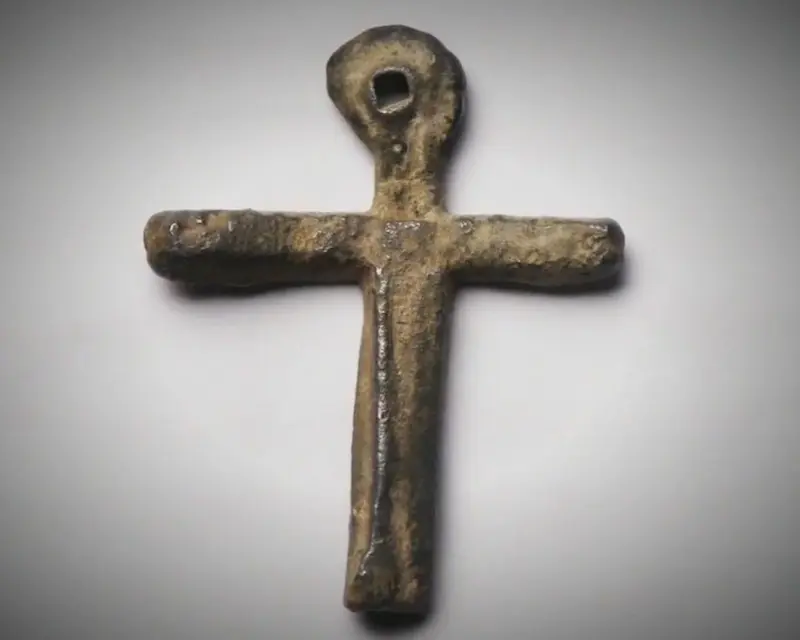 Lead cross→
For closer examination of a metal's microscopic structure, samples can be sent to Saint Mary's University in Halifax, where chemist Dr. Christa Brosseau works with a scanning electron microscope capable of magnifications up to 200,000 times.
Wood, charcoal and bone still go to specialist facilities for radiocarbon dating, a technique that addresses questions beyond the capabilities of the island's three X-ray instruments.
There is also a more fundamental limit to what any laboratory can establish.
A coin can be identified and dated. Its composition can be compared with known examples. Corrosion can provide evidence about the conditions it has experienced. None of those findings necessarily reveals who possessed it, when it was lost or why it was deposited in a particular place.
The quartered coin from Lot 4 can now be identified as a shilling of William III, most likely struck in 1697. The letters hidden beneath its corrosion have given the searchers an answer they could not obtain simply by looking at it.
But the laboratory cannot tell them who carried the coin to Oak Island, or why it ended up cut into pieces.
That remains another kind of mystery.
Sources
1 min
The Laboratory
- Oak Island Materials and Archaeological Services (OIMAS), Who We Are, About and Our Services, oimas.ca.
- Oak Island Lab (OIMAS), Case Study: A corroded metal sphere is discovered near the shoreline in Shelburne County, Nova Scotia, March 2026.
- Oak Island Lab (OIMAS), Case Study: A cross-shaped artifact pulled from the sand in Pender Harbour, British Columbia, provokes intrigue, April 2026.
- Emma Culligan, Jillian Parsons and Fiona Steele, Using X-ray Instrumentation to Find Contextual Clues: A Case Study of Artifacts from the LaHave River, Nova Scotia, Canada, poster, Canadian Archaeological Association Annual Meeting, May 2026.
The Instruments
- Bruker, SKYSCAN 1273: High-Capacity 3D X-ray Microscopy, product specifications, bruker.com.
Emma Culligan
- Sky HISTORY, Who is Emma Culligan? Unveiling her role in Oak Island's secrets, history.co.uk.
- Tom Burns (host), The Curse of Oak Island & Beyond Podcast, interview with Emma Culligan, May 2023.
Other Excavations and Laboratories
- Jamestown Rediscovery Foundation, New technology solves lingering questions in Jamestown collection, press release, March 2024.
- Jamestown Rediscovery, dig update, historicjamestowne.org, January 2013.
- Krishna Ramanujan, Cornell technology identifies artifacts in Jamestown graves, Cornell Chronicle, August 2015.
- Cathy Mathias, The Impact of Conservation on an Archaeological Site in Ferryland, Newfoundland, Material Culture Review.
- Cathy Mathias, Matthew Carter, Barry Gaulton and Mike Tubrett, Metallurgic Analysis of Slag Samples from a Seventeenth-Century Blacksmith Shop in Ferryland, Newfoundland, Material Culture Review.
- Rhys Williams, Developing pXRF soil analysis of preservation at Vindolanda, doctoral thesis, Teesside University.
- Archaeological Park of Pompeii, Applied Research Laboratory, pompeiisites.org.
- Canadian Conservation Institute, Government of Canada, Scientific services and Assessment of service requests, canada.ca.
- Beta Analytic, AMS Lab Dating Services, radiocarbon.com.
Outside Laboratories
- University of New Brunswick Newsroom, UNB researchers have moment in the spotlight on History Channel show, November 2018.