
About This Artifact
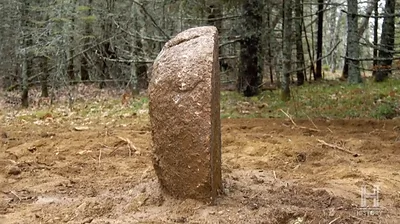
When Fred Nolan's crew rolled over the granite boulder at the end of the south arm of the cross formation, lettered B on his plot plan, they found the remains of a wrought iron stove beneath it, along with small beach stones. John C. O'Keefe of East Uniacke, who worked with Nolan on the island, told Crooker that they moved the boulder with a bulldozer and backhoe, that pieces of an old pot-bellied stove lay directly underneath, that the pieces were bevelled so the stove type was clear as they dug them up, and that further digging produced more pieces and other items including knives and forks. O'Keefe could not account for how a boulder of that size had come to rest on top of the material. Crooker notes that O'Keefe did not know about the cross configuration at the time of the interview. Pot-bellied stoves of cast or wrought iron were common in Nova Scotia from the early nineteenth century, which places the deposit within the farming period of the Graves and Sellers families unless the boulder was moved more than once. The cutlery invites comparison with the dishes and cutlery Nolan found at Joudrey's Cove. The stove pieces were not retained for analysis as far as Crooker records.
Historical Context
William S. Crooker, Oak Island Gold (1993), chapter 23; interview with John C. O'Keefe
Where It Was Found
Found Beneath the granite boulder at the end of the south arm of the cross formation (Cone B on Nolan's plot plan). Location: Oak Island, Nova Scotia, Canada.