About This Structure
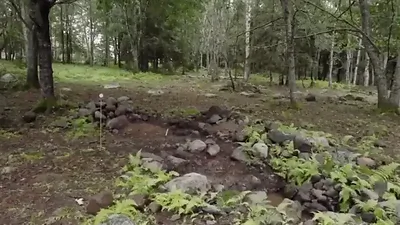
A formation of six large cone-shaped boulders arranged in the shape of a cross, discovered in 1981 by Fred Nolan, a surveyor and Oak Island landowner. Nolan, who surveyed every feature of his property with precision, noticed emerging geometric patterns along his sight lines and investigated the intersection points, where he uncovered the boulders. The cross measures 360 feet wide by 867 feet tall, oriented northeast to southwest. Five boulders were labelled Cones A through E, with a sixth boulder at the centre bearing features described as a carved human face and sword image, traits associated with Templar tomb effigies. None of the boulders were found seated in glacial till, indicating they are not in natural positions deposited by glaciers but were deliberately placed by human hands. Fred Nolan found items beneath Cone B, including pieces of a wrought iron stove and cutlery, though their current whereabouts are unknown. In Season 10, the team visited archaeoastronomer Professor Adriano Gaspani in Italy.
Gaspani identified six stars that aligned with the positions of the Nolan's Cross boulders and dated their placement to approximately 1200 AD. In Season 11, Gaspani extended his analysis to the five stone cairns on Lot 15, concluding they were likely constructed by the same group of people around the same period. The dating coincides with the carbon dating of the paved area in the swamp, also dated to the 1200s, and with Zena Halpern's theory that Templar knights made voyages to Oak Island beginning in 1179 AD. The formation is not unique. At Temple Beeld on the North York Moors in Yorkshire, England, five megaliths stand in a configuration that mirrors the Oak Island boulders. The Temple Beeld formation measures approximately 100 feet by 57 feet, with the central stone offset from the geometric centre, exactly as on Oak Island. The land on which Temple Beeld stands was held by the Templar knight William de Villiers, documented Templar property.
The arm angles of the Temple Beeld formation have been measured: the vertical axis runs at approximately 150 degrees from north, with the arms opening at approximately 60 and 150 degrees from the axis. These measurements are, within the margin of error imposed by centuries of weathering, identical to the corresponding angles of the Oak Island formation. Two megalithic formations on opposite sides of the Atlantic, same number of stones, same angular geometry, same off-centre placement of the central stone, one on confirmed Templar land in England.
Researcher Brian Pharoah identified sacred numbers in the cross's proportions: 144, 288, 360, 432, 740, and 864. He demonstrated that these figures appear in the construction measurements of Chartres Cathedral, Rosslyn Chapel, and the Temple Mount in Jerusalem. Pharoah concluded that the cross functions as an astronomical calendar aligned with equinoxes and solstices, with the constellation Cygnus and its Northern Cross asterism playing a prominent role. Norwegian researcher Petter Amundsen projected the Kabbalistic Tree of Life onto Nolan's Cross and found the distances between boulders matched the corresponding Sephirots, discovering buried flat stones at the Kingdom (Malkuth) and Victory (Netzach) points.
Norwegian researcher Petter Amundsen proposed in 2003 that the five boulders of Nolan's Cross correspond to five of the ten Sephirots on the Kabbalistic Tree of Life. In his projection, Cone A aligns with Kether (Crown), Cone B with Chokmah (Wisdom), Cone C with Binah (Understanding), Cone D with Tiphereth (Beauty), and Cone E with Yesod (Foundation). The remaining five Sephirots would occupy positions beyond the visible cross. With permission from David Tobias of the Triton Alliance, Amundsen visited the island and found buried flat stones at the positions corresponding to Malkuth (Kingdom) and Netzach (Victory), stones that had not been previously recorded. He concluded that the cross and the Tree of Life are a single unified design, a symbol consistent with the Rosicrucian tradition of merging Christian and Kabbalistic imagery. Amundsen identified the Chesed (Mercy) point, located in the swamp, as the most significant position on the projected Tree, a conclusion he connected to coded references in the works attributed to Shakespeare. His research was first published in 2006 through the book Organisten (The Organist) by Norwegian novelist Erlend Loe, later republished in English as The Seven Steps to Mercy.
William S. Crooker, who surveyed the formation with Nolan in 1992, describes it as five cone-shaped boulders lettered A to E plus the sandstone Head Stone at the intersection of the arms and the stem, not six cones; the Head Stone differs in material and shape from the granite cones. Crooker also records that Nolan had planned a shaft at the cheek of the Head Stone, below the point of the carved dagger, and had referenced its original position with an iron bar.Historical Context
Fred Nolan
Where It Was Found
Found at Island interior. Location: Oak Island, Nova Scotia, Canada.