About This Artifact
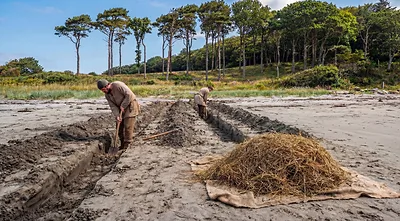
A clay pipe bowl fragment was recovered from the cobblestone pathway in the uplands near Lot 13 during Season 8 filming. Rick Lagina joined Dr. Aaron Taylor and archaeologist Miriam Amirault on the excavation, which followed the pathway as it ran diagonally uphill away from the swamp. In the same pass Rick recovered a piece of annular ware pottery from the early 1760s and an intact creamware plate base that Taylor dated to approximately 1763, the period when the British introduced the refined lead-glazed earthenware to Nova Scotia.
Clay pipe bowls are used in colonial archaeology to date the contexts in which they appear. Bowl shape, rim form, and decoration evolved through distinct phases between the 1620s and the 1850s, and English and Dutch maker catalogues record many of the workshop styles. The presence of this bowl alongside the annular ware and creamware suggests deposition in the mid-eighteenth century, consistent with the period when the cobblestone path was in active use.
Alex Lagina also assisted with the dig as the team worked to determine whether the cobblestone pathway connects to the Money Pit. The team's broader objective was to map the swamp's cobblestone features and see whether they form a continuous transport route to the underground works on the eastern drumlin. No laboratory dating of this specific pipe bowl has been publicly reported.
Historical Context
The Curse of Oak Island, Season 8, Episode 24, "Silver Lining" (History Channel, April 27, 2021). Eyewitnesses on screen: Rick Lagina, Dr. Aaron Taylor, Miriam Amirault, Alex Lagina. Companion artifacts from the same context: annular ware pottery (early 1760s) and creamware plate base (ca. 1763), both with their own artifact records.
Where It Was Found
Found at Cobblestone pathway in the uplands near Lot 13. Location: Oak Island, Nova Scotia, Canada.