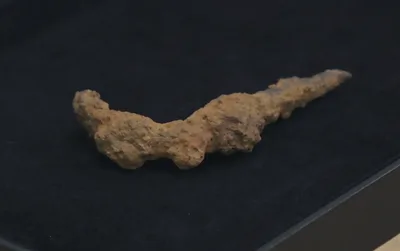
About This Artifact
A clay pipe stem was recovered from the interior of the stone feature on Lot 5 by archaeologist Miriam Amirault during Season 10 filming. Miriam was working with Jack Begley and Helen Sheldon to excavate the round depression that the team had been investigating since earlier in the season, alongside ancient tools and a Roman half coin that could date as far back as 2,000 years.
Helen Sheldon explained on screen that clay pipes were used from the late 1500s to the late 1800s, and that the borehole diameter of the stem could help narrow the date of manufacture. English pipe stem boreholes decreased at a measurable rate over time as manufacturing techniques evolved, allowing archaeologists to estimate manufacture date by measuring the hole with calipers. The borehole measurement of this specific stem has not been publicly reported.
Miriam noted on screen that Rick Lagina had wondered why no clay pipes had been found during excavation of the stone road in the swamp, the structure the team had been investigating as a possible early transport route. Their absence on the swamp road and presence in the Lot 5 feature suggested to the team that the two features may have been in use during different periods or by different groups.
When Rick and Gary Drayton arrived at the site, Helen Sheldon told them the stones at the edges of the feature were packed tightly while the centre stones were loose fill, an arrangement she described as the oldest European deposit the team had identified on the island. The feature was subsequently described in later episodes as the round feature on Lot 5.
Historical Context
The Curse of Oak Island, Season 10, Episode 11, "Oh, Well!" (History Channel, January 31, 2023). Eyewitnesses on screen: Miriam Amirault, Jack Begley, Helen Sheldon, Rick Lagina, Gary Drayton, Craig Tester. Pipe-stem bore-diameter methodology: J. C. Harrington, Quarterly Bulletin of the Archeological Society of Virginia 9.1 (1954); Lewis Binford, Southeastern Archaeological Conference Newsletter 9 (1962).
Where It Was Found
Found at Lot 5, interior of stone feature. Location: Oak Island, Nova Scotia, Canada.