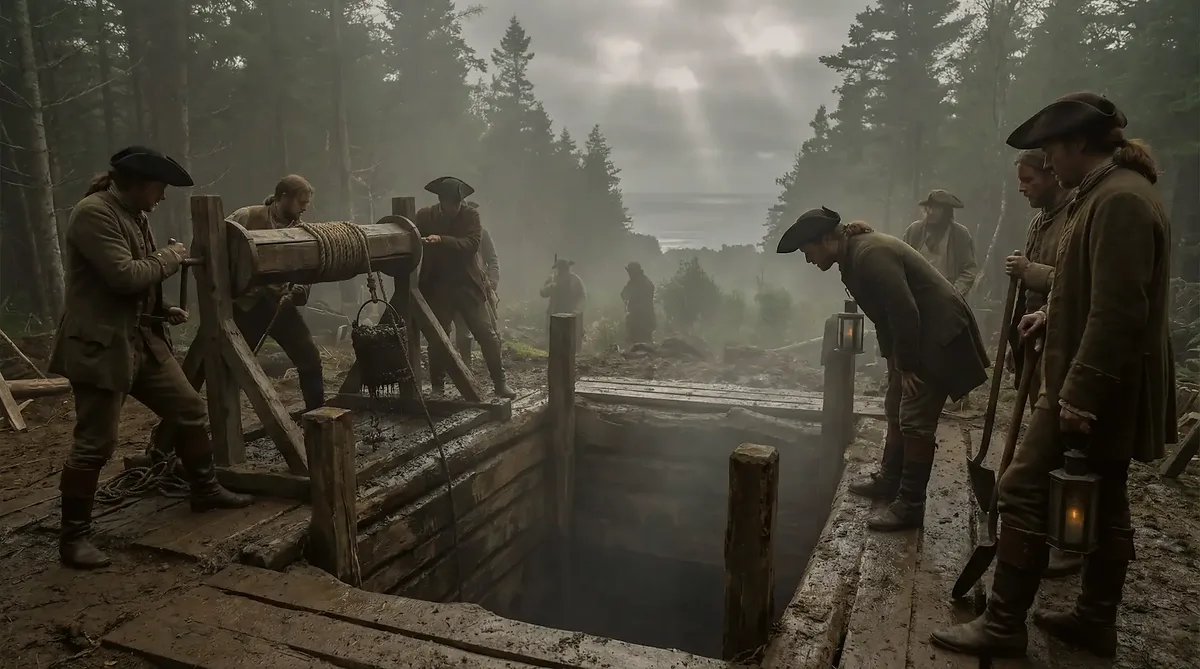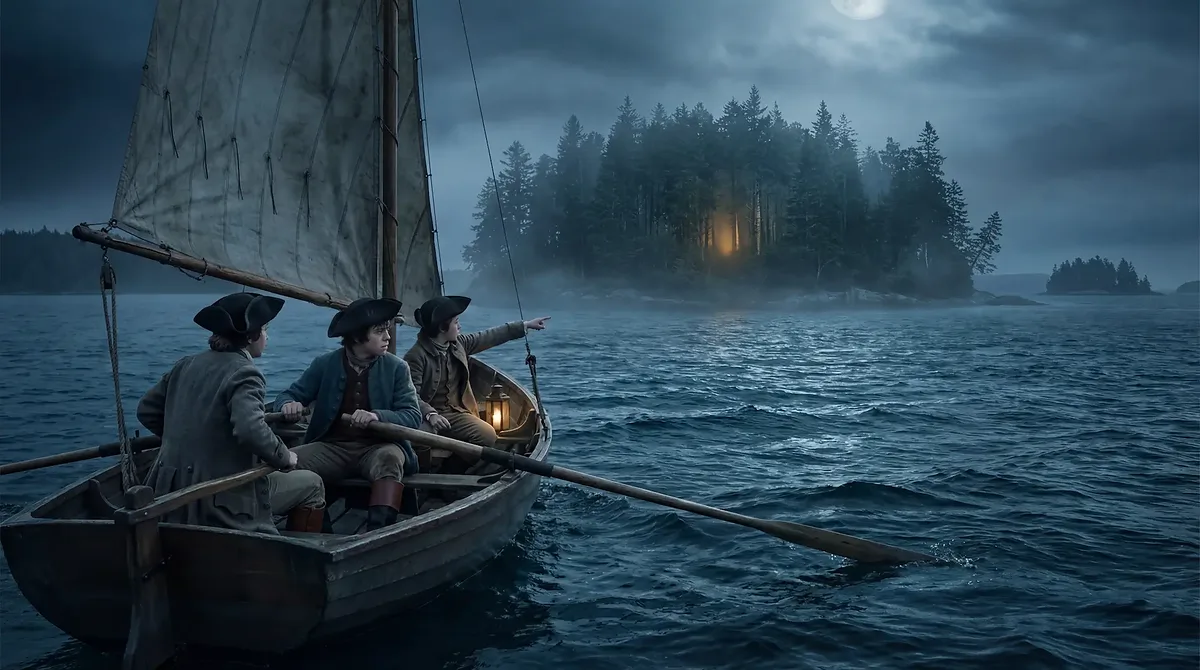
On the morning of September 25, 1746, Jean-Baptiste de La Rochefoucauld, Duc d'Anville, was walking the forecastle deck of his flagship in the harbor of Chebucto (present Halifax, Nova Scotia), when he collapsed with a stroke. He died two days later. He had crossed the Atlantic at the head of the largest fleet France had ever sent to the New World, with orders to retake Fortress Louisbourg from the English and win back Acadia for France. Storms had scattered his ships and disease was spreading through the crews. By mid-October, of the 7,006 sailors and soldiers counted at Chebucto, 587 were dead and 2,274 were sick. The admiral was buried on George's Island in the Chibouctou harbor.
In Paris, his only son, Louis-Alexandre, was three years old.
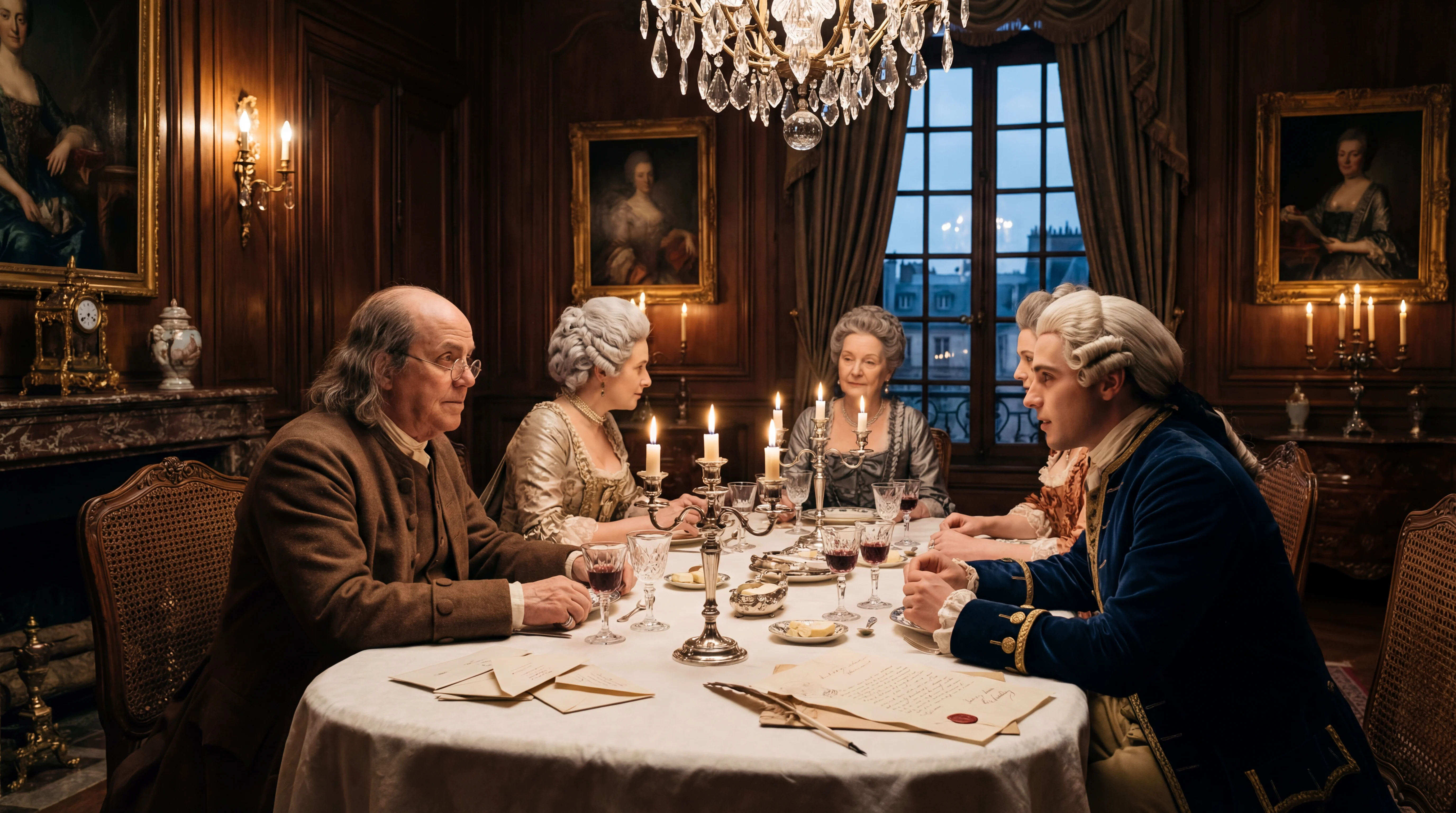
Thirty years later, in 1776, that son had become one of the most respected noblemen in France, hosting the American envoy Benjamin Franklin at his table. The theory at the heart of this article connects the two moments. It proposes that if the d'Anville expedition left something of value on or near Oak Island, knowledge of it may have passed from father to son, and from son to the Americans who needed money more than anything else.
The need was real. The thirteen colonies had no central bank, no national currency, and no power to tax but they were fighting the wealthiest empire on earth. Continental paper money lost value so fast that "not worth a Continental" became a common insult, and George Washington's army came close to dissolving at Valley Forge for lack of pay and supplies.
The Admiral's Son, Champion of America
1 min
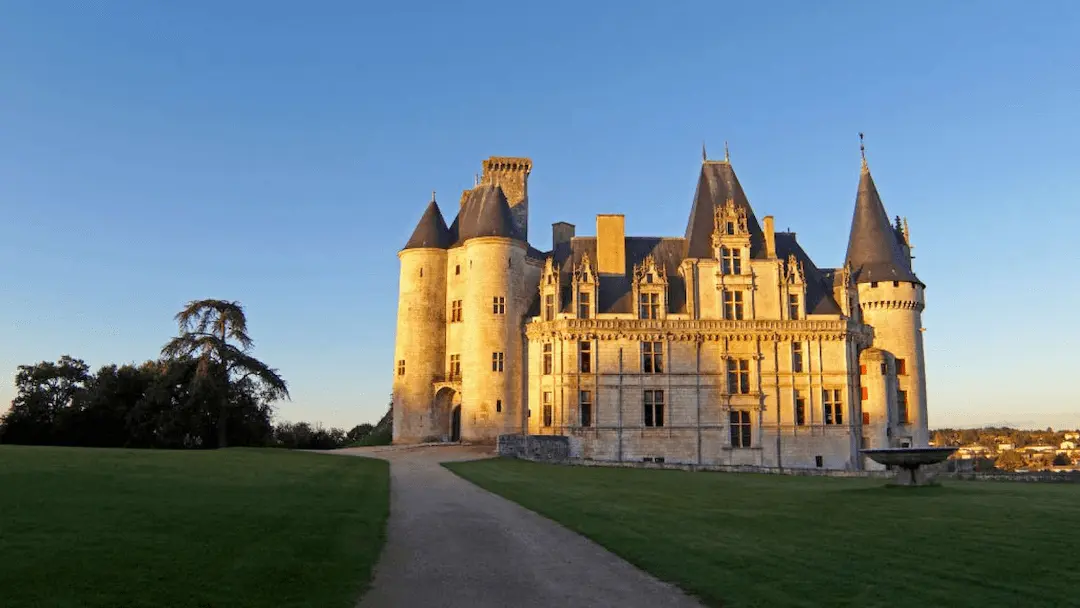
Louis-Alexandre de La Rochefoucauld was a man of the French Enlightenment. His mother raised him on science; at nineteen he was hiking to the glaciers of Savoy and writing up what he saw. He built a scientific cabinet at the family château of La Roche-Guyon, joined the Royal Academy of Sciences, and later presided over the Royal Society of Medicine. He was also among the most committed French supporters of the American cause.
His friendship with Franklin began almost at once. The editors of Franklin's papers date a note from the duke to January 26, 1777, written just after Franklin and Silas Deane, the American agent who had been buying arms in Paris since the previous summer, left a dinner at his house. By April the two men were at work together. La Rochefoucauld was translating the new state constitutions into French, and Franklin was reading his drafts line by line, correcting the Virginia text on everything from legislative procedure to the meaning of the word "fees." The duke took every correction into the published version.
The finished book appeared in 1783 as Constitutions des Treize Etats-Unis de l'Amerique. It was a political act as much as a literary one, meant to show French readers that republican government could work. In 1786 the American Philosophical Society in Philadelphia, the learned society Franklin had founded, elected the duke a member.
 Benjamin Franklin's Nova Scotia Connection→
 Château de la Rochefoucauld→
Dinner Table Diplomacy
1 min
The duke was not the only member of the family in Franklin's circle. It was his mother, the widow Marie-Louise-Nicole de La Rochefoucauld, the duchesse d'Enville, who set the stage. She kept one of the leading reform-minded households in Paris and corresponded with the most influential ministers and scholars of the day.
She and Franklin became friends. In February 1778, by his editors' dating, Franklin accepted an invitation to dine with her and brought his grandson along, adding that he would take breakfast with the duke the following morning. In 1781 he wrote to mother and son together, with condolences on the death of a friend they shared and a copy of a sermon preached at the launch of the new Massachusetts constitution, knowing the duke would want to read it.
For the theory in front of us, this matters more than any single letter. The two people in France most likely to hold private knowledge of the d'Anville expedition, the admiral's widow and his son, both sat at Franklin's table, repeatedly, during the years he was trying to finance a war.
When Thomas Jefferson arrived in Paris in 1784 and succeeded Franklin as Minister to France the following year, he entered the same household. Years later he wrote to the duke with "respect & attachment" and asked to be remembered to the duchesse.
A Carved Pine Tree
1 min
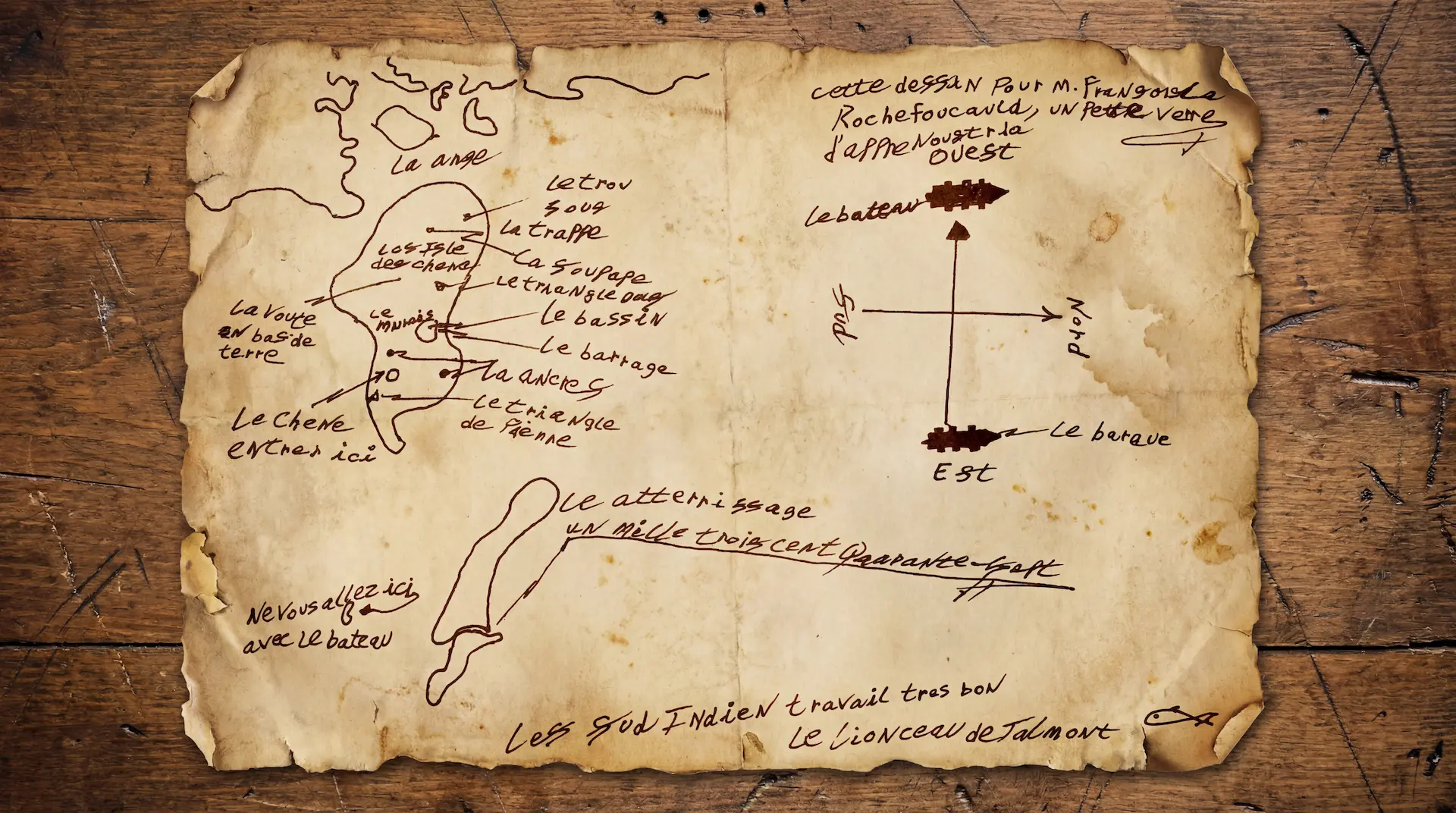
The theory was put to the Oak Island team in the War Room during the Season 6 finale, Episode 22, titled "Lost and Founding" by researchers Justin Cannady and the brothers Cort and Bruce Lindahl. It built on two earlier threads. The first was the Duc d'Anville theory, the idea that the 1746 expedition or its advance ships deposited treasure on the island. The second was a map brought to the show in earlier seasons by Zena Halpern, a New York researcher whose documents, as presented on the series, carry the La Rochefoucauld name.
 Zena Halpern's Templar Map→
From there the theory made its central claim: that Louis-Alexandre, having inherited whatever his father's expedition knew, shared the location with Franklin and Jefferson in Paris. In that reading, the Founding Fathers, or agents acting for them, may have tried to recover the treasure to help pay for the war, or at least knew that it existed.
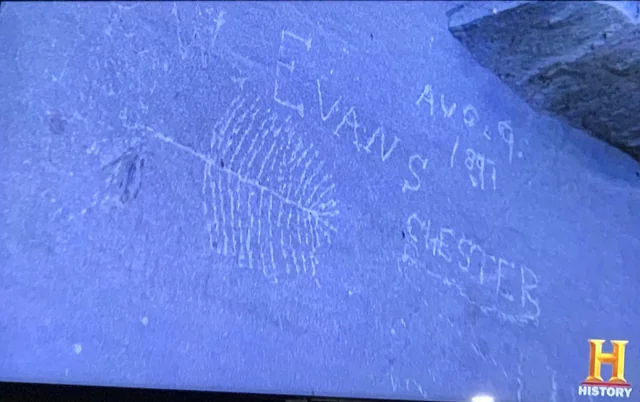
A piece of physical evidence was offered that sits on the northeastern shore of Oak Island's Lot 14, known as the Evans Stone. This boulder carries a date "August 9, 1897," the word "CHESTER," the name "E.W. EVANS," and a horizontal carving of what appears to be a pine tree. The theory compared it to the pine on the Appeal to Heaven flag, a symbol of colonial resistance. Washington used it on his ship's flags in 1775. On the stone, the team counted what appeared to be thirteen branches on each side, the number some versions of the flag use for the thirteen colonies. The proposal was that the carving had been made by an American revolutionary who came to Oak Island in connection with the treasure.
 Evans Stone - 13-branched tree carving in rock→
Revolution In Mahone Bay
1 min
The segment also claimed that people in Nova Scotia had tried to bring the province into the rebellion. The documented version of that story belongs to Jonathan Eddy, a Massachusetts-born settler on the Chignecto isthmus. In March 1776 Eddy rode to Washington's headquarters at Cambridge asking for troops to take Nova Scotia. Washington refused. Invading a colony that had not risen on its own, he wrote, would make the Americans "the aggressors." Eddy's own attack on Fort Cumberland that November failed, and Nova Scotia stayed with the Crown.
That did not keep the war away from Mahone Bay. New England privateers raided the Nova Scotia coast for years, burning ships and seizing cargo. On June 30, 1782, five privateer vessels under Captain Noah Stoddard, sailed into Chester, a few miles across the water from Oak Island. The Chester militia under Jonathan Prescott fired back from the town blockhouse and hit one of the vessels. The privateers withdrew and asked permission to bury their dead. Prescott agreed on condition they came ashore unarmed, then invited their captains to tea.
What followed has entered local legend. Prescott let it be known that a hundred soldiers were marching from Lunenburg, and the women and children of Chester paraded in red clothing to look like British troops. The privateers sailed away and fell on Lunenburg the next morning. It puts armed American revolutionaries in the waters around Oak Island during the war itself.
The Gunpowder Plot
1 min
The theory sits inside a well-documented history of hidden money. Long before France openly entered the war in 1778, the court of Louis XVI was quietly arming the rebels. The French Foreign Minister saw the rebellion as a chance to weaken Britain after France's losses in the Seven Years' War. Sympathy for American liberty had little to do with it.
In 1776 France backed a scheme run by Pierre-Augustin Caron de Beaumarchais, the playwright behind The Barber of Seville, who also worked as a royal secret agent. Beaumarchais set up a fictitious trading house funded with one million livres drawn from untraceable royal funds and a further million from Spain. At its peak it ran as many as forty ships across the Atlantic, carrying gunpowder, muskets, cannon, and uniforms, often through Caribbean ports to disguise where they came from, while American tobacco came back to France to be sold. Beaumarchais was later credited with supplying most of the material behind the American victory at Saratoga in 1777, the victory that persuaded France to sign an open alliance the following year.
The alliance brought French troops, warships, and loans. By the end of the war France had spent more than a billion livres on American independence, a debt that fed directly into its own fiscal crisis and the French Revolution a decade later. Secret funding, front companies, and deniable shipments were ordinary tools of this war, and that is the setting in which the theory asks to be read.
Secrets Kept Secret
1 min
Franklin lived in France for more than eight years, from December 1776 to July 1785, and cultivated dozens of aristocrats and scholars. Jefferson followed him and stayed until 1789. Both were tireless letter writers and collectors of information. If talk of treasure on the Nova Scotia coast ever circulated in Parisian society, they were well placed to hear it, and the La Rochefoucauld household was the most likely place for it to be heard.
There is no paper trail. The letters of Franklin, Jefferson, and Washington have been catalogued and largely published, including the notes between Franklin and the La Rochefoucaulds quoted above. They discuss constitutions, sermons, dinners, and friends. None of them mentions Oak Island, buried treasure in Nova Scotia, or the d'Anville expedition in connection with hidden wealth and perhaps we shouldn't expect that if the secret was to be kept.
The Second Tragedy
1 min
What the papers do show is how deeply Louis-Alexandre believed in the American cause. When the States-General met in 1789 he sat for the nobility of Paris, and on June 25 he was among the 47 nobles who crossed over to join the Third Estate. He proposed Article XI of the Declaration of the Rights of Man and of the Citizen, the article on freedom of expression, and it was adopted.
The revolution he helped encourage eventually turned on him. In early September 1792, he was arrested at Gisors and killed by volunteer troops passing through the town. He was forty-nine years old. His mother had now lost both her husband and her son to wars of empire and revolution, as she wrote to Jefferson in Philadelphia after the tragedy.
Whether the duke ever spoke to his American friends about his father's expedition remains unknown. The d'Anville fleet was no secret; its collapse was public knowledge across Europe. What the expedition may have done before that collapse is another matter. Two advance ships, l'Aurore and le Castor, reached the Nova Scotia coast ahead of the main fleet, and by some accounts one of them sailed close to Mahone Bay. If mother or son held private knowledge of their orders, their dining room is where it could have reached American ears.
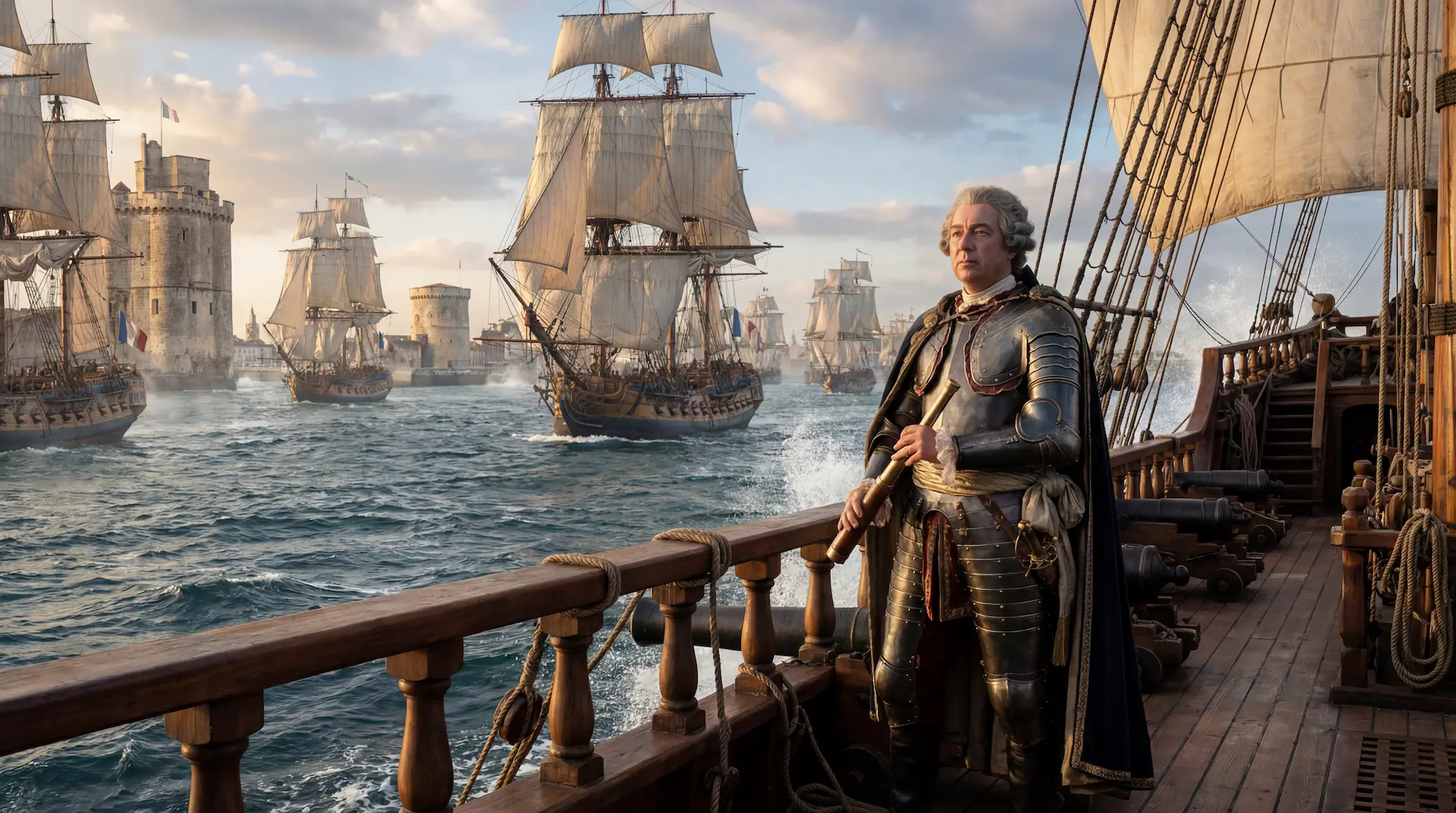 Duc d'Anville's Doomed Fleet→
Oak Island War Chest
1 min
Put together, the pieces form the argument at the heart of this hypothesis. It holds that the d'Anville fleet, or its advance ships, deposited a treasure on Oak Island in 1746; that knowledge of it survived in Paris with the admiral's widow and his son; that it passed across their dining table to Franklin; and that the treasure was recovered and used to help finance the American Revolution. It would have been one more hidden stream of French money alongside the front companies, the smuggled gunpowder, and the secret loans.
Seen that way, much of what is documented falls into line. The family with the closest ties to the expedition was also one of the families closest to Franklin. France was already moving money to the rebels through channels designed never to appear in a ledger. Armed Americans were in the waters of Mahone Bay before the war was over. And a secret of that kind is exactly what would have been kept out of letters that were likely to be copied, read, and preserved.
Since the late nineteenth century, people around Mahone Bay have told what is essentially the same story: the treasure of Oak Island is the cargo of a French pay ship, stored in a vault on the island. The final link, a letter, a ledger, or a find in the ground, has yet to surface. Until it does, the story stays with the reader: a widow and her son, an American envoy at their table, a young nation in need of gold, and an island in Mahone Bay that has never given up all of its secrets.
Sources
1 min
Television
- The Curse of Oak Island, Season 6, Episode 22, "Lost and Founding," History Channel, first aired April 30, 2019
Correspondence (Founders Online, National Archives)
- La Rochefoucauld to Benjamin Franklin and Silas Deane, [26 January? 1777]
- Benjamin Franklin to La Rochefoucauld and the Duchesse d'Enville, 25 April 1777
- Benjamin Franklin to La Rochefoucauld, 8 February 1778
- Benjamin Franklin to the Duchesse d'Enville and La Rochefoucauld, 31 March 1781
- Thomas Jefferson to La Rochefoucauld d'Enville, 24 April 1790
- Madame d'Enville to Thomas Jefferson, 30 December 1792
Primary Publications
- Constitutions des Treize Etats-Unis de l'Amerique, translated by Louis-Alexandre de La Rochefoucauld, Paris, 1783
- Mather Byles DesBrisay, History of the County of Lunenburg, 1895
Biography
- Etienne Taillemite, "La Rochefoucauld de Roye, Jean-Baptiste-Louis-Frederic de, Duc d'Anville," Dictionary of Canadian Biography, vol. 3, 1974
- "La Rochefoucauld d'Enville, Louis-Alexandre de," Historical Dictionary of Switzerland
- Louis-Alexandre de La Rochefoucauld d'Enville, deputy record, Assemblee nationale
History
- Jonathan R. Dull, A Diplomatic History of the American Revolution, Yale University Press, 1985
- Stacy Schiff, A Great Improvisation: Franklin, France, and the Birth of America, Henry Holt, 2005
- "Clarifying Beaumarchais," Journal of the American Revolution, 2020
- "When Nova Scotia Almost Joined the American Revolution," Smithsonian Magazine
Oak Island Literature
- Randall Sullivan, The Curse of Oak Island: The Story of the World's Longest Treasure Hunt, Atlantic Monthly Press, 2018
- Joy A. Steele and Gordon Fader, The Oak Island Mystery Solved: The Final Chapter, 2nd edition, Nimbus Publishing and Cape Breton University Press, 2018