In November 2016, area historian Doug Crowell introduced the Oak Island team to a New York-based researcher named Zena Halpern. What she brought to the table would reshape the investigation for years to come: three documents that, if authentic, would place the Knights Templar on Oak Island centuries before the Money Pit's discovery in 1795. Halpern was not a casual theorist. She had spent more than a decade tracing a chain of evidence from a medieval document purchased in Cremona, Italy, through a web of collectors, secret societies, and hidden objects, all the way to the shores of Nova Scotia.
Her work appeared across multiple seasons of the show, generated real archaeological investigation, and connected Oak Island to European noble families, Templar history, and ancient navigation technology. She passed away in 2018, and her entire research archive was bequeathed to the Oak Island team. This article examines what she presented, what the team found when they tested her claims on the ground, and where her evidence stands today.
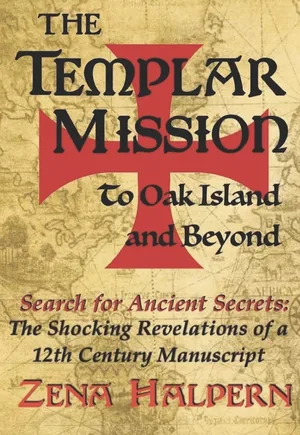 The Templar Mission to Oak Island and Beyond
The Templar Document and its Origins
1 min
The foundation of Halpern's theory was a manuscript she called the Templar Document. According to her account, the document was purchased in 1971 by a man she identified as Dr. W. David Jackson from a Mr. Benvenuto in Cremona, Italy. The manuscript had reportedly been kept at the Church of San Sigismundo in Cremona, and before that at Castrum Sepulchri, a Cistercian abbey in Seborga, a small principality on the Italian Riviera near the French border. Seborga had documented Templar connections dating to the 12th century and sat along the medieval pilgrimage route.
 The Inscribed Marker Stones of Seborga→
The Templar Document contained maps, journal entries, and descriptions of objects recovered from beneath the Temple Mount in Jerusalem during the early 12th century. Among these was a journal entitled "A Year We Remember," attributed to an English Templar knight named Ralph de Sudeley of Gloucestershire. According to the journal, de Sudeley was dispatched on a mission in 1178 by Templar Grand Master Odo de St. Amand to recover secret scrolls hidden in a land called Onteora, a mountain range in what is now New York State. On his way there, de Sudeley and his men reportedly stopped at an island of oak along the coast of maritime Canada.
The document also described five devices found in the Jerusalem tomb, including navigation instruments, a decoder with Arabic and Hebrew letters, maps, gold, and the bones of a man named John. These items were said to have been transported to Castrum Sepulchri, where Cistercian monks translated the accompanying scrolls with the help of Jewish scholars. The scrolls allegedly described a hidden cache of treasure in Onteora and provided maps showing the route.
 The Knights Templar on Oak Island→
Three Documents on the War Room Table
1 min
When Halpern appeared on Season 4, Episode 1, she presented three specific documents via conference call with Marty Lagina, Craig Tester, and Doug Crowell.
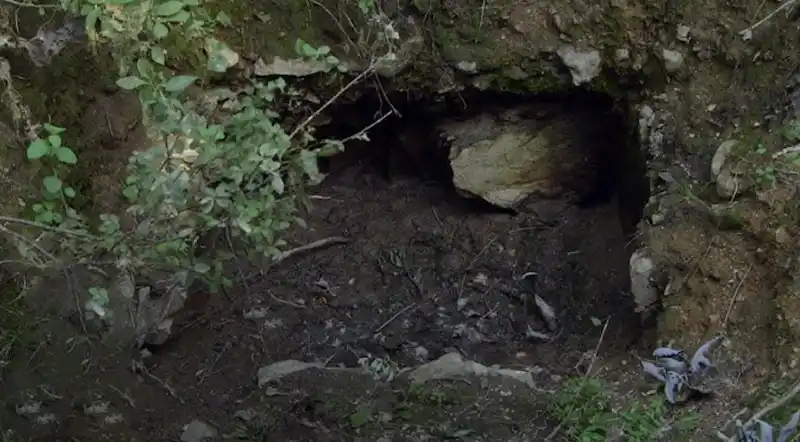
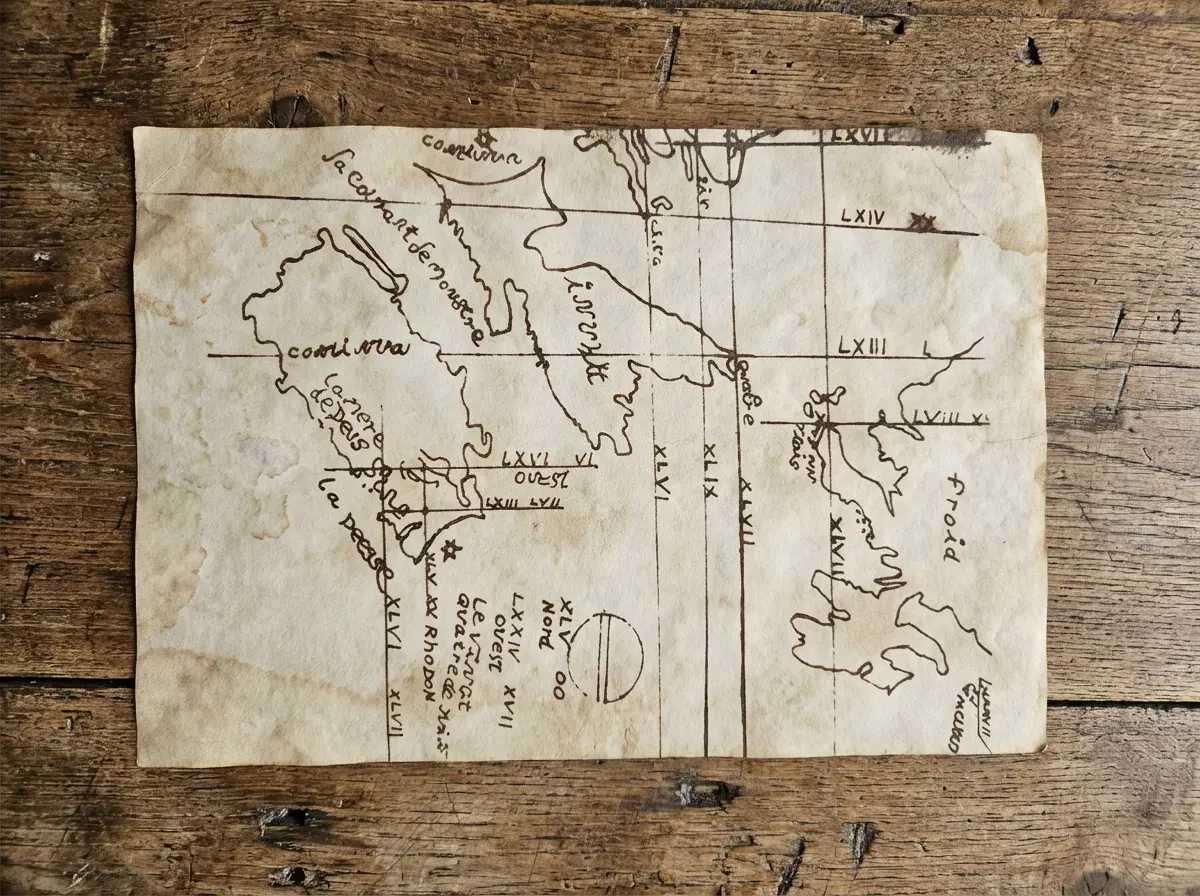
The first was a hand-drawn French map of Oak Island, which she dated to 1347. The map labelled landmarks in French, including a basin corresponding to the swamp, a marsh, a dam, and an entry point labelled "la chene" ("the oak"). Three features on the map drew particular attention: the anchors, the valve, and a location marked "Le Trou Sous la Trappe," meaning "the hole under the trap door." The team would spend years searching for this feature, eventually calling it the Hatch.
 Square-shaped hatch→

The second was a Nova Scotia map dated 1179, which Halpern connected to the Templar Document. This map marked an area from west to east where gold was present, corresponding to the Gold River that flows from New Ross to Mahone Bay, where gold deposits triggered a major rush in the mid-1800s. The map also showed a land bridge connecting Nova Scotia to Cape Breton Island, and depicted water levels and island configurations consistent with what oceanographers confirmed were lower sea levels several centuries ago.
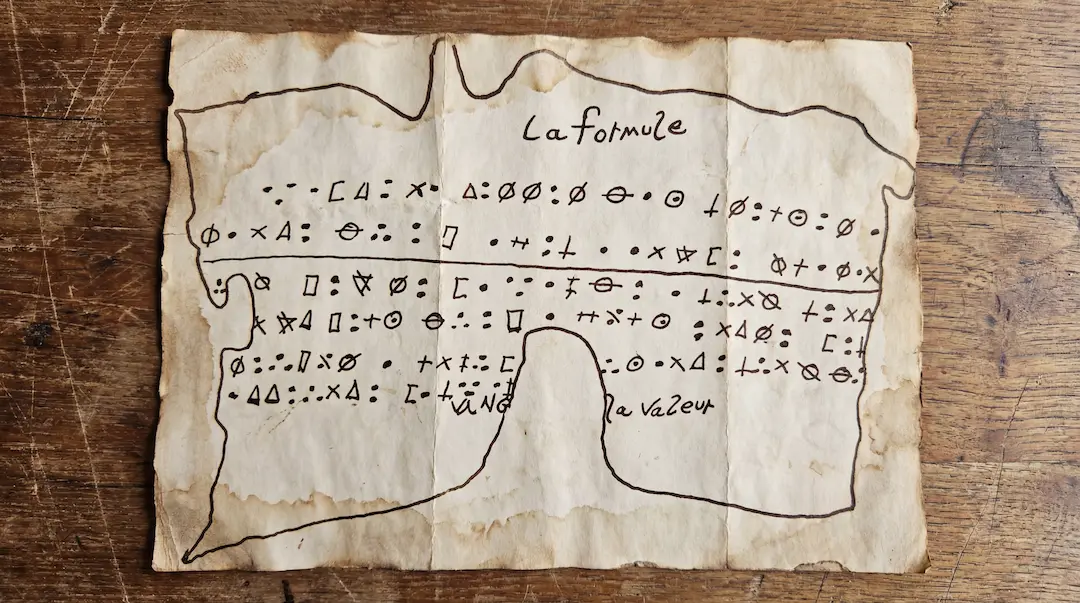
The third was the La Formule cipher, a coded page covered in strange symbols. Crowell noted immediately that the symbols appeared to match those believed inscribed on the lost 90-foot stone, the stone found in the original Money Pit shaft in the 1790s whose inscription was famously translated as "Forty Feet Below, Two Million Pounds are Buried." The La Formule page was torn in a deliberate jigsaw pattern and bore a faint inscription at the bottom: "Tim McInnis to W. David Jackson, one of seven."
The McGinnis Connection
1 min
The surname McInnis caught the team's attention. Halpern and fellow researcher Judi Rudebusch had tracked the name to Jim McGinnis, a direct descendant of the original Oak Island discoverer Daniel McGinnis. McGinnis had lived in Florida, worked for the CIA, and was known to have shared Oak Island information with Dr. Jackson in the 1970s. Before his death, McGinnis gave his sister a gold cross he always wore, the same cross she later showed on The Curse of Oak Island. The cross was authenticated and dated to the 16th century.
 McGinnis Gold Cross→
Halpern believed Jackson found information about Oak Island within the Templar Document and that certain parties wanted it. She pointed to a note Jackson had written in the back of a book, dated 1996, which read: "They wanted the info about the tunnels so they bought the document from me. But they didn't get it. Who has it now? I think it was broken up into 8 parts. I have 4, what happened to the rest?" The La Formule page, torn like a puzzle piece, appeared to be one of those parts.
The Ralph de Sudeley Problem
5 min
The entire chain of evidence presented by Halpern rests on the claim that Ralph de Sudeley was an English Templar knight who led a transatlantic voyage in 1178 to 1180 and produced the maps bound in the Templar Document, including the Nova Scotia map dated 1179. Without de Sudeley, there is no 12th-century voyage, and no basis for dating any of the maps to the medieval period. The claim deserves careful scrutiny, and checking Halpern's cited sources against the original documents reveals that every one of them has been misrepresented.
Ralph de Sudeley was a real person. He was a 12th-century English baron in Gloucestershire who died before September 1192. But the historical record paints a very different picture from the one in Halpern's book. He was not a Knight Templar. He was a benefactor who donated land to the order in 1185, a routine act of baronial piety. Donating to the Templars was how wealthy landholders fulfilled their crusading obligations without leaving home, and the Oxford Dictionary of National Biography describes Ralph as a man who "took little part in public affairs." He founded Arbury Priory, endowed it with lands, and had a private chapel licensed at his manor house at Griff. He was succeeded by his son Otuel. That is essentially the full extent of what the records say about him.
Halpern did not originate the extraordinary claims about de Sudeley. They first appeared in Graham Phillips' 2004 book The Templars and the Ark of the Covenant: The Discovery of the Treasure of Solomon. Phillips placed Ralph at Petra in Jordan as commander of Templar fortifications, described him returning to England mysteriously wealthy, and claimed he displayed sacred relics at a Templar preceptory at Herdewyke in Warwickshire. Halpern adopted Phillips' framework, corrected a genealogical error Phillips had made (Phillips called Ralph a younger son when he was in fact the elder), and then extended the narrative far beyond what Phillips had written, adding the transatlantic voyage, the Onteora Document, the Oak Island stopover, and the maps.
Phillips cited four primary sources for his claims. All four have been checked against the originals, and none say what he claimed.
First, Phillips wrote that the Feet of Fines preserved in the Warwickshire Records Department contained entries mentioning "objets sacrés" and "Vestiges d'ancien Testament" (Old Testament relics) at de Sudeley's preceptory chapel. The published Feet of Fines for this period are formulaic Latin records of land transfers between named parties before royal justices. They do not contain narrative descriptions of chapel contents, pilgrim donations, or sacred artifacts in Norman French. Phillips provided no folio number, no record reference, and no citation. His bibliography contains not a single work on English medieval history, Warwickshire records, or the Pipe Roll Society publications.
Second, Phillips wrote that "according to the Warwickshire historian William Dugdale, who wrote in 1656, the Elizabethan explorer Sir Walter Raleigh visited Herdewyke in 1600 and was told a story about the Templars hiding treasure in the area." Dugdale's Antiquities of Warwickshire has been searched in full. The Herdwick entry records that "Raph de Sudley gave some quantity of what he had here to the Templars, which in 31 H.2. was valued at xl s. per annum." There is no mention of Sir Walter Raleigh, no treasure legend, no preceptory of a thousand men, and no sacred relics. The Raleigh family that appears elsewhere in Dugdale is the local landed gentry of Farnborough, not the Elizabethan explorer.
Third, Phillips attributed a quote to the Swiss explorer Johann Ludwig Burckhardt, writing that "Burckhardt himself described the Crusaders' find as comprising 'treasures of pure gold, precious stones, and a golden chest.'" Burckhardt's Travels in Syria and the Holy Land (1822) contains a detailed account of his 1812 visit to Petra. He describes the ruins, the Siq gorge, the monument he calls Kaszr Faraoun (now known as the Treasury), and his guide's suspicion that he was searching for treasure. At no point does Burckhardt record any legend about Crusaders finding a golden chest, precious stones, or anything else. The quote Phillips attributed to him does not exist in the text.
Fourth, Halpern claimed that "the record of his return to the Shropshire, Herefordshire area is documented in the 'Annals of Winchcombe and Sudeley,' and it gives the date of 1185." Emma Dent's Annals of Winchcombe and Sudeley (1877) is a Victorian local history that records the same facts found in Dugdale: Ralph succeeded to his father's estates in 1165, founded Arbury Priory, and in 1185 gave lands to the Knights Templar. It documents a land donation, not a return from anywhere. The actual medieval Winchcombe Chronicle, held at the British Library, ends at 1181, four years before the date Halpern cited.
The journal attributed to de Sudeley presents its own problems. Halpern stated it was written in Theban script, which she described as a cipher used by 12th-century Cistercian monks. The Theban alphabet was first published in 1518 in Johannes Trithemius' Polygraphia and has not been found in any manuscript or publication predating that work. A document from 1180 written in a script that does not appear in the historical record for another 338 years is difficult to reconcile with authenticity.
Halpern also claimed that "historical records reveal 'missing years' for de Sudeley during the 1175 to 1185 time period," which she presented as an opening for the transatlantic voyage. Gaps in the medieval English records are normal for minor barons. A landholder appeared in the Pipe Rolls only when he owed money to the crown, was involved in legal proceedings, or paid scutage. Ralph appears in these records in 1166, 1169, and 1172 to 1174. The absence of entries after 1174 does not indicate absence from England. It indicates he had no outstanding business before the Exchequer. If he had been abroad on crusade, the Pipe Rolls would likely have recorded an exemption from scutage for that reason, as they did for other crusading barons. No such exemption appears.
Phillips' book contains a single footnote in its entirety, which clarifies that biblical quotations use the King James translation. No footnote, endnote, or citation supports any of his claims about de Sudeley, the Feet of Fines, Dugdale, or Burckhardt. All four primary sources are freely available on the Internet Archive for anyone to verify.
Testing the Map on the Ground
2 min
The team did not simply accept Halpern's documents at face value. They tested them against the physical landscape of Oak Island, and that investigation produced a trail of results that stretched across multiple seasons.
In Season 4, Jack Begley overlaid the 1347 map onto modern satellite imagery and found that the old French coastline aligned with the current island shape. Dave Blankenship revealed a strange depression near his property on Lot 22, close to where the map placed the Hatch. The team found a rectangular opening that appeared to have been chiseled through bedrock. Archaeologist Laird Niven confirmed the feature did not appear natural and recommended a formal archaeological permit before further excavation.
In Season 9, mechanical engineer Matt Sandt corrected a translation from the map: the original French read "the hole under the hatch" rather than simply "the hatch," a distinction that changed the search parameters. CSR GeoSurveys scanned Lot 22 and Lot 4 with VLF radio signals and magnetometer equipment, revealing anomalies near the road on Lot 4 in the area where the team believed the Hatch could be located. Subsequent metal detecting on Lot 4 produced a leather strap and buckle, a gold-plated button, an iron spike, and a topping adze that Carmen Legge dated to 1620 to 1740.
By Season 10, the team had identified a 13-foot-diameter circular stone feature on Lot 5, close to where a half Roman coin and a lead barter token had been found. Its dimensions matched the original Money Pit, and the construction resembled a wall on Lot 26 that contained charcoal dated to the 15th century. The team considered whether this could be the Hole Under the Hatch.
In Season 8, GIS expert Erin Helton used the positions of Nolan's Cross boulders and other landmarks to identify geometric alignments across the island, placing the original Money Pit just three feet from Borehole RF-1. She later interpreted the La Formule cipher's instructions as describing a 522-foot corridor at a 45-degree alignment from the Money Pit, followed by a passage of 1,065 feet, leading her to propose the treasure vault lay not beneath the Money Pit itself but at the end of a tunnel extending west.
The Rochefoucauld Connection
1 min
One of the most productive threads from Halpern's material was the name "La Rochefoucauld," which appeared on the alleged 14th-century map. Doug Crowell researched the family and found the Rochefoucaulds were a prominent French noble house dating to the 10th century with direct connections to the Crusades through the Lusignan family, who ruled in Jerusalem.
At the Centre of Geographic Sciences in Lawrencetown, the team discovered that a Francois de La Rochefoucauld married into the line of Pierre Dugua, the founder of the first French colony in Nova Scotia. Dugua's personal cartographer was Samuel Champlain, whose otherwise meticulous maps conspicuously omit Mahone Bay, a body of water containing more than 360 islands. The team asked why Champlain would leave a 25-by-20-mile bay off his charts.
Rick Lagina and Alex Lagina later traveled to the Chateau de la Rochefoucauld in France, where family representative Sonia Matossian confirmed the family's participation in the Crusades. Critically, Matossian and translator Nichola Lewis corrected a translation on Halpern's map: a phrase previously rendered as "a little drink from Neustria" in fact read "a little towards the west," strengthening the map's potential as a directional document.
The most striking Rochefoucauld connection came from the Halifax archives. Doug Crowell presented what appeared to be a French military ship's log describing an advance vessel for the fleet of Duc d'Anville, which sailed 97 ships and 13,000 men to recapture Acadia from the British in 1746. The log described the crew burying treasure in a deep pit with a secret entrance by tunnel from the shore. The shaft reached 67 feet before seepage made conditions too damp. Duc d'Anville's real name was Jean-Baptiste Louis Frederic de Rochefoucauld, connecting the expedition directly to the family whose name appeared on Halpern's map.


The La Formule Decipherment
1 min
Rick Lagina sent the La Formule page to Professor Kevin Knight at the University of Southern California, a leading expert in machine translation and decipherment. Knight concluded the cipher was likely a substitution cipher used by secret societies and created by someone knowledgeable in cryptography. His partial decipherment translated into French and, rendered in English, read: "Halt. Do not dig to forty foot with an angle of forty-five degrees the shaft of five hundred twenty-two foot you enter the corridor of one thousand sixty-five foot reach the chamber."
Rick noted that 522 feet was almost exactly the distance from Smith's Cove to the Money Pit, suggesting the cipher might describe the relationship between the flood tunnel and the treasure location. Knight also identified the cipher as one of seven pieces of a larger document, with the remaining six fragments still missing. The number seven carried its own weight on Oak Island, where legend holds that seven men must die before the treasure can be found.
Halpern's Visit and the H+O Stone
1 min
In Season 5, Rick visited Halpern at her New York home, where she presented material for her book on pre-Columbian Templar contact with North America. She traced Ralph de Sudeley's 12th-century voyage from Gloucestershire, England, to Oak Island and beyond, arguing he was sent to recover ancient scrolls hidden in North America.
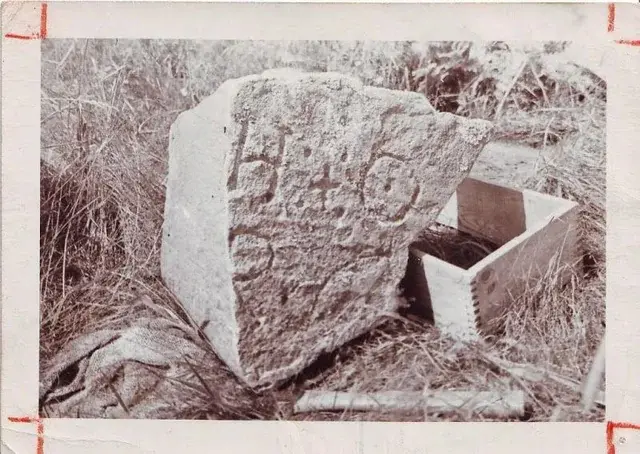
Halpern drew a connection between Templar coins bearing four distinctive dots around a cross and the markings on the H+O stone, a fragment salvaged by Gilbert Hedden in 1936 from a massive carved boulder that earlier searchers had dynamited in 1921 on the island's northern shore. The four dots on the H+O stone matched the embellishment style found exclusively on Templar crosses, according to her research. She also offered an unexpected interpretation of the lead cross found at Smith's Cove: rather than a depiction of Christ crucified, she identified the figure as a representation of Tanit, a Phoenician goddess dating back 3,000 years who was revered as the protector of sailors.
 H+O stone→
Legacy
1 min
Zena Halpern died in 2018 at age 88. Rick learned of her passing during Season 6 and read a tribute written by archaeoastronomer Rich Moats, who had worked closely with her. Rick and nephew Peter Fornetti traveled to Halpern's Long Island home, where they joined her sons Davin and Jason in sorting through more than 50 years of research materials. The Oak Island team established a dedicated research center on the island to house Halpern's archive, and Rick promised a candlestick from her collection would be lit only once: when the team finds answers because of her work.
Assessment
3 min
Zena Halpern's contribution to the Oak Island investigation was substantial in its impact. She drove years of fieldwork, connected the team to verifiable European noble families, and introduced documents that generated testable predictions about specific locations on the island. The Rochefoucauld family is historically real. Champlain's omission of Mahone Bay is documented. The Duc d'Anville expedition happened. The artifacts found in the areas her map indicated are genuine and have been dated by independent experts.
The documents themselves, however, are forgeries. The French across all three is riddled with errors no native speaker would make: masculine and feminine articles are mixed up throughout, modern vocabulary appears on supposedly medieval documents, and grammatical constructions read like dictionary translations from English. The word "atterrissage" on the 1347 map did not enter the French language until 1830. The word "chene" was still written "chaisne" in the 14th century. The Oak Island map depicts the island as it appears today rather than as it would have looked in 1347, when sea levels were lower. The Frog Island Shoal, submerged today, would have been visible land at the time the map was supposedly drawn, yet it does not appear. The Oak Island Compendium has published a detailed four-part linguistic and provenance investigation of the Jackson documents that lays out the full case, and their findings are thorough.
The provenance is equally problematic. Every document traces back to Dr. W. David Jackson, a figure whose existence cannot be independently verified and who had a remarkable habit of discovering important objects hidden inside other objects. The Vatican confirmed to the Compendium that Franco Franzetti, who supposedly authenticated the Cremona Document, never worked for them. The Parisian rare book dealer who allegedly sold Jackson the document has no record of existence in France. Don Ruh, who co-owned the documents with Halpern, eventually declared the Oak Island map a forgery on Scott Wolter's blog in 2018, claiming it had been fabricated by Jackson as bait in an intelligence operation, though his account of how Jackson obtained the map contradicts what he wrote in his own book. Your author visited Cremona multiple times and found no Mr. Benvenuto ever worked at San Sigismundo, the City Archives, or in any other place that had an archive or library.
Beyond the documents, the historical foundation of Halpern's theory collapses under examination. The extraordinary claims about Ralph de Sudeley originated not with Halpern but with Graham Phillips' 2004 book, and Phillips' cited sources do not support his claims. The Feet of Fines do not mention sacred relics. Dugdale does not record a Raleigh treasure hunt. Burckhardt does not describe a Crusader find at Petra. The Annals of Winchcombe and Sudeley do not document a return from the Holy Land. Ralph de Sudeley was a stay-at-home baron who paid the Templars so he would not have to go on crusade. He was not a Templar knight, he never left England, and he did not draw a map of Nova Scotia. All the primary sources are available on the Internet Archive for independent verification.
None of this is Halpern's fault. She was given these documents by others and believed them to be genuine. She invested years of her life researching their contents in good faith, and the connections she drew were logical given the materials she had to work with. The team respected her deeply, and Rick Lagina's relationship with her was genuine. The deception, if that is what it was, was done to her as much as to anyone else. In fact, all facts indicate Don Ruh himself is the forger.
In an irony that life sometimes produces, Zena's work spurred research she probably would have loved. The Rochefoucauld research stands on its own merits. The artifacts found on Lots 4 and 5 are real. The carbon dates are real. The questions she raised about pre-Columbian European contact with Nova Scotia continue to be worth asking, regardless of the documents that prompted them.
Sources
4 min
The Jackson Documents
- Zena Halpern, The Templar Mission to Oak Island and Beyond: Search for Ancient Secrets: The Shocking Revelations of a 12th Century Manuscript (self-published). Contains the 1347 Oak Island map, the 1179 Nova Scotia map, and the La Formule cipher page. All three documents trace to Dr. W. David Jackson, who reportedly purchased the Templar Document from a Mr. Benvenuto at the Church of San Sigismundo in Cremona, Italy, in 1971.
Provenance and Forgery Investigation
- Oak Island Compendium, "The Bill Jackson Documents Investigation," Parts 1–4. Published at theoakislandcompendium.com. Comprehensive linguistic and provenance analysis by Charlotte and contributors, including: French language errors across all three documents (masculine/feminine article confusion, modern vocabulary on supposedly medieval documents); confirmation from the Vatican that Franco Franzetti never worked for them; non-existence of the Parisian rare book dealer in French records; handwriting matches across documents from supposedly different centuries. Entry point: https://www.theoakislandcompendium.com/post/the-bill-jackson-documents-investigation-part-1
- Donald Ruh, "The Truth about Oak Island and the Cremona Document," guest blog post on Scott Wolter Answers, December 26, 2018. Ruh declared the Oak Island map a fabrication, claiming Jackson created it as bait in an intelligence operation targeting members of Propaganda Due (P2). As evidence, he produced a letter allegedly written by Jackson in 1979, though the letter appears to have been typed in a proportional font consistent with modern word-processing software rather than a 1979 typewriter. His account of how Jackson obtained the map contradicts the provenance he published in his own book, The Scrolls of Onteora (2018), months earlier. Link: http://scottwolteranswers.blogspot.com/2018/12/the-truth-about-oak-island-and-cremona.html
- Corjan Mol, personal fieldwork in Cremona, Italy (multiple visits). No Mr. Benvenuto found at the Church of San Sigismundo, the City Archives, or any other institution with an archive or library.
Linguistic Evidence of Forgery
- The word "atterrissage" on the 1347 map did not enter the French language until 1830.
- The word "chene" (oak) was still written "chaisne" in 14th-century French.
- The map depicts Oak Island as it appears today rather than as it would have looked in 1347, when sea levels were lower. Frog Island Shoal, submerged today, would have been visible land at the supposed date of the map.
Ralph de Sudeley: Primary Sources Checked Against Claims
- Feet of Fines for the Reign of Henry II and the Reign of Richard I (Pipe Roll Society, vols. 17–18). Formulaic Latin land transfer records. Contain no narrative descriptions of chapel contents, sacred artifacts, or "objets sacres." Available at: https://archive.org/details/feetoffinesofrei1718grea
- William Dugdale, The Antiquities of Warwickshire (1656; second edition 1765). The Herdwick entry records that "Raph de Sudley gave some quantity of what he had here to the Templars." No mention of Sir Walter Raleigh, treasure legends, preceptories of a thousand men, or sacred relics. Available at: https://archive.org/details/bim_eighteenth-century_the-antiquities-of-warwi_dugdale-william-sir_1765_1
- Johann Ludwig Burckhardt, Travels in Syria and the Holy Land (London, 1822). Describes his 1812 visit to Petra in detail. Contains no legend about Crusaders finding a golden chest, precious stones, or any treasure. The quote attributed to Burckhardt by Graham Phillips does not exist in the text. Available at: https://archive.org/details/travelsinsyriaan08884gut
- Emma Dent, Annals of Winchcombe and Sudeley (London, 1877). Records that Ralph succeeded to his father's estates in 1165, founded Arbury Priory, and in 1185 gave lands to the Knights Templar. Documents a land donation, not a return from any voyage. Available at: https://archive.org/details/annalswinchcomb00dentgoog
- Oxford Dictionary of National Biography, entry for Ralph de Sudeley. Describes him as a man who "took little part in public affairs."
- The medieval Winchcombe Chronicle (British Library) ends at 1181, four years before the date Halpern cited for de Sudeley's alleged voyage.
Books:
- Zena Halpern, The Templar Mission to Oak Island and Beyond: Search for Ancient Secrets: The Shocking Revelations of a 12th Century Manuscript (Lake Worth, Florida: self-published, 2016). Presents the three Jackson documents (the 1347 Oak Island map, the 1179 Nova Scotia map, and the La Formule cipher), the Ralph de Sudeley narrative, the Bannerman Island brass navigation device, the Onteora Document, and the claimed provenance chain from Cremona through Dr. W. David Jackson.
- Graham Phillips, The Templars and the Ark of the Covenant: The Discovery of the Treasure of Solomon (Rochester, Vermont: Bear & Company, 2004). Contains a single footnote (clarifying that biblical quotations use the King James translation). No footnote, endnote, or citation supports any of his claims about de Sudeley, the Feet of Fines, Dugdale, or Burckhardt.
The Theban Alphabet
- Johannes Trithemius, Polygraphia (1518). First known publication of the Theban alphabet. No manuscript or publication predating this work contains the script. The journal attributed to de Sudeley, supposedly written in 1180, uses a cipher that does not appear in the historical record for another 338 years.
The La Formule Decipherment
- Professor Kevin Knight, University of Southern California. Identified the cipher as a substitution cipher used by secret societies. Partial decipherment translated into French, rendered in English: "Halt. Do not dig to forty foot with an angle of forty-five degrees the shaft of five hundred twenty-two foot you enter the corridor of one thousand sixty-five foot reach the chamber."
The Rochefoucauld Connection
- The Duc d'Anville expedition (1746): Jean-Baptiste Louis Frederic de la Rochefoucauld de Roye, Duc d'Anville, sailed 97 ships and 13,000 men to recapture Acadia from the British. A ship's log presented by Doug Crowell on the show described a crew burying treasure in a deep pit with a secret tunnel entrance from shore. The shaft reached 67 feet before seepage. This connects the Rochefoucauld family name on Halpern's map to a documented naval expedition to Nova Scotia.
- Jean-Baptiste du Casse, French Admiral, whose son-in-law was Louis de La Rochefoucauld, Marquis de Roye. Some researchers have attributed the map to du Casse rather than to 1347.
Television Appearances
- The Curse of Oak Island, Season 4, Episode 1 (November 2016). First presentation of the three Jackson documents to the team.
- Halpern appeared or was referenced in approximately 25 episodes across Seasons 4 through 11