In his last will and testament, dated July 17, 1788, Benjamin Franklin left his estranged son William a single bequest: "all the lands I hold or have a right to in the Province of Nova Scotia." It was an act of calculated coldness. William had sided with the British during the Revolution, and his father never forgave him. The Nova Scotia lands were undeveloped and, by that point, effectively worthless. "The part he acted against me in the late war, which is of public notoriety," Franklin wrote, "will account for my leaving him no more of an estate he endeavoured to deprive me of."
The will is well known. What has received far less attention, particularly in the context of the Oak Island mystery, is the fact that Benjamin Franklin owned land in Nova Scotia at all, and the circumstances that led him there. The answer, documented in the Papers of Benjamin Franklin held at the American Philosophical Society, Yale University Library, and the National Archives, leads to a web of land speculation, French aristocratic salons, covert wartime intelligence, and a family connection to the most catastrophic French military expedition ever launched against the province.
The Nova Scotia Land Speculator
3 min
Franklin's interest in Nova Scotia began in 1764, when his English friend Richard Jackson alerted him to the possibility of acquiring land there as a speculative investment. At roughly the same time, Alexander McNutt, a Scotch-Irish adventurer from Virginia who had been promoting settlement schemes across the province, made contact with John Hughes and other Philadelphians. Franklin committed to a share in one of McNutt's syndicates before sailing for England in November 1764.
The timing was opportune. The British government had recently expanded its programme of granting large tracts of Nova Scotian land to groups willing to settle them. In a frenzy of activity during the last half of October 1765, the governor and his council granted more than two and a half million acres, rushed through before the Stamp Act took effect on November 1 and raised the cost of the paperwork. McNutt and his associates received nearly 1.5 million acres in a single day. Among the grantees listed was "Dr. Franklin and Co."
Franklin's syndicate interests included a share of 100,000 acres on the north side of the River St. John (in what is now New Brunswick) and a share of the Philadelphia Company's 200,000 acres in the Pictou and Tatamagouche region on Nova Scotia's northern coast. But Franklin was not content with his syndicate shares. In early 1766, he petitioned the Privy Council individually for a personal grant of 20,000 acres, to be located wherever he or his agent chose within the province. The Board of Trade took over a year to act, but on June 26, 1767, the Privy Council issued an order directing the governor to survey and grant the land.
The 20,000 acres were located at what is now the community of Enfield, Nova Scotia, along the Shubenacadie River, roughly 30 kilometres north of Halifax and approximately 80 kilometres from Oak Island. Franklin hired a man named Jacob Hall, a Philadelphia tavern keeper, to manage the settlement and operate an inn on the property. His son William, writing from New Jersey in October 1767, acknowledged receipt of the grant and noted with cautious optimism: "I have not the least doubt but something handsome might be made of it if well managed."
The community of Enfield takes its name, according to local tradition, from Enfield, Connecticut, the former home of an early settler. The etymology is not documented in any primary source. On the southern edge of the town, in Bedford Basin, stands D'Anville's Encampment National Historic Site, a Parks Canada monument marking the place where the Duc d'Anville's fleet anchored in 1746 and where the admiral died. French Landing, also in Bedford Basin, is identified in the Place-Names of the Province of Nova Scotia as "the landing place and the encampment ground for the men who were with the ill-fated, disease-stricken, Duc D'Anville's fleet." For decades after the expedition, the skeletal remains of French soldiers and sailors were found in the woods around Halifax by later settlers. The name d'Anville was part of the landscape of Halifax County long before Franklin's grant was surveyed there, and the La Rochefoucauld family title, used interchangeably in Franklin's own correspondence, was "duc d'Enville."
Franklin held these Nova Scotia lands for the rest of his life. He never visited the province, and the settlement conditions prescribed by the grant were never fully met. But the lands remained part of his estate through the Revolution, through his years in Paris, and through the drafting of the Constitution. When he died in 1790, five years before the discovery of the Money Pit, the Province of Nova Scotia was still listed among his assets.
 The Real Daniel McGinnis of Oak Island→
 Duc d'Anville's Doomed Fleet→
The Man Who Drew Both Maps
3 min
The Privy Council's 1767 order directed the governor to "cause twenty thousand Acres of Land to be Surveyed in one Contiguous Tract" for Franklin. The survey fell to the office of Charles Morris, Surveyor General of Nova Scotia, a position Morris had held since 1749 and would hold until his death in 1781. Morris was not a minor functionary. Born in Boston in 1711, he had come to the colony as a military officer and risen to become one of its most powerful administrators, serving simultaneously as a member of the Nova Scotia Council, Justice of the Peace, and eventually Chief Justice of the Supreme Court. He designed the layout of Halifax, Lunenburg, Lawrencetown, and Liverpool. His surveys of Acadian settlements were later used by the military authority in Halifax to plan the Expulsion of the Acadians during the Seven Years' War. He was, by any measure, the man who drew the map of colonial Nova Scotia, and the intelligence he gathered while doing so served purposes well beyond cartography.
Five years before processing Franklin's grant, Morris turned his attention to a small island in Mahone Bay. In 1762, he travelled 45 miles from Halifax and surveyed it into 32 lots of approximately four acres each, arranged as narrow rectangular strips running from a central road to the waterline on both sides, giving every lot both road access and water frontage. He designated the island as Number 28. It would later become known as Oak Island.
The layout Morris chose was a variation of the strip lot system used across the Maritimes for planned settlements along rivers and coastlines, where large numbers of families needed frontage. Morris himself had applied similar patterns when laying out townships at Lunenburg, Liverpool, and elsewhere on the South Shore. The system was designed for density: dozens of families sharing a common road, each with their own access to water. Applying it to a 140-acre island was a different matter. Most small islands in the region were granted whole to a single person or a small group. Morris subdivided Oak Island as though he were planning a township, creating infrastructure for a scale of settlement the island never achieved. The central road he laid out does not follow the island's natural long axis but cuts across it at a deliberate diagonal, an orientation that was chosen rather than dictated by the terrain.
The Shoreham Grant of 1759, which opened the Chester area to settlement, is the standard explanation for the survey. But the grant covered a large area with hundreds of islands. The 32-lot strip subdivision that Morris applied to Oak Island was a level of formal planning that went well beyond what a routine land grant required for an island of this size. The lots Morris drew in 1762 are the same lots that Daniel McGinnis would begin purchasing in 1788: lot 28 first, then lot 21 (where he built his home), lot 27, and lot 1. The Money Pit was discovered on lot 18. The grid that defined every property boundary on the island, every excavation permit, and every treasure-hunting claim for the next 260 years was the work of Charles Morris.
Morris is the institutional thread connecting Benjamin Franklin's Nova Scotia holdings to Oak Island. His office surveyed both properties. The Surveyor General position remained in the Morris family for four generations, from Charles Morris Sr. in 1749 through his son Charles II, his grandson Charles III, and finally his great-grandson John Spry Morris, who served until the office was merged with the Commissioner of Crown Lands in 1851. The Morris family held the position for its entire existence, covering the full period from Franklin's land grant through the discovery of the Money Pit and beyond.
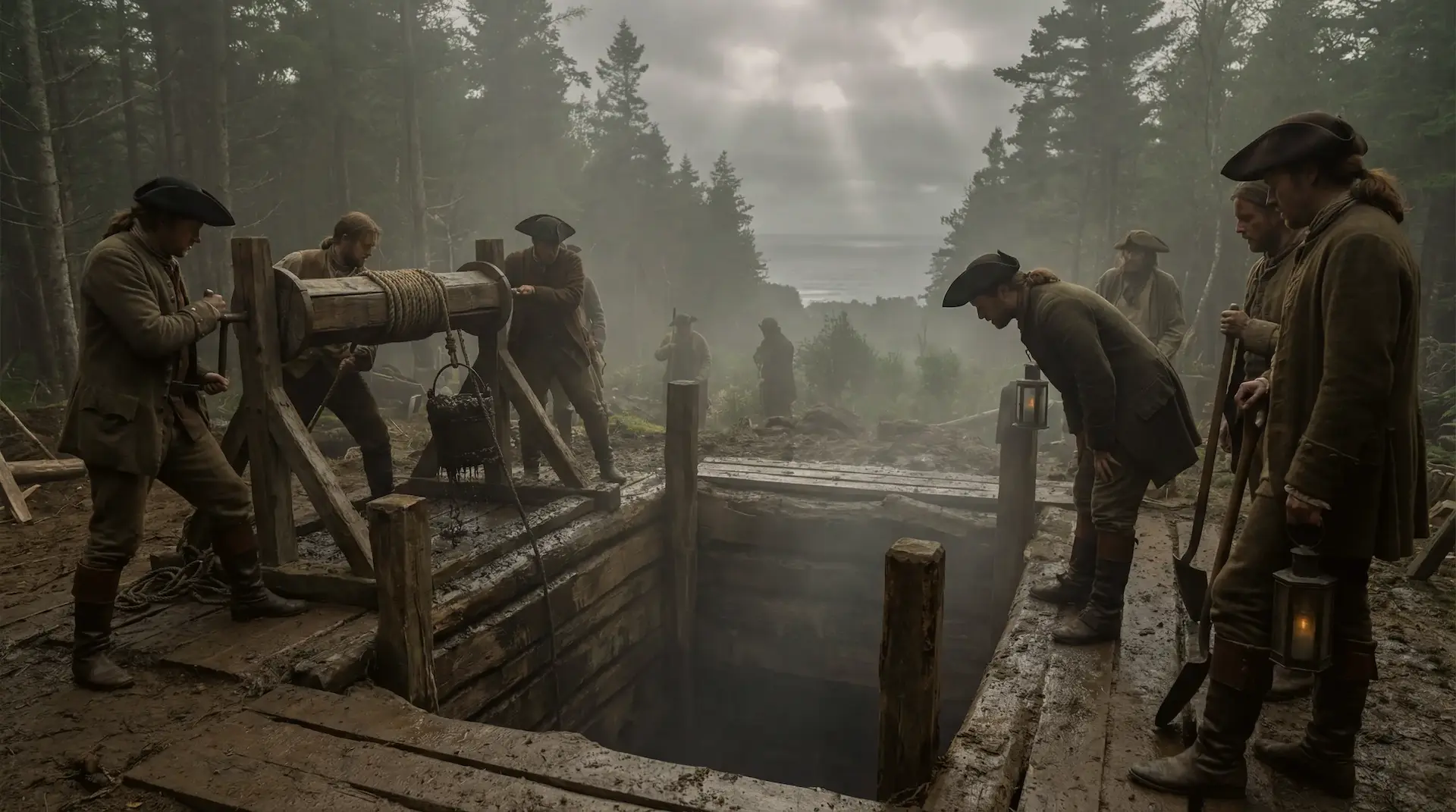 The Oak Island Money Pit→
The Son of the Duc d'Anville
1 min
Louis-Alexandre de La Rochefoucauld was born in Paris on July 4, 1743. He was the only son of Jean-Baptiste de La Rochefoucauld de Roye, who held the title Duc d'Anville and served as Lieutenant General of the Naval Armies of France. In 1746, when Louis-Alexandre was three years old, his father was appointed to command the largest military fleet France had ever assembled for operations in the New World: 64 ships and approximately 11,000 men, dispatched to recapture Nova Scotia from the British. The expedition was a disaster. Storms, disease, and poor planning destroyed most of the fleet before it reached its objective. The Duc d'Anville himself died of a stroke in Halifax Harbour on September 27, 1746, six days after arriving. His son grew up fatherless, inheriting one of the oldest noble titles in France and whatever private knowledge the family retained of the expedition's final days.
Louis-Alexandre became one of the most accomplished noblemen of the French Enlightenment. He was elected to the Royal Academy of Sciences, served as president of the Academy of Medicine, and travelled extensively across Europe. He inherited the title 6th Duke of La Rochefoucauld from his grandfather in 1762. His mother, the Duchesse d'Anvil (also spelled d'Enville), maintained one of the most influential salons in Paris, where she received Turgot, Condorcet, Adam Smith, and, in time, Benjamin Franklin.
Franklin in Paris
2 min
Benjamin Franklin arrived in France on December 3, 1776, officially to negotiate a treaty of cooperation and alliance with the French Crown. He was received in Paris on December 21 by Silas Deane and Arthur Lee. Within weeks, he had renewed an acquaintance with the La Rochefoucauld family that would deepen into one of the most productive partnerships of his decade in France.
The first documented communication between the duke and Franklin dates to January 20, 1777, when La Rochefoucauld sent Franklin and Deane fifty copies of a translated document, probably the draft Articles of Confederation. The editors of the Franklin Papers at Yale University Press note that this was "the first communication from a man who, with his mother, soon became part of Franklin's circle, and who corresponded with him intermittently for the rest of the Doctor's life." Franklin had met the mother on an earlier visit to Paris, and the son at a dinner in London in 1769, but the connection had been casual. The American crisis made it something else entirely.
Six days later, on January 26, 1777, Franklin dined at the duke's residence. Writing to Mary Hewson the same day, he noted casually: "Yesterday, we dined at the Duke of La Rochefoucauld's; there were three duchesses and a countess." The letter is held at Yale University Library. On the same evening, after Franklin and Deane had left, the duke received word that the Amphitrite, a ship loaded with arms for the American rebels, had sailed from Brittany. He immediately forwarded the letter to Franklin, asking that it be returned after reading. The intelligence sharing had begun.
According to Daniel Vaugelade, whose 2005 study La Question americaine au XVIIIe siecle a travers la correspondance du duc Louis Alexandre de La Rochefoucauld (Publibook) is the most detailed analysis of this correspondence, Franklin frequented the La Rochefoucauld salon "very regularly, especially from 1777 to 1779." The tone of the salon was serious. "They discuss politics," Vaugelade writes, "they comment on the ups and downs of the war, they celebrate victories, they worry about reversals." The duke's mother, the Duchesse d'Anville, kept a certain distance from Franklin, but admired him. John Adams, visiting the salon, described her as "a venerable old lady; several of her remarks at table seemed marked with good sense, with something of the masculine and the bold."
Arms, Intelligence, and Constitutions
2 min
The correspondence between Franklin and La Rochefoucauld, preserved at the American Philosophical Society, Yale University Library, and the Archives municipales de Mantes, documents a relationship that went well beyond social courtesy. Franklin was sharing classified military intelligence with the duke. In a letter dated approximately January 29, 1778 (Franklin Papers, vol. 25), Franklin reported to La Rochefoucauld the arrival in America of a ship from Marseilles carrying "48 Pieces brass Cannon 4 pounders, with Carriages &c. compleat. 19 brass Mortars 9 Inch. 2500 Bombs. 4110 Fusils. 18000 lb. Gunpowder and other Stores." This was the covert supply chain run through Beaumarchais' fictitious trading house, Roderigue Hortalez et Compagnie, and Franklin was passing the details directly to the son of the Duc d'Anville.
On February 18, 1778, the duke wrote to Franklin inviting him to a concert at his mother's residence, but warned that Lady Stormont, wife of the British ambassador, was among the subscribers. The Franco-American treaty had not yet been publicly announced, and a meeting between Franklin and the ambassador's circle would have been diplomatically awkward. Franklin declined, noting that "he sees clearly with them the Impropriety of his appearing at the concert, under the circumstances mentioned." The La Rochefoucaulds had to manage their guest lists carefully to ensure the American delegation did not encounter their British friends in the corridors of their hotel.
On March 27, 1778, nine days after France officially recognised American independence, the duke wrote to Franklin in celebration: "Finally, Sir, your Nation and ours are declared allies, and the liberator of America is a public Plenipotentiary in France." The letter is held at the American Philosophical Society.
Vaugelade documents that the duke also served as an intelligence intermediary, forwarding sensitive correspondence between Franklin and French officers serving in America. He provided money and uniforms to officers through what Vaugelade describes as "his political and military connections, and the complicity of Franklin." When the Duchesse d'Anville's friend Turgot died on March 18, 1781, Franklin wrote to the family: "Dr. Franklin presents his respectful Compliments to Madame la Duchesse d'Enville, and to Monsieur le Duc de Rochefoucauld; he condoles with them most sincerely on the loss of their excellent Friend M. Turgot, and mingles his Tears with theirs." The letter survives in the Archives municipales de Mantes.
The most visible product of their collaboration was the 1783 publication Constitutions des Treize Etats-Unis de l'Amerique, a French translation of all thirteen American state constitutions, the Declaration of Independence, the Articles of Confederation, and the Franco-American treaties. The duke translated the documents at Franklin's suggestion, with Franklin contributing over fifty footnotes. Only 600 copies were printed, including 100 on large paper for distribution to foreign ministers. The title page bore the first appearance of the Great Seal of the United States in any printed book. The work was a political act, intended to demonstrate to the French public that republican government was viable. The editors of the Franklin Papers note that "numerous letters from the Duc de la Rochefoucauld, all undated, referring to his translations" survive in the collection, and that "Franklin made suggestions" throughout the process. The publication is held at the Library of Congress, Princeton University Library, and the Internet Archive.
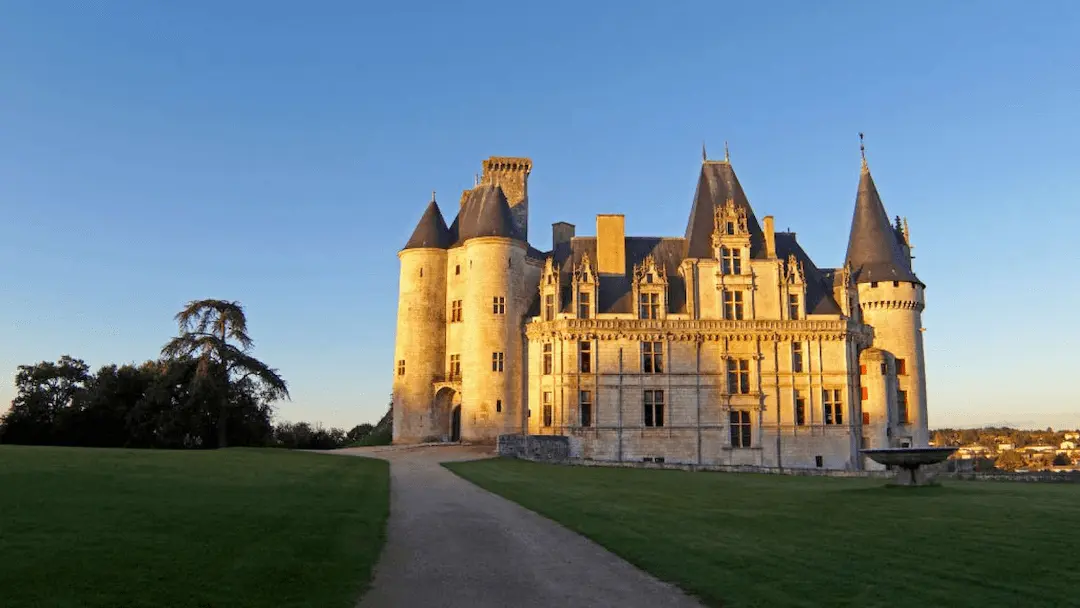 Château de la Rochefoucauld→
The French Secret War
1 min
The Franklin-La Rochefoucauld correspondence took place against the backdrop of one of the most elaborate covert operations of the 18th century. Long before France officially entered the war in 1778, the court of Louis XVI was secretly channelling money and military supplies to the American rebels. The architect of this programme was Charles Gravier, Comte de Vergennes, the French Foreign Minister, who saw the rebellion as an opportunity to weaken Britain after France's losses in the Seven Years' War.
In May 1776, Vergennes approved a scheme devised by Pierre-Augustin Caron de Beaumarchais, a playwright, spy, and arms dealer, to channel aid through a fictitious trading house called Roderigue Hortalez et Compagnie. The French government provided an initial investment of one million livres, Spain added another million, and private investors contributed a third. Through this front company, Beaumarchais ran as many as forty ships across the Atlantic, smuggling gunpowder, muskets, cannons, and uniforms to the Continental Army. Much of this material passed through the neutral Dutch Caribbean island of Sint Eustatius and the French port of Martinique. Military historians writing in the Journal of the American Revolution estimate that Hortalez et Compagnie supplied between two-thirds and three-quarters of the gunpowder used by American forces at the Battles of Saratoga in 1777, the turning point of the war. A 2025 article in the Smithsonian Magazine placed the estimate of French-supplied arms and ammunition at up to 90 percent of what was used in the Saratoga campaign.
When Hortalez et Compagnie was dissolved in 1783, its books revealed over 21 million livres (equivalent to several billion dollars today) had been sent to the United States. The broader French financial commitment to American independence eventually exceeded one billion livres, a debt that contributed directly to the fiscal crisis leading to the French Revolution. The era's statecraft was entirely comfortable with hidden financial arrangements, shell companies, and covert supply lines. That is the world in which Franklin and La Rochefoucauld operated.
Jefferson and the Family
1 min
Thomas Jefferson succeeded Franklin as Minister to France in 1785 and developed his own relationship with the La Rochefoucauld family. The duke wrote to Jefferson (the letter is undated but placed after October 1785 by the editors of the Jefferson Papers at Princeton University Press) declining a dinner invitation and asking for "clarifications on the Description of Virginia," a reference to Jefferson's Notes on the State of Virginia. Jefferson moved in the same circle of Enlightenment reformers that included Lafayette, Condorcet, and the La Rochefoucauld family.
The duke's fate was bound up with the Revolution he helped inspire. On September 4, 1792, during the September Massacres, Louis-Alexandre de La Rochefoucauld was killed by a mob while travelling under escort to his family's estate at La Roche-Guyon, murdered in front of his elderly mother and his wife. He was forty-nine years old. The Marquis de Condorcet, writing to Jefferson on December 21, 1792, called him "a truly virtuous man and friend of liberty." The letter is in the Jefferson Papers, volume 24.
The duke's cousin, Francois-Alexandre-Frederic de La Rochefoucauld-Liancourt, who inherited the dukedom, survived the Terror by fleeing to England and then to the United States. In 1796 he visited Jefferson at Monticello, where they discussed farming, mutual acquaintances in France, and the tobacco trade. His observations were published in 1799 as Travels through the United States of North America. The La Rochefoucauld family's connections to America persisted across generations and upheavals.
The Theory
1 min
A version of the American Revolution financing theory was presented to the Oak Island team in Season 6, Episode 22 ("Lost and Founding"), the 2019 season finale. The theory proposed that Louis-Alexandre de La Rochefoucauld, having inherited knowledge of his father's 1746 expedition, revealed the location of treasure on Oak Island to Franklin and Jefferson during their years together in Paris, and that the Founding Fathers may have attempted to retrieve it to help finance the war.
The physical evidence cited on the show was the Evans Stone, a boulder on the northeastern shore of Lot 14 bearing the date "August 9, 1897," the word "CHESTER," the name "E.W. EVANS," and the image of a horizontal pine tree resembling the Appeal to Heaven flag commissioned by George Washington in 1775. The team counted what appeared to be thirteen branches on each side of the tree, matching the number of colonies represented on variations of the revolutionary flag.
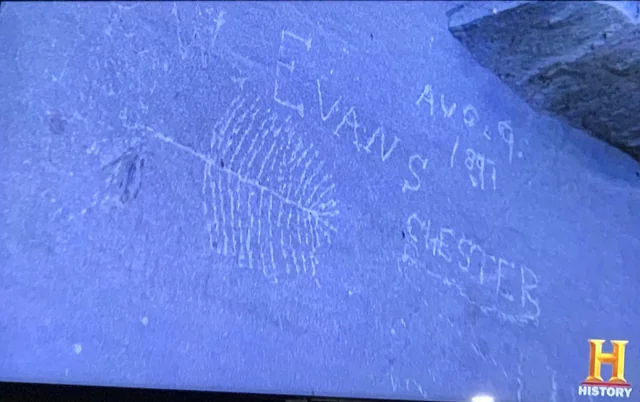 Evans Stone - 13-branched tree carving in rock→
What the Archives Say
3 min
The primary sources tell a clear story about the relationship, and an honest one about its limits. The correspondence between Franklin and La Rochefoucauld, accessible through Founders Online (the National Archives' digital edition of the Papers of Benjamin Franklin, published by Yale University Press), documents a partnership that began in January 1777 and lasted until Franklin's departure from France in 1785. The duke translated American founding documents at Franklin's request. Franklin shared arms shipment intelligence with the duke. The duke forwarded sensitive military correspondence on Franklin's behalf and served as a conduit between the American delegation and French officers fighting in the war. The Duchesse d'Anville hosted Franklin at her salon on the rue de Seine, where politics, the war, and the future of the American republic were the regular topics of conversation.
At the same time, Franklin held 20,000 acres of Nova Scotia land, was part of a Philadelphia syndicate that claimed hundreds of thousands of acres across the province, and had agents physically managing settlements there. His collaborator in Paris was the orphaned son of the French admiral who died attempting to retake that same province thirty years earlier. Vaugelade notes that the general staff may have hesitated to send the duke into combat "thinking of the sad death of his father in Canada in 1746," and that Jean-Baptiste de La Rochefoucauld wrote recommendations during the expedition that influenced subsequent French naval reform. The father's expedition was not a secret. Its catastrophic failure was a matter of public record, and its lessons shaped French military policy for decades.
What does not appear in any surviving letter, at any of the three archives where the correspondence is held, is a reference to Oak Island, to treasure in Nova Scotia, to the Duc d'Anville expedition in connection with buried wealth, or to any plan to retrieve hidden assets from the province. The Franklin Papers have been exhaustively catalogued and published across more than forty-seven volumes. The Jefferson Papers have been similarly treated by Princeton University Press. The silence, across tens of thousands of pages of correspondence by two of history's most prolific letter writers, is significant.
What the documents do establish is a set of connections. Charles Morris surveyed Oak Island into 32 lots in 1762 and processed Benjamin Franklin's 20,000-acre land grant through the same office five years later. Daniel McGinnis, a Loyalist settler whose father had fought on the British side in the same war Franklin helped fund from Paris, began purchasing Oak Island lots within Morris's grid in 1788. Franklin was still alive, still holding his Nova Scotia lands, and still corresponding with the son of the French admiral who had died trying to take the province. When McGinnis discovered the Money Pit on lot 18 in 1795, Franklin had been dead for five years. The lands he owned 80 kilometres away were passing to the Loyalist son he had disinherited.
None of this proves that Franklin knew about Oak Island. But the people, the institutions, and the land records of colonial Nova Scotia connect these stories through the same office and the same provincial administration. The Surveyor General who drew the lines on Oak Island also drew the lines on Franklin's property. The man who found the Money Pit bought his lots in a system that same office created. And the aristocrat who translated the American Constitution at Franklin's dining table was the fatherless son of the man who died leading 11,000 men to the shores of the province where all of this land was held.
Sources
6 min
Primary correspondence (Franklin-La Rochefoucauld):
- Duc de La Rochefoucauld to Benjamin Franklin and Silas Deane, January 20, 1777. First documented communication. The duke sends fifty copies of a translated document, probably the Articles of Confederation. American Philosophical Society. Published in The Papers of Benjamin Franklin, vol. 23 (Yale University Press, 1983). Founders Online, National Archives: founders.archives.gov/documents/Franklin/01-23-02-0128.
- La Rochefoucauld to Franklin and Silas Deane, c. January 26, 1777. Forwards a letter about the departure of the Amphitrite, asks Franklin to return it after reading. American Philosophical Society. Franklin Papers, vol. 23. Founders Online: founders.archives.gov/documents/Franklin/01-23-02-0147.
- Benjamin Franklin to Mary Hewson, January 26, 1777. "Yesterday, we dined at the Duke of La Rochefoucauld's; there were three duchesses and a countess." Yale University Library. Cited in Vaugelade, p. 49.
- La Rochefoucauld to Franklin, March 26, 1777. American Philosophical Society. Franklin Papers, vol. 23. Founders Online: founders.archives.gov/documents/Franklin/01-23-02-0343.
- Franklin to La Rochefoucauld and the Duchesse d'Enville, April 25, 1777. Constitutional translation corrections for the Virginia constitution. Franklin Papers, vol. 23. Founders Online: founders.archives.gov/documents/Franklin/01-23-02-0416.
- Duc de La Rochefoucauld to Franklin, c. June 8, 1777. Dinner invitation on behalf of his mother for Franklin and Silas Deane; offers to carry commissions to Rouen. American Philosophical Society. Franklin Papers, vol. 24 (Yale University Press, 1984). Founders Online: founders.archives.gov/documents/Franklin/01-24-02-0108.
- Franklin to La Rochefoucauld, c. June 7, 1777. Apology for delaying documents; "My time every day is devoured by applications of Officers and people who would go to America." Yale University Library. Cited in Vaugelade, p. 67.
- Franklin to La Rochefoucauld, c. January 29, 1778. Reports arrival of arms from Marseilles: "48 Pieces brass Cannon 4 pounders, with Carriages &c. compleat. 19 brass Mortars 9 Inch. 2500 Bombs. 4110 Fusils. 18000 lb. Gunpowder." Franklin Papers, vol. 25 (Yale University Press, 1986). Founders Online: founders.archives.gov/documents/Franklin/01-25-02-0435.
- Franklin to La Rochefoucauld, February 6, 1778. Translation discussion regarding the word "habilite" vs. "industrie." Franklin Papers, vol. 25. Founders Online: founders.archives.gov/documents/Franklin/01-25-02-0480.
- La Rochefoucauld to Franklin, February 18, 1778. Concert invitation; warns that Lady Stormont is a subscriber. American Philosophical Society. Franklin Papers, vol. 25. Founders Online: founders.archives.gov/documents/Franklin/01-25-02-0538.
- Franklin to La Rochefoucauld, February 18, 1778. Declines the concert: "He sees clearly with them the Impropriety of his appearing at the concert, under the circumstances mentioned." Archives municipales de Mantes. Cited in Vaugelade, p. 58.
- La Rochefoucauld to Franklin, March 27, 1778. Celebrates the Franco-American alliance: "Enfin Monsieur voila donc votre Nation et la notre alliees declarees." American Philosophical Society. Franklin Papers, vol. 26 (Yale University Press, 1987). Founders Online: founders.archives.gov/documents/Franklin/01-26-02-0130.
- Franklin to La Rochefoucauld, January 21, 1778. War intelligence regarding General Howe's movements at Philadelphia. Archives municipales de Mantes, author's translation. Cited in Vaugelade, p. 63.
- La Rochefoucauld to Franklin, February 23, 1781. Dinner invitation from mother and son. American Philosophical Society. Cited in Vaugelade, p. 59.
- Franklin to Duchesse d'Enville and Duc de La Rochefoucauld, March 31, 1781. Condolence on Turgot's death: "he condoles with them most sincerely on the loss of their excellent Friend M. Turgot, and mingles his Tears with theirs." Archives municipales de Mantes. Franklin Papers, vol. 34 (Yale University Press, 1998). Founders Online: founders.archives.gov/documents/Franklin/01-34-02-0390.
- Comte de Sarsfield to Franklin, June 23, 1779. Invitation to dine with the Duchesse d'Enville. American Philosophical Society. Cited in Vaugelade, p. 59.
Primary correspondence (Jefferson-La Rochefoucauld):
- La Rochefoucauld to Thomas Jefferson, c. 1786. Declines dinner; requests "clarifications on the Description of Virginia." Yale University (CtY). Jefferson Papers, vol. 10 (Princeton University Press, 1954). Founders Online: founders.archives.gov/documents/Jefferson/01-10-02-0510.
- Condorcet to Thomas Jefferson, December 21, 1792. On La Rochefoucauld's death: "homme vraiment vertueux et ami de la liberte." Jefferson Papers, vol. 24 (Princeton University Press, 1990). Founders Online: founders.archives.gov/documents/Jefferson/01-24-02-0752.
- La Rochefoucauld-Liancourt to Thomas Jefferson, July 11, 1796. Visit to Monticello. Jefferson Papers, vol. 29 (Princeton University Press, 2002). Founders Online: founders.archives.gov/documents/Jefferson/01-29-02-0111.
Franklin's Nova Scotia land grants:
- Privy Council, Order for a Grant of Land for Benjamin Franklin, June 26, 1767. Orders the governor to survey 20,000 acres in Nova Scotia. Public Record Office. Franklin Papers, vol. 14 (Yale University Press, 1970). Founders Online: founders.archives.gov/documents/Franklin/01-14-02-0116.
- Privy Council, Referral of Franklin's Application, February 10, 1766. Franklin Papers, vol. 13 (Yale University Press, 1969). Founders Online: founders.archives.gov/documents/Franklin/01-13-02-0033.
- Montagu Wilmot to Alexander McNutt and Associates: Two Land Grants, October 31, 1765. McNutt syndicate grants including "Dr. Franklin and Co." Franklin Papers, vol. 12 (Yale University Press, 1968). Founders Online: founders.archives.gov/documents/Franklin/01-12-02-0175.
- William Franklin to Benjamin Franklin, October 23, 1767. Acknowledges receipt of the Nova Scotia grant: "I have not the least doubt but something handsome might be made of it if well managed." Franklin Papers, vol. 14. Founders Online: founders.archives.gov/documents/Franklin/01-14-02-0173.
- Benjamin Franklin, Last Will and Testament, July 17, 1788. "To my son, William Franklin, late Governor of the Jerseys, I give and devise all the lands I hold or have a right to in the Province of Nova Scotia."
- Benjamin Franklin to Cadwallader Colden, October 16, 1746. William Franklin commissioned as ensign for the 1746 expedition against Canada. Franklin Papers, vol. 3 (Yale University Press, 1961). Founders Online: founders.archives.gov/documents/Franklin/01-03-02-0040.
Published books and scholarly works:
- Daniel Vaugelade, La Question americaine au XVIIIe siecle a travers la correspondance du duc Louis Alexandre de La Rochefoucauld (Paris: Publibook, 2005). The principal scholarly study of the duke's American correspondence. Draws on material held at the American Philosophical Society, Yale University Library, and the Archives municipales de Mantes.
- The Papers of Benjamin Franklin, 47+ volumes (New Haven and London: Yale University Press, 1959-). The authoritative edition, digitised on Founders Online (founders.archives.gov).
- The Papers of Thomas Jefferson, main series (Princeton: Princeton University Press, 1950-). Digitised on Founders Online.
- L. S. Livingston, Franklin and His Press at Passy (New York: Grolier Club, 1914). Documentation of the Constitutions des Treize Etats-Unis and the duke's role as translator.
- Solange Fasquelle, Les La Rochefoucauld: une famille dans l'Histoire de France (Paris: Perrin, 1999). Family history covering the d'Anville expedition and the duke's political career.
- Francois-Alexandre-Frederic de La Rochefoucauld-Liancourt, Travels through the United States of North America, 2 vols. (London, 1799). Observations from the cousin's 1795-1797 journey, including the Monticello visit.
- George Rawlyk, Yankees at Louisbourg (Orono: University of Maine Press, 1967). Context for the 1745 capture of Louisbourg and the French response.
- L. H. Butterfield, ed., Adams Family Correspondence (Cambridge: Harvard University Press). John Adams's description of the Duchesse d'Enville. Cited in Vaugelade, p. 56.
- A. O. Aldridge, B. Franklin et ses contemporains francais (Paris, 1963). Letter of the Abbe de Flamarens, January 15, 1777, describing Franklin's reception in Paris. Cited in Vaugelade, p. 49.
The 1783 publication:
- Benjamin Franklin and Louis-Alexandre de La Rochefoucauld, Constitutions des Treize Etats-Unis de l'Amerique (Philadelphia [i.e. Paris]: Ph.-D. Pierres, Pissot, 1783). 600 copies printed, including 100 on large paper. First appearance of the Great Seal of the United States in a printed book. Held at Library of Congress, Princeton University Library, Boston Public Library (John Adams Library copy), and Internet Archive.
Beaumarchais and French covert financing:
- "Clarifying Beaumarchais," Journal of the American Revolution, September 2020. Hortalez et Compagnie operations and gunpowder estimates at Saratoga.
- "America's First Black Ops," Journal of the American Revolution, September 2017. Detailed breakdown of ship manifests, the Vergennes/Duvergier laundering scheme, and Amphitrite cargo.
- "How an American Merchant, a French Official and a Pioneering Chemist Smuggled Much-Needed Gunpowder to the Continental Army," Smithsonian Magazine, April/May 2025. French-supplied arms estimated at up to 90 percent of the Saratoga campaign.
Nova Scotia land history:
- Nova Scotia Archives, Land Papers 1765-1800. Digital resource: archives.novascotia.ca/land-papers/grants.
- George Patterson, History of Pictou County (Montreal, 1877), Chapter 4. "Dr. Franklin and Co." among fifteen companies seeking Nova Scotia grants.
- Enfield, Nova Scotia, Wikipedia article. Documents Franklin's 20,000 acres at present-day Enfield, Jacob Hall as land agent, and the Wayside Inn.
- Alexandra Montgomery, "Not Subject to the Scorn and Contumely of the Great: Alexander McNutt's Nova Scotia," The New Canadian History, May 2017. McNutt syndicate and the 1765 land rush.
Television:
- The Curse of Oak Island, Season 6, Episode 22: "Lost and Founding" (History Channel, 2019). Season finale in which the American Revolution financing theory was presented to the Oak Island team.