In the Season 6 finale, Rick and Marty Lagina visit veteran treasure hunter Dan Blankenship at his home to share the dendrochronology results from Smith's Cove. When told that the U-shaped structure and slipway have been dated to 1769 with 99.99 percent accuracy by Dr. Colin Laroque at the University of Saskatchewan, Dan, who first discovered both structures during his own large-scale investigation in the early 1970s, absorbs the news with visible interest. The date places construction more than 25 years before the discovery of the Money Pit in 1795. Dan admits he always suspected the structures were old but was never clear whether they were original or searcher-built. Marty calls it conclusive proof that something substantial preceded the Money Pit, and Rick notes how important it is to give Dan these answers after decades of dedication to the island.
Back at Smith's Cove, with less than a week before winter shutdown, the team races to locate the flood tunnel convergence point beneath the beach. Billy Gerhardt begins excavating inside the U-shaped structure at Rick's direction. Wooden boards packed with clay emerge from the ground, raising the possibility that they were placed either by 1850s searchers attempting to block the flood tunnel or by the original builders themselves. When the Onslow Company excavated the Money Pit to 90 feet in 1804, packed clay was found at the 40-foot level, likely placed to protect whatever lay below from groundwater. The parallel is not lost on the team. Further digging reveals massive uprights and a second wooden wall just five feet behind the first. Rick notes that the U-shaped structure, Billy's wall, the rock formation, and these new walls all fall on a single line, suggesting a deliberate alignment of structures leading inland from Smith's Cove toward the Money Pit.
As daylight operations at Smith's Cove wind down, Eagle Canada begins their seismic survey of the triangle-shaped swamp under cover of darkness to minimize wind interference with the geophone recorders. More than 2,000 explosive charges, each containing 20 grams of dynamite, are detonated across the swamp to generate underground imaging at depths of 20 feet and below. Rick, Marty, and Charles Barkhouse observe the operation alongside the Eagle Canada team, including Jared and Alex G., who confirm that by the end of the night's shooting they will be roughly halfway through the survey. Marty predicts that whatever the data reveals will likely be something nobody anticipated.
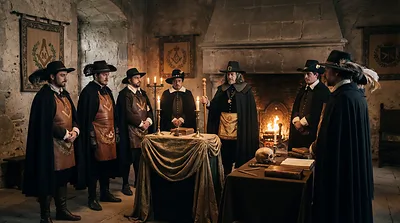
In the War Room, treasure hunter Justin Cannady and researcher Bruce Lindahl, joined by Bruce's brother Cort Lindahl via video from California, present a theory connecting the Zena Halpern map to the American Founding Fathers through the Rochefoucauld family. Cort, a professional land surveyor and author with more than 40 years of research experience, explains that Louis Alexandre Rochefoucauld, the son of the Duc d'Anville who led the 1746 naval expedition to Nova Scotia, maintained close friendships with Benjamin Franklin and Thomas Jefferson. He argues that through these relationships, the Rochefoucaulds may have shared knowledge of Oak Island and its treasure, possibly helping finance the Revolutionary War. Cort adds that French families in Nova Scotia corresponded with George Washington before the war, attempting to convince him that Nova Scotia should become the 13th colony, and notes that the number 13 held sacred significance in Freemasonry. The season closes with a round-table reflection. Dan Blankenship urges the team to trust the physical evidence they can hold in their hands. Rick asks everyone to put their hands in for the team's rallying call, and Marty, looking ahead, declares his belief that they are the only searchers in more than 200 years to have proved that something substantial happened on Oak Island before the Money Pit was ever found.