The Privateer
1 min
William Kidd was born around 1645 in Dundee, Scotland, and by the 1690s had established himself as a respected sea captain in New York. He owned property in Manhattan, attended the English Church, and moved in colonial high society. In 1695, the Earl of Bellomont, newly appointed governor of New York, Massachusetts Bay, and New Hampshire, offered Kidd a royal commission to hunt pirates and French vessels in the Indian Ocean. The backers behind the venture included some of the most powerful men in England, among them the Lord Chancellor and the Secretary of State. It was a legitimate assignment with powerful political sponsors, and Kidd sailed from New York in September 1696 aboard the Adventure Galley, a 34-gun warship with a crew of 150.
The voyage went badly from the start. The crew grew mutinous, provisions ran low, and prizes proved elusive. Under pressure from his men, Kidd captured the Quedagh Merchant in January 1698, a 400-ton Armenian trading vessel sailing under French passes. Whether this constituted piracy or fell within the bounds of his commission has been debated for more than three centuries. Kidd insisted it was a lawful prize taken under French colours. But political winds in London had shifted against him. His powerful backers, now embarrassed by association, disowned him. By the time Kidd sailed north along the American coast in 1699, he was a wanted man.
Gardiners Island: The Confirmed Burial
1 min
Before surrendering to Governor Bellomont in Boston, Kidd made a stop that would cement his place in treasure-hunting lore. In June 1699, he buried a cache of valuables on Gardiners Island, a small private island off the eastern tip of Long Island. This is not legend. Bellomont had the deposit recovered and shipped to England, where it was catalogued and used as evidence at Kidd's trial. The inventory included over 1,000 troy ounces of gold, more than 2,000 troy ounces of silver, gold dust, rubies and other precious stones, silk, and 57 bags of sugar. At the time, this represented a substantial fortune, though far less than the full value of the Quedagh Merchant's cargo.
Kidd was arrested in Boston on 6 July 1699, imprisoned for over a year, then shipped to London in chains. His trial at the Old Bailey in May 1701 was widely seen as politically motivated. The French passes from the Quedagh Merchant, which could have supported his defence, had conveniently disappeared. He was found guilty of piracy and the murder of a crewman named William Moore, whom he had struck with a wooden bucket during an argument. On 23 May 1701, Kidd was hanged at Execution Dock in Wapping. The rope broke on the first attempt. He was hanged a second time and his body was gibbeted over the Thames as a warning to others.
To the end, Kidd insisted that he had hidden more treasure elsewhere and offered to lead his captors to it in exchange for his life. The offer was refused. That claim, made by a desperate man with a noose around his neck, launched centuries of searching.
The Dying Sailor and the Origin of the Legend
1 min
The connection between Kidd and Oak Island begins with a story first recorded in print in 1863 by the Liverpool Transcript, though it had been circulating orally among Nova Scotia settlers for decades before that. According to the tradition, a dying sailor from Kidd's crew confessed that treasure worth two million pounds had been buried on an island "east of Boston." The tale was vague enough to apply to dozens of islands along the Atlantic coast, but specific enough to capture the imagination of anyone who lived near one.
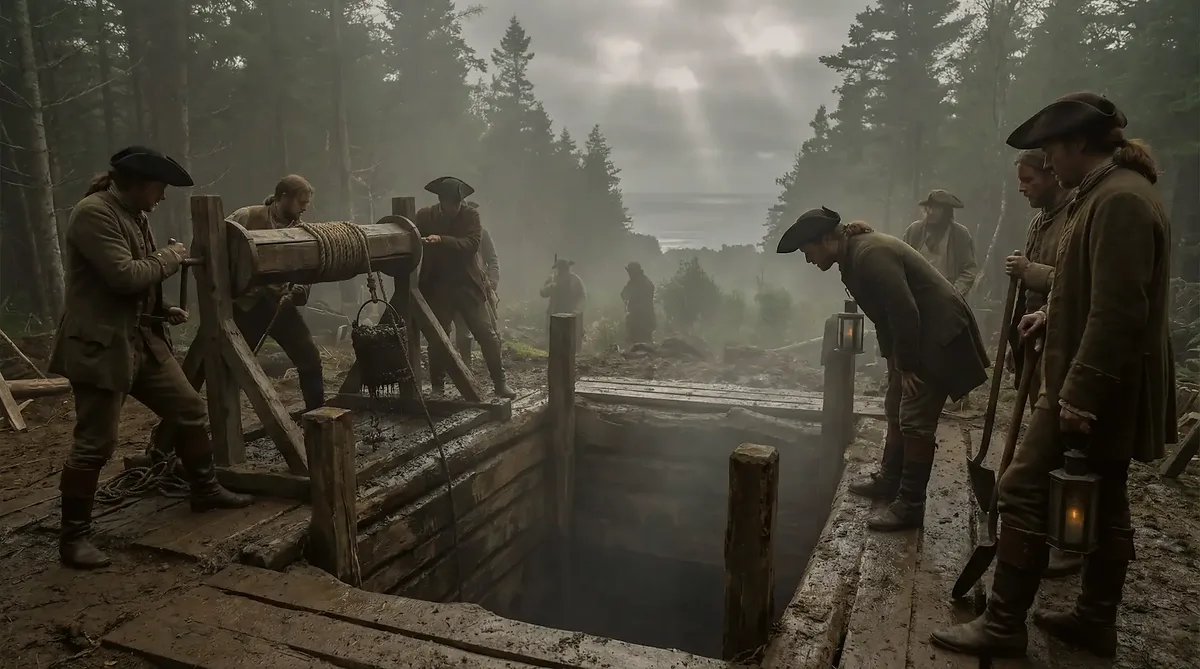
When Daniel McGinnis found a circular depression beneath an old oak tree on Oak Island in 1795, with what was described as a ship's tackle block hanging from one of the branches, it was the Kidd legend he thought of first. That assumption shaped everything that followed. The Onslow Company, the Truro Company, and every early expedition dug with pirates in mind. The Money Pit was, from its very first excavation, understood as a pirate vault. Whether or not Kidd had anything to do with Oak Island, his name was the reason people started digging there, and the reason they never stopped.
The Kidd-Palmer Maps
2 min
In 1929, a retired English lawyer and collector of pirate relics named Hubert Palmer purchased a heavy oak bureau bearing the inscription "Captain William Kidd, Adventure Galley 1669." When a runner supporting the lid broke off, Palmer noticed the barely legible words "William Kidd, his chest" carved on it. The runner was hollow, sealed with wax stamped with an anchor. Inside was a brass tube containing a scrap of yellowed parchment depicting an unnamed island, marked with an X, the words "China Sea," and the initials "W.K. 1669."
Over the following years, Palmer tracked down three more pieces of 17th century furniture said to have belonged to Kidd: two sea chests and a small workbox inscribed "William and Sarah Kidd, their box," found in Jersey in the Channel Islands. Each contained a hidden compartment, and each compartment held a hand-drawn map depicting what appeared to be the same island, with increasing levels of detail. The third map showed hills, a lagoon, reefs, four conspicuous dots, and a cross connected by a red zigzag line. It included a compass bearing and cryptic wording believed to be directions for recovering the treasure. The fourth was found beneath the beading of the workbox.
After Palmer's death in 1949, the maps passed to his housekeeper, Elizabeth Dick, who took them to the British Museum. Map expert R.A. Skelton examined all four charts and expressed the opinion that they were genuine 17th century documents. Dick sold the maps around 1950 to an Englishman who later moved to Canada. Their current whereabouts are unknown.
Many have noted that the island depicted in the Palmer charts bears a resemblance to both Gardiners Island and Oak Island, though others have argued the shape corresponds more closely to Juan Fernandez Island off the coast of Chile. The "China Sea" inscription, if taken at face value, points to none of these locations. Sceptics regard the maps as elaborate forgeries. Supporters argue that "China Sea" was a deliberate misdirection, a common pirate tactic to protect the real location of a cache.
Wilkins, Hedden, and the Impossible Coincidence
2 min
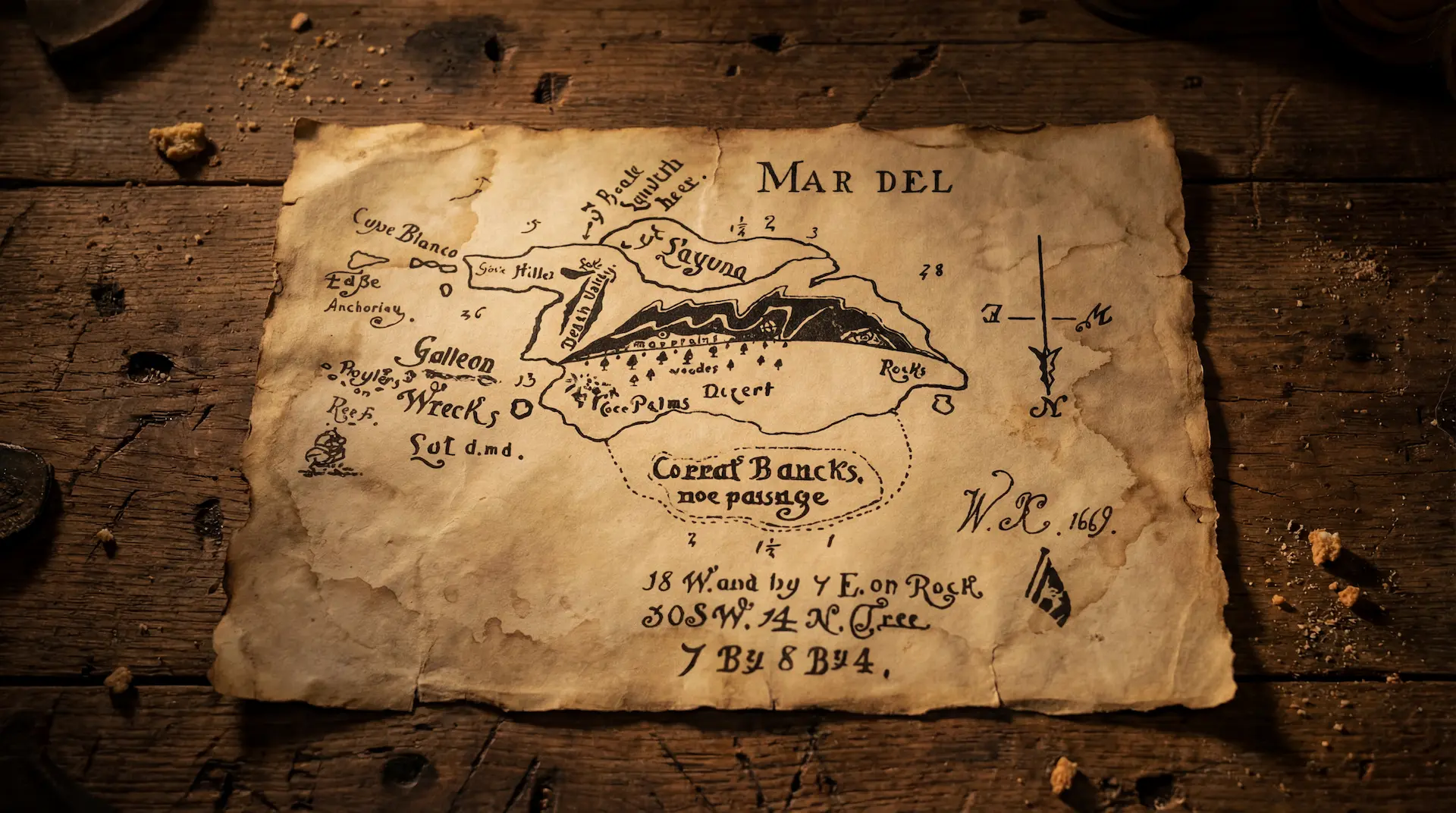
The maps gained unexpected prominence through a chain of events so improbable that it borders on farce. In 1935, British journalist Harold T. Wilkins published "Captain Kidd and His Skeleton Island," a historical fiction book about pirates and buried treasure. Palmer had refused to let Wilkins reproduce photographs of the Kidd charts, so Wilkins drew his own map from memory, inventing the treasure-hunting directions at his publisher's insistence.
Two years later, R.V. Harris, a Halifax lawyer working for Oak Island treasure trove licence holder Frederick Blair, discovered the map in Wilkins' book. He noticed that it bore a striking resemblance to Oak Island. Harris identified fourteen correspondences between the fictional map and the real geography of the island, and only one minor discrepancy. The lagoon matched the swamp. The elevations matched the hills. The cross fell on the location of the Money Pit.
Gilbert Hedden, a wealthy New Jersey businessman who had purchased the treasure trove licence, was electrified by the discovery. He had already found a triangle of beach stones on Oak Island laid out in the shape of a rough sextant, pointing toward the Money Pit. The distances between landmarks on the island corresponded with the directions on Wilkins' map when measured in old English rods. Hedden travelled to London in December 1937 to meet the author.
The meeting was strange. Wilkins confessed that the map was entirely his own fabrication. But as Hedden described the drilled stones, the stone triangle, the Cave-in Pit, and the peculiar alignments on Oak Island, Wilkins became convinced he was the reincarnation of a 17th century pirate, possibly Kidd himself, and that his subconscious mind had conjured genuine instructions from some forgotten past life. Hedden walked away thinking Wilkins was, in his own words, "every bit as crazy as his book would make him seem." The coincidences between Wilkins' imaginary map and the real geography of Oak Island have never been satisfactorily explained.
Henry Every and the Communal Bank
1 min
A more ambitious version of the pirate theory places Kidd not as a lone depositor but as a partner in a larger operation. Henry Every, known as the "King of Pirates," pulled off what has been called the most profitable act of piracy in history when he seized the Mughal ship Ganj-i-Sawai in 1695, capturing a fortune estimated at several hundred thousand pounds in gold, silver, and jewels. Every vanished completely after the raid, and neither his treasure nor his body was ever recovered.
According to a tradition that appears in the earliest accounts of the Oak Island mystery, Kidd and Every used the island as a communal bank, hiding their combined riches in a shared vault. The theory gained new life in 2014, when historian and metal detectorist Jim Bailey unearthed a 17th century Yemeni coin at a pick-your-own orchard in Middletown, Rhode Island. The coin was minted in 1693, consistent with the type of currency seized from the Ganj-i-Sawai. Further Yemeni coins turned up at sites across Rhode Island and Massachusetts. Testimony from captured members of Every's crew confirmed that at least one of their ships sailed from the Bahamas through Virginia and New England before crossing to Ireland, placing Every's men in American colonial waters in 1696.
The coin finds prove that Every's crew passed through New England. They do not prove a connection to Nova Scotia, and no physical evidence on Oak Island has been directly linked to Every. But the geographical and chronological overlap between the two pirates remains one of the more compelling threads in the pirate tradition. Every had the treasure. Kidd had the confirmed habit of burying it. Oak Island sat between their known operating grounds.
Evidence on the Island
1 min
Several finds on Oak Island fall within the window of pirate activity. During Season 5 of The Curse of Oak Island, metal detection expert Gary Drayton recovered two 17th century English coins from the island's surface. The presence of contemporaneous British coins alongside the 17th century Spanish coin previously found in the Oak Island swamp was considered consistent with pirate operations, since pirate crews routinely handled currency from multiple nations.
An earlier discovery adds an intriguing detail. During William Chappell's excavation in 1931, artefacts recovered at 127 feet included an axe, a fluke anchor, and a pick identified as a Cornish miner's pick. If authentic to the original deposit (rather than debris from prior search attempts), a Cornish miner's pick suggests the involvement of experienced tunnellers. Some proponents of the pirate theory have noted that Every was known to have recruited west countrymen, many of whom would have had experience working in the tin mines of Cornwall.
Carbon dating of wood and other materials from the Money Pit has returned dates ranging from the early 1600s to the mid-1700s, a window that encompasses the careers of Kidd, Every, Blackbeard, and dozens of other pirates operating in Atlantic waters.
The Case Against
1 min
The strongest argument against Kidd as the builder of the Money Pit is one of scale. The shaft, with its precisely layered oak platforms every ten feet, its fills of charcoal, putty, and coconut fibre, and its apparent flood tunnel system connected to Smith's Cove, represents a major engineering project requiring significant manpower, technical knowledge, and time. Pirates were sailors and fighters, not civil engineers. They lived hard, spent freely, and rarely stayed in one place long enough to undertake anything approaching this level of construction.
Then there is the problem of secrecy. A project of this size would have required dozens of workers, possibly more. Pirates were not known for keeping secrets. They drank, they moved between crews, and they talked. Beyond the dying sailor legend, no confession, no rumour, and no drunken boast connecting a specific pirate crew to Oak Island has ever surfaced in the historical record.
Kidd's documented treasure, recovered from Gardiners Island, was buried in a shallow pit on an open beach. It required no engineering, no flood tunnels, and no imported materials. It was the act of a man in a hurry, not the work of a construction crew. Whether Kidd had a second, larger cache hidden elsewhere remains possible but unproven. What is certain is that his name, more than any other, is the reason Oak Island became a treasure island in the first place.