About This Coin
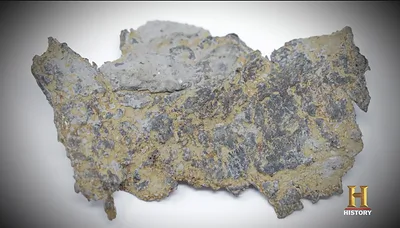
A heavily worn silver sixpence recovered by Katya Drayton from Dunfield / Money Pit spoils on Lot 18, where 1965 treasure hunter Robert Dunfield's 100-foot crater was abandoned at 143 feet when seawater overwhelmed the operation and the displaced fill was never sifted at the time. Searching alongside Katya were surveyor Steve Guptill and heavy equipment operator Billy Gerhardt, who turned over a fresh pile shortly before the find. The edges of the coin showed no visible milling, a feature initially read in the field as evidence of seventeenth-century or earlier hammered coinage. At the laboratory, Emma Culligan returned an XRF reading of roughly 87 percent silver, slightly below the 92.5 percent sterling standard, a result consistent with prolonged surface wear on a long-buried specimen. CT imaging brought out the bust on the obverse and the partial legend MVS, the closing letters of GVLIELMVS, the Latin form of William used on William III obverse inscriptions. Overlaid against a reference example, the coin matched a William III sixpence struck between 1697 and 1701, part of the milled silver issued under the Great Recoinage of 1696. The recoinage program, overseen by Sir Isaac Newton in his role as Master of the Mint, replaced the country's clipped and forged hammered silver with machine-struck coins protected by grained or inscribed edges. On the Oak Island specimen the original grained edge has been worn smooth, which accounts for the initial field reading of an unmilled coin. The sixpence belongs to a small group of seventeenth and early eighteenth century British coins recovered on Oak Island. The team described the piece as an object likely carried by someone of means, leaving open whether it was lost by an early searcher or by an original depositor. Tied to the Money Pit deposit itself, the date would push that deposit no earlier than 1697, half a century before the British founding of Halifax in 1749.
The Season 5 episode S05E03 (Obstruction) recorded the first William III coin from Money Pit spoils: a 1694 copper recovered by Katya's father Gary Drayton from Dunfield / Money Pit spoils on Lot 16, alongside a 1673 Charles II piece. The cast read the 1694 date on camera but could not identify the monarch from the worn obverse. Because Charles II had died in 1685, the 1694 date placed that coin in the reign of William III. See the 1673 Charles II and 1694 William III Britannia coins entry for the Season 5 finds.
Historical Context
Recovered Season 13 from Robert Dunfield's 1965 spoils on Lot 18 by Katya Drayton. XRF and CT-overlay analysis performed by Emma Culligan in the laboratory; identified as a William III sixpence by reference match.
Where It Was Found
Found at Dunfield spoils from the Money Pit. Location: the original 1795 excavation shaft on Oak Island, Nova Scotia.
Gallery