The Most Dangerous Place in the Empire
1 min
Between 1710 and 1763, Nova Scotia was the site of six colonial wars. Control of the territory passed between France and Britain repeatedly, and each transfer was paid for in blood. Father Rale's War, Father Le Loutre's War, King George's War, the Seven Years' War: the names have faded from popular memory, but in the eighteenth century the Atlantic coast of Canada was among the most violently contested ground on earth.
The British made six attempts to conquer the Acadian capital before finally succeeding at the Siege of Port Royal in 1710. Over the following fifty years, the French and their Indigenous allies launched six more campaigns to take it back. Into this arena the British poured men, ships and money on a scale that dwarfed almost anything else happening in North America. The 40th Regiment of Foot was stationed in Nova Scotia for 46 consecutive years, from 1717 to 1763. Halifax was founded in 1749 not as a settlement but as a military fortress, purpose-built to counterbalance the French stronghold at Louisbourg on Cape Breton Island. By the 1750s the Royal Navy maintained a squadron in the North Atlantic, and Halifax harbor served as its main base. Regiments rotated through the garrison, engineers fortified the coastline, and payroll, supplies and captured spoils moved through the region in quantities that required serious protection.
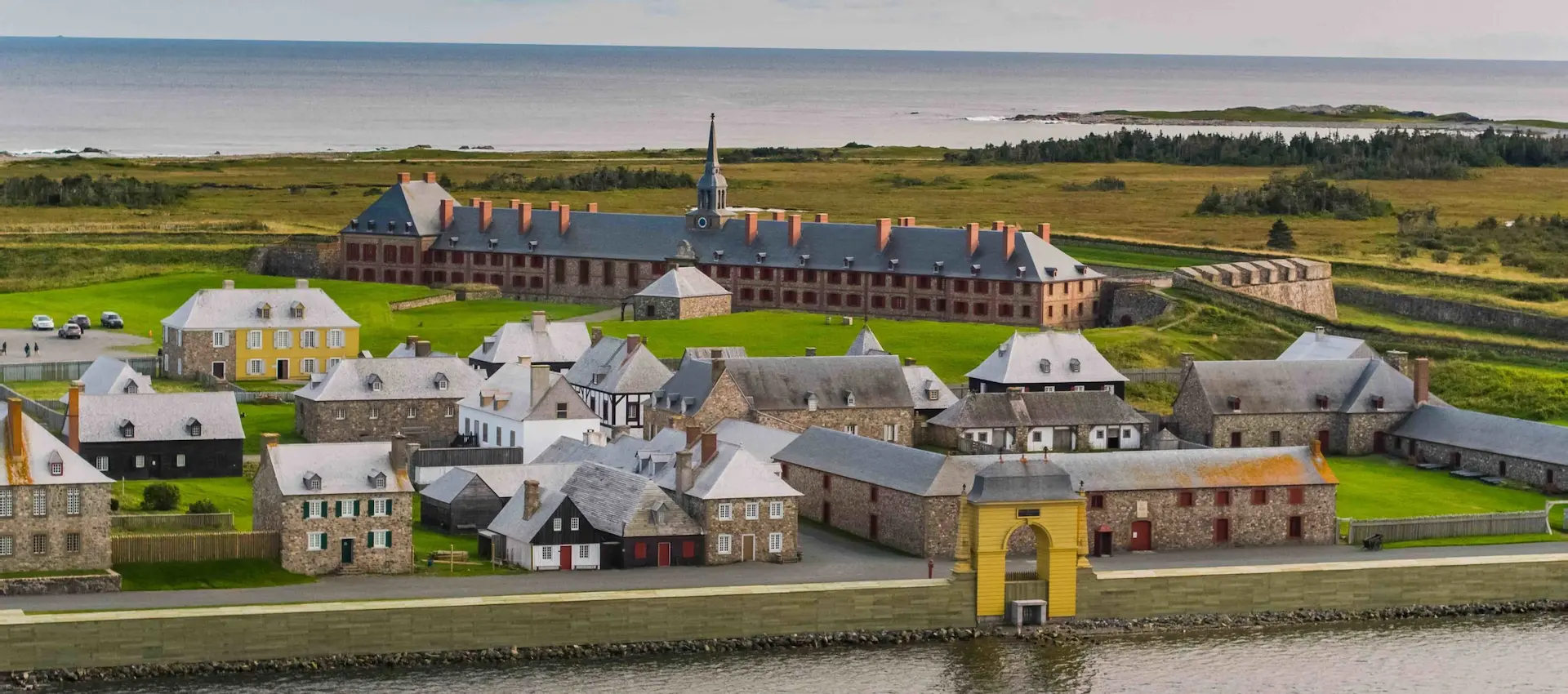 Fortress of Louisbourg→
Oak Island sits in Mahone Bay, about 50 miles southwest of Halifax. In the mid-eighteenth century it was uninhabited, wooded and accessible only by boat. For a commander looking to secure something valuable away from the main garrison, away from enemy raids and away from the civilian population, supporters of this theory argue it would have been a logical choice.
 Mahone Bay: History of the Waters That Hold Oak Island→
Two Engineers Count the Cost of the Flood Tunnel
2 min
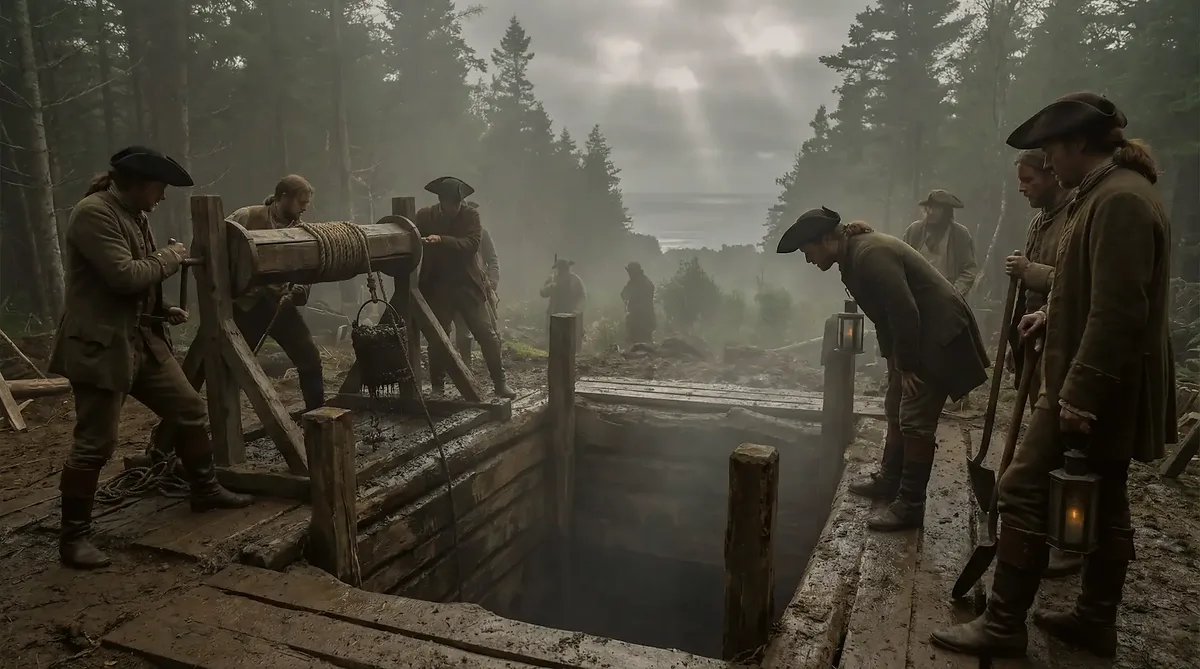
The most persistent question in the Oak Island story is not what was buried, but who had the ability to bury it. The Money Pit, with its oak platforms at regular intervals, its flood tunnel connecting to the sea, and its layered construction reaching more than 100 feet, is widely treated as an engineered project rather than the work of a few men with shovels.
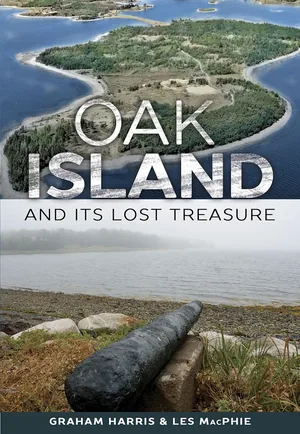
The most detailed engineering analysis comes from Graham Harris and Les MacPhie, two geotechnical engineers who spent close to two decades on the Money Pit and published their findings across three editions of Oak Island and Its Lost Treasure. They distinguish between the two parts of the works. The shaft itself, they argue, could have been dug by a ship's crew in a few months. The flood tunnel and its filter beds at Smith's Cove were another matter: in their estimate the tunnel needed a team of professional miners, a support force of around a hundred men, and roughly eighteen months to two years of work, the kind of resources only an army could supply in eighteenth-century Nova Scotia.
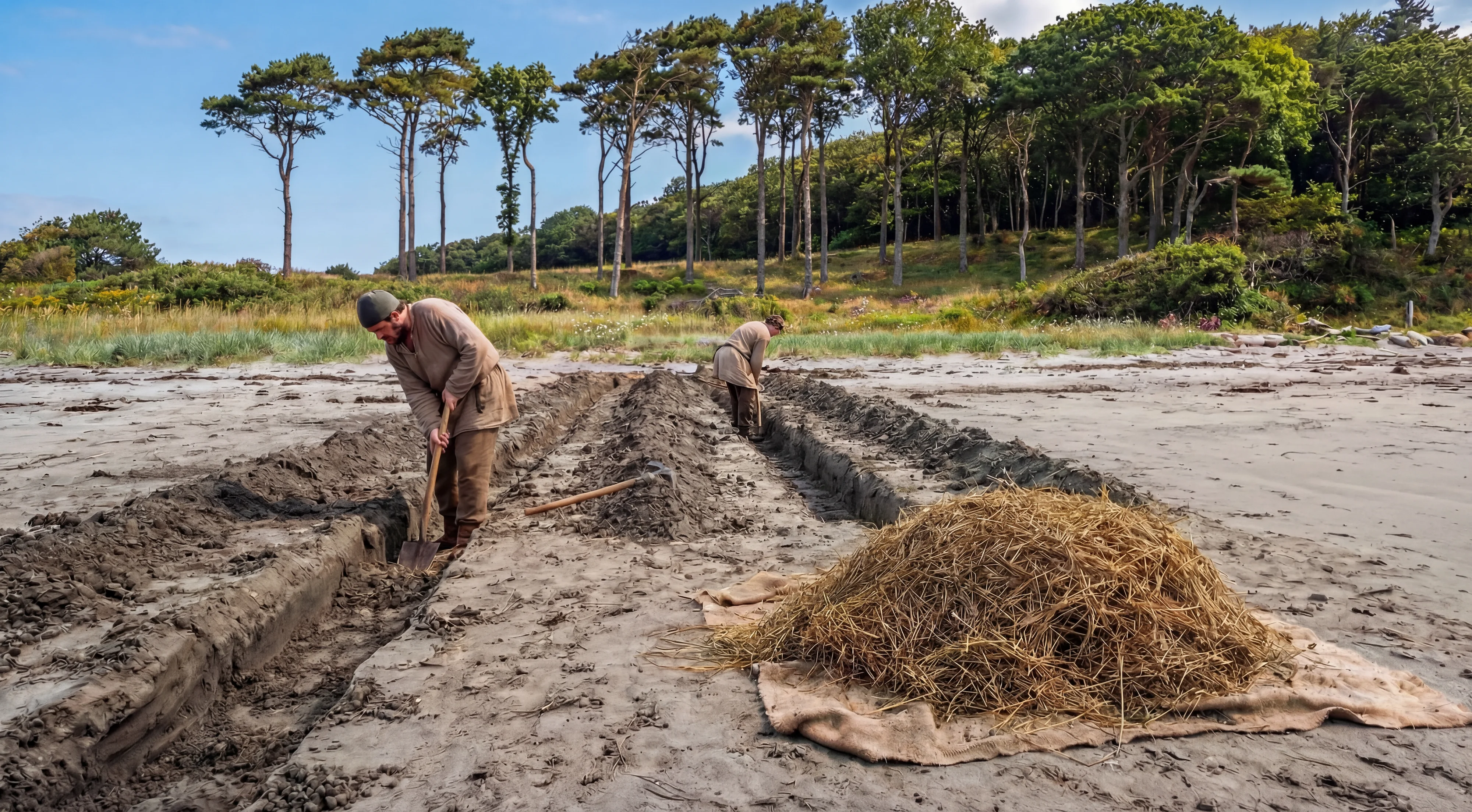 Oak Island Flood Tunnels and Box Drains: The Water Trap→
 Box drains (fan-shaped)→
In their third edition, Harris and MacPhie drew on British military records to name the engineers they believe were responsible and placed the tunnel's construction between 1752 and 1754. Their purpose for it, however, differs from the one this theory proposes. In their reading the army did not build a vault. It sealed one: the tunnel was dug to flood a shaft that the crew of Sir William Phips, the Maine-born treasure hunter who salvaged a fortune in silver from a Spanish galleon in 1687, had dug in 1688 and lost, so that nobody else could ever recover what lay at the bottom. The British Military Bank theory borrows their engineering case, that only a military force could have built the flood system, and applies it to a different purpose.
In the 1750s the army's engineers served under the Board of Ordnance; the title Royal Engineers was only granted in 1787. By 1752 Halifax was three years old, the garrison was growing, and the colony was bracing for the conflict that would become the Seven Years' War. The army had engineers and trained military miners in the colony, and could draw on soldiers for labor. No other body in mid-eighteenth-century Nova Scotia could have marshaled the same combination of engineering knowledge, manpower and sustained logistical support.
What Needed Protecting
1 min
The sums moving through Nova Scotia during the colonial wars were substantial. Military payroll for several garrisons had to be stored securely in a region under constant threat. The first fall of Louisbourg in 1745 yielded captured French military funds. The second and final siege in 1758, conducted by a large British force under General Jeffery Amherst and his brigadier James Wolfe, who went on to take Quebec the following year, ended with the demolition of the fortress and the seizure of everything inside it.
Then came Havana. In 1762 British forces besieged and captured the Cuban capital, seizing treasure and prize goods estimated at around three million pounds. The prize money was enormous, and the naval base at Halifax was the nearest secure British port in the western Atlantic. William Crooker, a Nova Scotia land surveyor who wrote several books on the island, proposed in Oak Island Gold that senior members of the British military diverted part of the Havana spoils to a secure location near Halifax rather than ship it directly to London, where it would be subject to Crown accounting and political dispute.
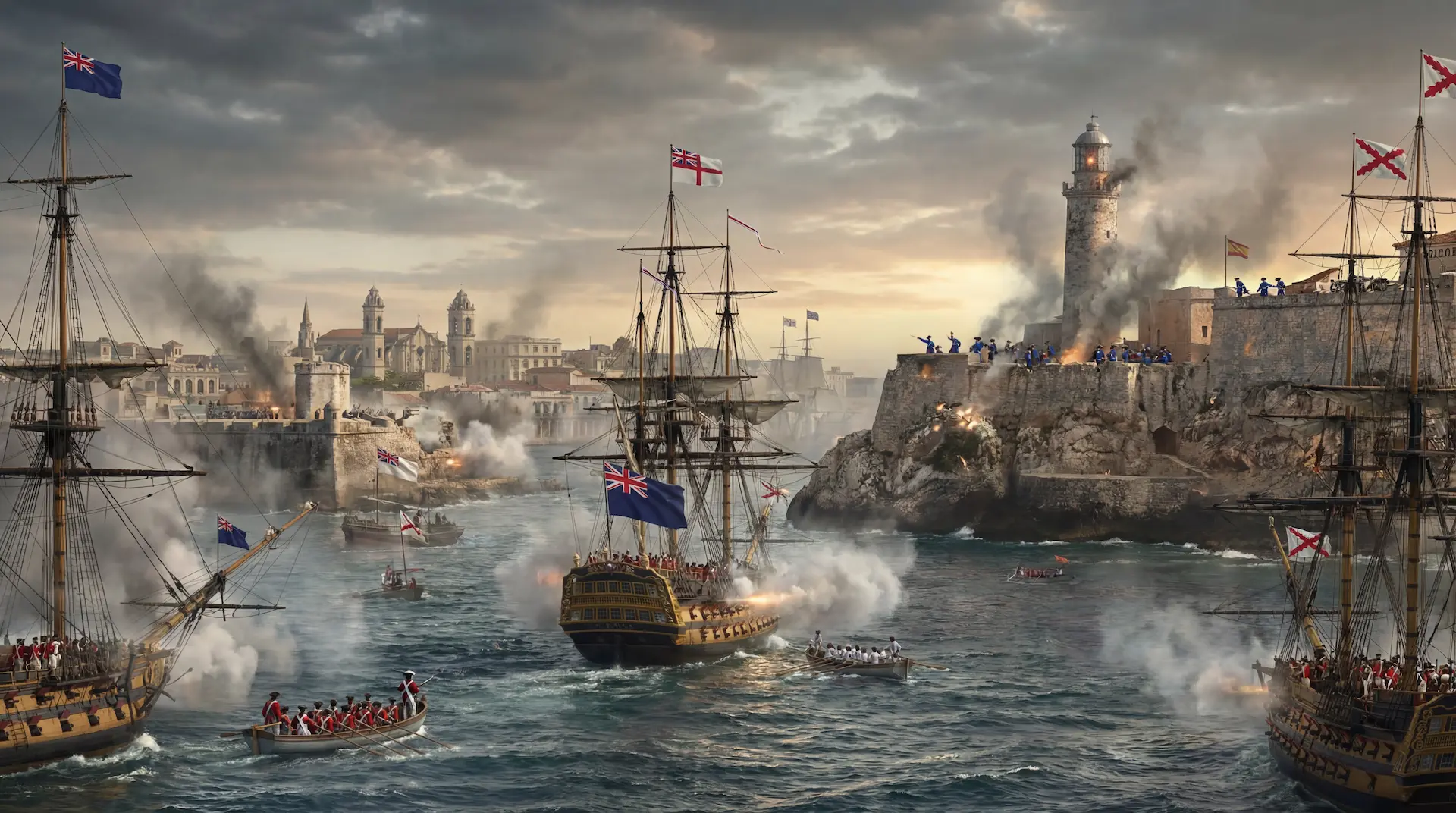 The Sack of Havana→
The threat to Nova Scotia was real. In 1746 France assembled the largest fleet it had ever sent to the New World, some 64 ships and 11,000 men under the Duc d'Anville, with orders to retake Acadia and drive the British from Nova Scotia. The expedition ended in disaster: storms, disease and the death of d'Anville himself destroyed the fleet before it could attack. The lesson for the British was that Halifax was a target. Supporters of the theory argue that a commander responsible for military funds would have wanted a reserve outside the main garrison, and that a vault on a nearby uninhabited island, protected by engineered flood defenses, would have provided it.
 Duc d'Anville's Doomed Fleet→
Buttons, a Cap Badge and a 1797 Coin
1 min
Several objects found on Oak Island fit an eighteenth-century British military context. A gold-plated British military officer's button was recovered in the spoils of borehole GAL-1 near the Money Pit, and a second gilded military cuff button of the same period turned up on the opposite side of the island. A British Royal Navy jacket button, dated to about 1804 to 1825, came from the foundation of Samuel Ball's home on Lot 25. A King George III cartwheel twopence, struck in 1797, turned up on Lot 2. A fragment of what may be a French military cap badge was also recovered from the Money Pit spoils, consistent with the presence of both British and French military personnel in the Mahone Bay area during the colonial period.
British naval officer's button→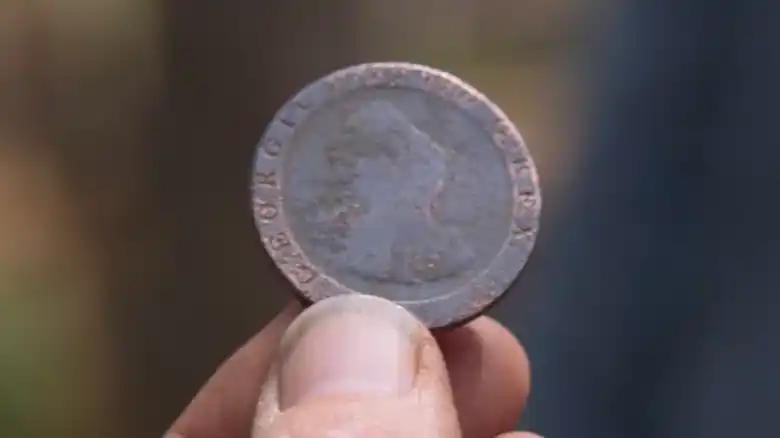 George III "Cartwheel" twopence, 1797 (Lot 2)→
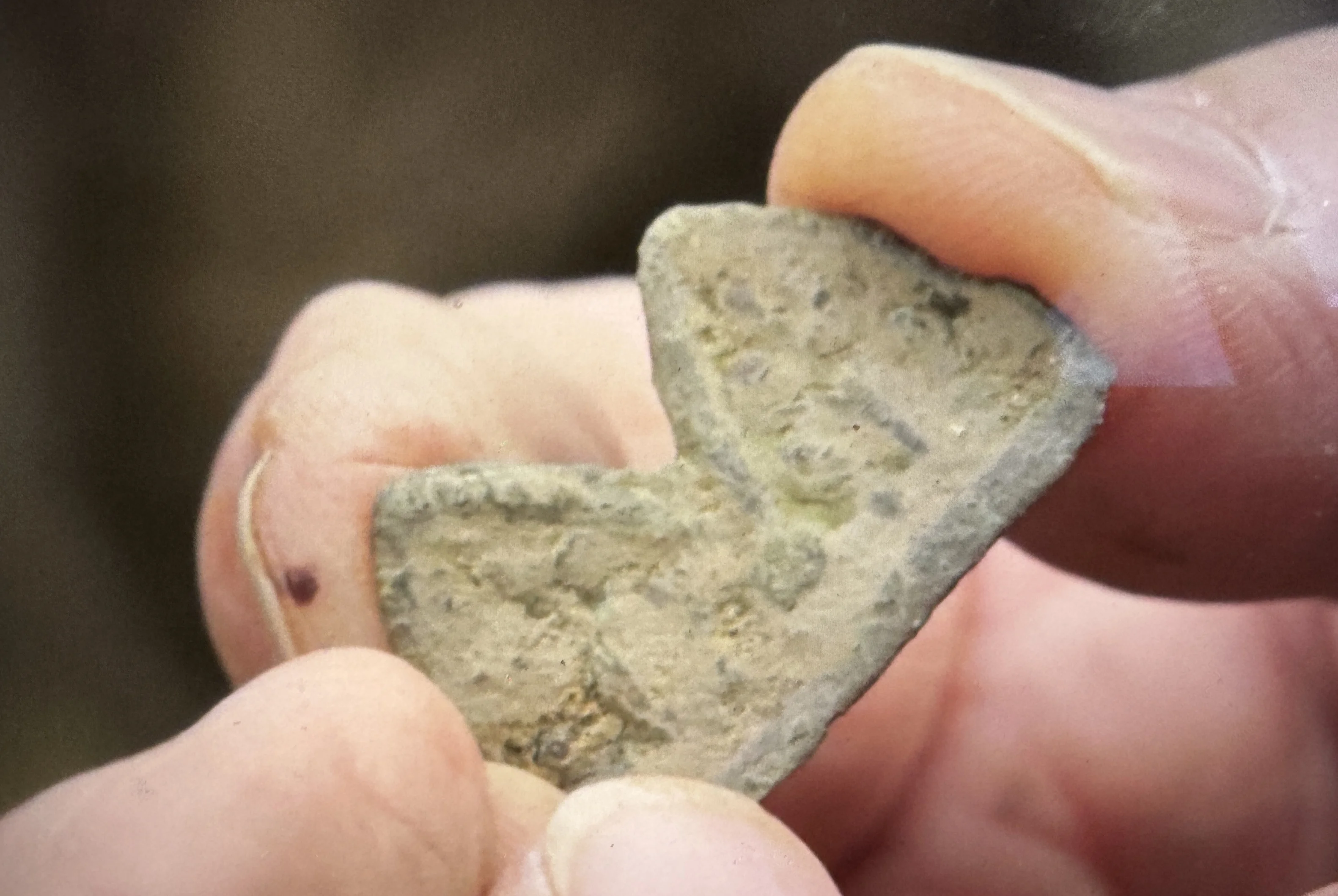 Cap Badge Fragment (Money Pit Dunfield spoils)→
None of these objects is medieval. They are the kind of items soldiers lose, drop or leave behind during extended operations. Taken individually, each could be explained by a casual visit to the island. Taken together and considered alongside the engineered structures underground, supporters of the theory read them as signs of sustained military activity during the period when British forces controlled the region.
How the Revolution Could Have Sealed a Vault
1 min
If the British military built a vault on Oak Island, the American Revolution may explain why its contents were never recovered. When the Thirteen Colonies declared independence in 1776, Halifax became Britain's most important remaining base on the Atlantic coast of North America. After the war some 30,000 Loyalists moved north to Nova Scotia, transforming the colony from a military outpost into a settled province.
Oak Island itself had been included in the Shoreham Grant of 1759, which opened the Chester area to New England settlers, and was surveyed into 32 lots in the 1760s. The lots changed hands through the 1770s and 1780s, and by the time Daniel McGinnis, a local settler who owned land on the island, reported the depression that became the Money Pit in 1795, the island had been privately owned for decades. Any military operation to recover a vault's contents would have meant digging on private land, in full view of civilian neighbors, an operation difficult to keep secret and hard to justify.
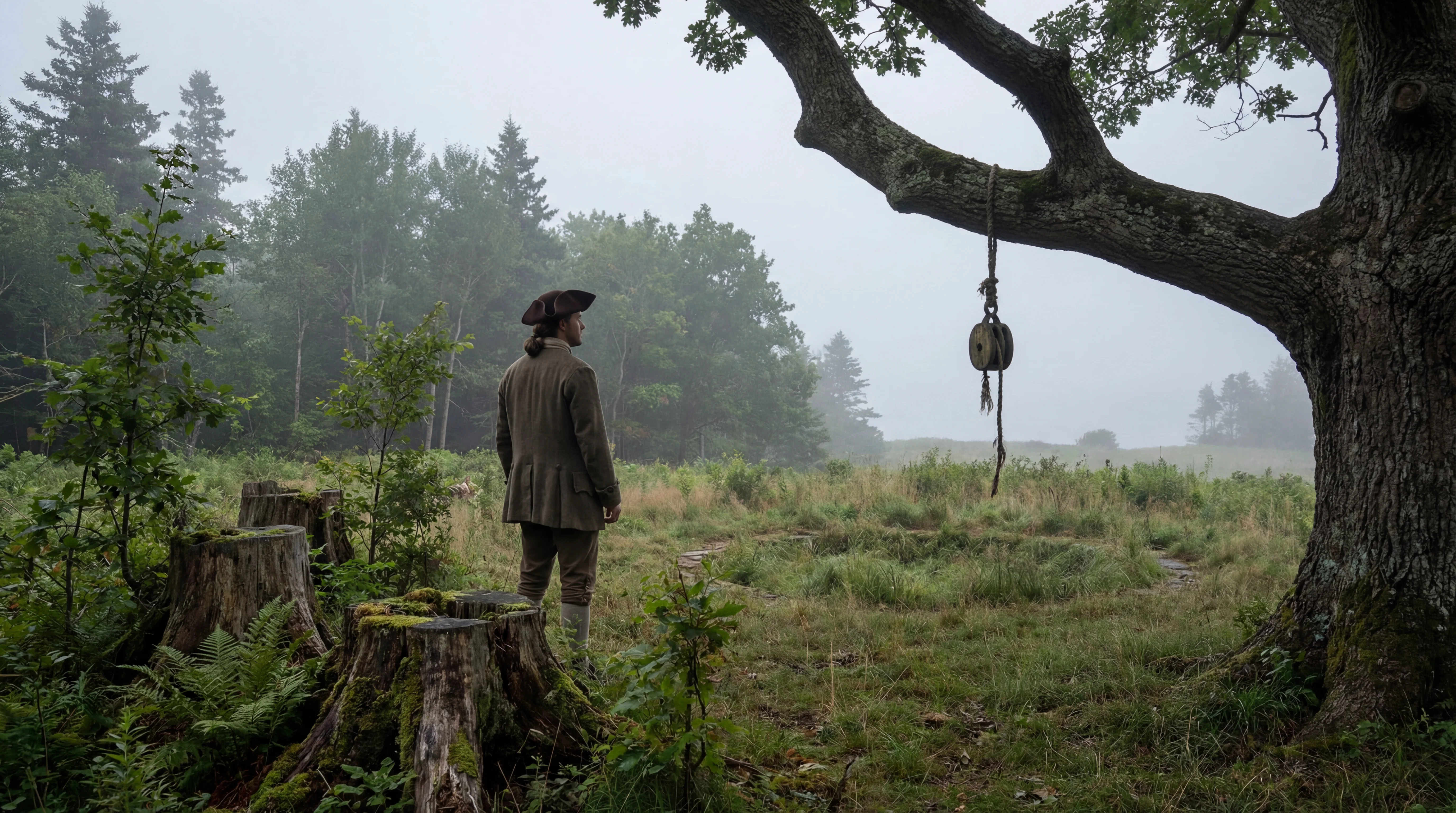 The Real Daniel McGinnis of Oak Island→
An earlier version of the idea came from the British writer Rupert Furneaux, who spent seven years on the Oak Island records. In Money Pit: The Mystery of Oak Island he argued that senior British officers in North America moved large sums from New York for concealment on the island around 1780, during the Revolution, and that a military and naval force working on Oak Island would not have seemed strange enough to local residents to be recorded.
The theory suggests the vault was simply abandoned: too difficult to access, too risky to expose, and eventually forgotten as the officers who knew its location died or were reassigned.
The Samuel Ball Question
1 min
One figure complicates any simple reading of the island's history. Samuel Ball was born into slavery in South Carolina in 1764. He gained his freedom by fighting for the British during the American Revolution, and after the war he came to Nova Scotia with thousands of other Black Loyalists. In 1786 Ball bought a four-acre lot on Oak Island at what was described as a premium price for a small parcel. He eventually acquired several more lots and became one of the more prosperous landowners in the Mahone Bay area, a remarkable outcome for a formerly enslaved man in late eighteenth-century Nova Scotia.
Researchers have long debated the source of Ball's wealth. His recorded livelihood was farming, particularly cabbages, which he sold to the Halifax garrison. Near his former home on the island, the team found what appears to be a man-made stone tunnel, and metal detection has recovered coins, buttons and other artifacts from the area. Supporters of the military theory suggest that a Loyalist veteran who had served the Crown and settled on the island is the kind of person who might have been trusted with partial knowledge of what lay beneath. No document links Ball to a vault, and his prosperity may have ordinary explanations that the surviving records do not capture.
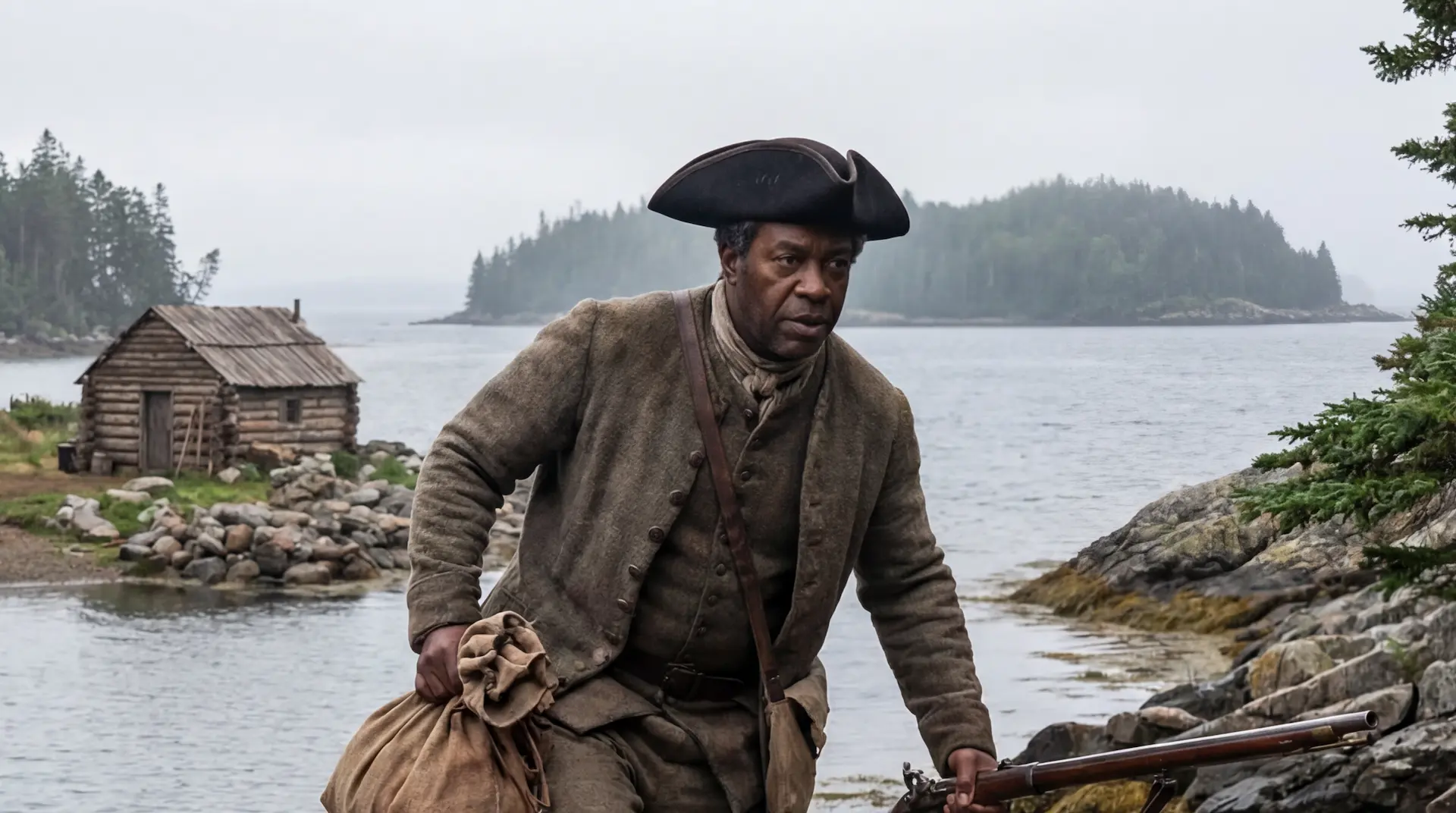 Samuel Ball, the Unlikely Oak Island Owner→
A Vault Without a Paper Trail
2 min
The British Military Bank theory does not require ancient orders, religious relics or voyages before Columbus. It asks that the Money Pit be understood as a product of the era when Nova Scotia was most heavily militarized, the middle and late eighteenth century, and proposes that the people best equipped to build it were army engineers with military miners and hundreds of soldiers at their disposal. The contents, in this view, would have been military payroll, captured spoils from Louisbourg or Havana, or reserves held against the French threat.
The theory also offers an answer to one of the deepest puzzles of the Oak Island story: why no one came back. If the depositors were a military bureaucracy rather than a private venture, knowledge of the vault would have been confined to a few officers, and death, reassignment, the upheaval of the Revolution and the settlement of the island could have broken the chain within a generation.
Some physical evidence fits the timeline. Dendrochronologist Colin Laroque of the University of Saskatchewan dated timbers from the U-shaped structure and slipway at Smith's Cove to 1769, a few years after the capture of Havana, as reported in Season 6, Episode 21. Other evidence points elsewhere. Carbon dating of the U-shaped structure's wood in Season 5, Episode 16 returned a range of 1684 to 1732, and radiocarbon dates from Smith's Cove coconut fiber run back to the medieval period.
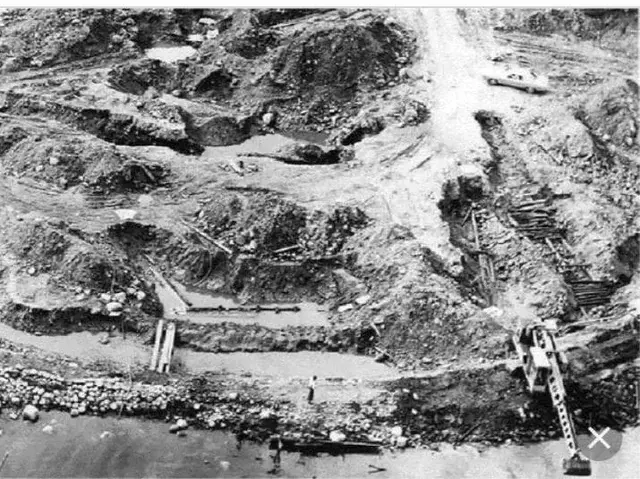 U-shaped wooden structure→
What can be established is that the British army had the means and the motive to protect large sums in mid-eighteenth-century Nova Scotia, and that it had engineers capable of building the flood system. No order, ledger or letter has been found that places a military vault on Oak Island, and the engineers whose analysis the theory relies on, Harris and MacPhie, concluded that the army's role there was to seal a lost treasure rather than to store a new one. Until a document emerges, the British Military Bank remains a reasoned possibility built on context rather than on a record of the deposit itself.
Sources
1 min
Books
- Graham Harris and Les MacPhie, Oak Island and its Lost Treasure, third edition, Formac Publishing, Halifax, 2013
- William S. Crooker, Oak Island Gold, Nimbus Publishing, Halifax, 1993
- Rupert Furneaux, Money Pit: The Mystery of Oak Island, Fontana, London and Toronto, 1976 (first published 1972 as The Money Pit Mystery)