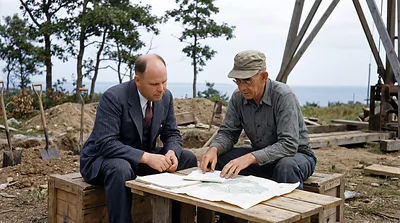
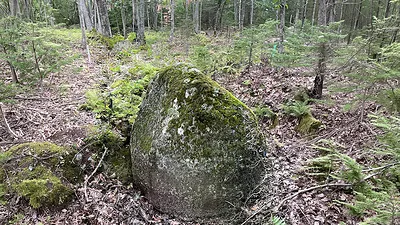
Rick Lagina turns his attention to the mysterious carved stones scattered across the island, beginning with a conversation with Dan Blankenship about the HO stone. In 1921, a large boulder covered with carved inscriptions was found on Oak Island's northern shore; searchers destroyed it with dynamite hoping treasure lay beneath it. In 1936, Gilbert Hedden saved several fragments, including one featuring an H, a cross, and a circle with a central dot. Dan recalls that the fragments were on the island until approximately 20 years ago, when they vanished. He mentions that Fred Nolan had embedded three large carved stones in the concrete floor of his now-closed mainland museum. Rick, Dave Blankenship, and Jack Begley visit the property, now owned by Barry and Karen Publicover, who confirm that Nolan told them the stones were very valuable to the Oak Island story and cemented them in place to keep them safe.
Using a jackhammer, the team extracts the three heavy stones from the concrete floor. Turning them over reveals carved markings including what appears to be a Roman numeral, and letters that could read ARE or part of a longer inscription. Rick arranges for stone researcher Terry Deveau to examine the finds at the Oak Island museum. Deveau identifies the carvings as definitively man-made and spots a semicircle and straight line forming what he believes is the letter D. Two of the three stones appear to be parts of the same original rock, fitting together like puzzle pieces. Once aligned, Rick reads the assembled inscription as the sequence R, E, D, D, E and probably an M, with the final letter unclear and possibly an H, raising the question of whether the stones reference Gilbert Hedden or carry an older, more significant message.
Underwater visualization expert Brian Abbott returns to the island to deploy an MS 1000 scanning sonar device down the borehole near the Money Pit where the team found evidence of the Chappell vault the previous year. Well driller Jordan Rogers first reams the hole to clear an obstruction at around 141 feet, then drops a measuring cable that confirms roughly seven feet of open space below. As the sonar descends, it shows nothing angular or structural, only unconsolidated sediment and a narrow cavity. Abbott cannot get a clear image and concludes the hole is too narrow and too impacted with decades of mud to produce useful data. The team pulls the equipment, acknowledging that the only way to confirm what lies at the bottom of the Money Pit is to dig a hole more than 143 feet deep, an operation that would require a freeze ring to prevent flooding and cost millions of dollars.
Mining industry veteran and Oak Island historian John O'Brien, who has over 35 years of experience retrieving precious objects from difficult locations, visits the island to share his theory. O'Brien grew up in nearby Halifax and has been obsessed with the mystery since childhood. He believes he can identify not only what is buried but who buried it and how to retrieve it. After touring the island, O'Brien marks specific coordinates for an excavation site. However, the location falls on property owned by Fred Nolan, not on the parcels controlled by the Laginas and their partners.
In the War Room, the team confronts the reality that meaningful progress on several fronts, including the swamp, Nolan's Cross, and O'Brien's theory, requires cooperation with Fred Nolan. Although Dan Blankenship and Nolan have maintained a bitter rivalry for decades, the team agrees that Rick should approach Nolan with a working relationship offer: the Laginas would fund drilling at several sites Nolan has identified, in exchange for access to his property and the wealth of information he has accumulated over more than 50 years of research.