Rick and Marty Lagina travel nearly 60 miles to Halifax to shop for heavy excavation equipment, marking a pivotal shift from data gathering to active digging. They select a 40-ton excavator, a backhoe for precision work, and a D4K bulldozer. Peter Fornetti, who shares Rick's passion for the mystery, joins them at the equipment yard. The machines are transported across the causeway to Oak Island, and veteran equipment operator Mike Carlo is brought in to assist. Dan Blankenship, now 92, greets the new arrivals and watches as the heavy machinery rolls onto the island for the first time in decades.
In a meeting in Traverse City, Michigan, Marty Lagina and business partner Alan Kostrzewa hear from Oak Island theorist Robert Marcus, who presents a treasure map theory rooted in a 1935 book by Harold Wilkins called "Captain Kidd and His Skeleton Island." The book contains a map that, when turned upside down, bears striking similarities to Oak Island, including the oblong shape, a peninsula resembling an elephant's trunk, stone markers, a swamp, and a treasure site near the Money Pit. Marcus believes the map was originally created by the Zeno brothers and Prince Henry Sinclair during their purported 1398 voyage to the New World. He traces a trail from the Westford boat stone in Massachusetts, a round two-foot-diameter stone with 14th-century carvings of a sailing vessel, an arrow, and the numbers 184. Using leagues as the unit of measure, 184 leagues north from the boat stone leads to Overton, Nova Scotia, where Marcus identifies another carved stone bearing a Templar cross pointing northeast toward Mahone Bay and Oak Island.
Marcus provides specific coordinates for a dig site: from the original Money Pit location, travel 14 feet north, then 30 rods on a northeast bearing. Rick and Jack Begley locate the spot using both GPS and old-fashioned compass-and-tape measurement from the drill hole where the team believes they contacted the Chappell vault the previous year. The two methods converge on the same location. Rick plants a stake and declares "I claim this spot." Marcus believes treasure lies 40 feet below the surface at this point, and the team agrees it is worth excavating.
The team also begins what they consider one of the most critical operations of the season: excavating in the Money Pit area for the first time in nearly 50 years. Their initial target is the Hedden shaft, dug in 1937 by industrialist and treasure hunter Gilbert Hedden. If they can locate the corners of the Hedden shaft, they can use its known position relative to the original Money Pit to confirm whether their drill hole from the previous season truly intersected the Chappell vault. Dan Henskee, who worked in this area decades earlier, guides the dig from memory, estimating the shaft's location relative to visible landmarks.
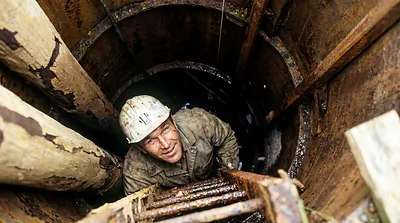
Marty operates the backhoe with precision, then switches to the larger excavator to dig a longer trench. Almost immediately, they strike oak timbers in the ground. Rick spots what appears to be a wall, a vertical structure consistent with the cribbed wooden walls of a 19th-century searcher shaft. If confirmed as the Hedden shaft, the discovery would provide the critical reference point needed to triangulate the exact position of the original Money Pit and plan a full-scale excavation to the Chappell vault at 153 feet.