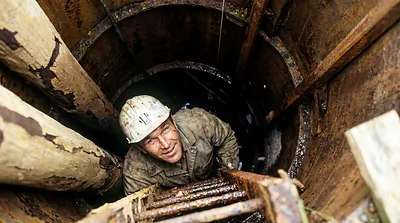
Rick and Marty Lagina, along with dive expert John Tapper, meet with certified saturation diver Brad Stabenow, who has worked in over 20 countries and dived to depths of 800 feet using trimix breathing systems. After reviewing the 10-X shaft dimensions, the three sonar targets in the cavern at 235 feet, and the 27-inch passage, Stabenow agrees to attempt the dive. However, the team decides to first deploy a remotely operated vehicle to gather high-definition images of the shaft and chamber before risking a human descent. Jake McNaughton and Larae Davies from Dominion Diving in Dartmouth arrive with a VideoRay Pro 4 ROV equipped with LED lights, a high-definition camera, and sonar.
The ROV descends 10-X successfully, passing through the eight-foot casing and entering the 27-inch hole. It locates the 20-foot drill bar that was dropped down the shaft in the 1970s and never recovered, finding it off to one side and not directly blocking the passage. Entering the cavern at 235 feet, the ROV captures images of two vertical structures: one that appears square and possibly wooden, consistent with the post identified by previous sonar scans, and a second that resembles a metal drill pipe extending from the ceiling. However, both objects then seem to vanish from the camera view and cannot be relocated. Dan Blankenship, 92, watches the monitors intently as the ROV bounces off the cavern walls in every direction. The expected tunnels do not appear. The floor is rarely visible. No chests, no body, and no definitive evidence of man-made construction can be confirmed.
Stabenow informs Rick and Marty that the ROV data does not warrant risking a human dive. Marty agrees and moves close to crossing 10-X off the list entirely. Rick resists, arguing that the ROV showed the same limited area repeatedly, never fully surveyed the floor, and constitutes an incomplete study. Dave Blankenship is brought into the discussion but remains uncertain. The brothers reach an impasse: Marty sees insufficient evidence to continue, while Rick refuses to abandon the shaft that represents Dan Blankenship's life's work. They agree to postpone the dive and reassess, but with Stabenow out of the picture, finding a new qualified diver becomes the next challenge.
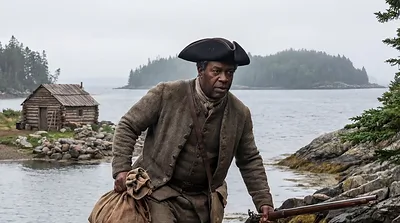
Meanwhile, Craig Tester, Drake Tester, and Jack Begley explore Lot 6, a four-acre parcel near the center of the island that has never been formally investigated. The lot was once owned by Samuel Ball, a man born into slavery in South Carolina in 1764 who fought for the British in the American Revolution, emigrated to Nova Scotia, and purchased land on Oak Island in 1786 for eight pounds sterling. By the time of his death on December 14, 1845, Ball had become one of the richest men in Nova Scotia, an extraordinary rise for a former slave turned cabbage farmer. The team recovers an iron stake, a non-ferrous metal object resembling a chest handle or buckle, and a triangle-shaped stone. Terry Deveau examines the stone and notes that while the greywacke rock can fracture naturally into prismatic shapes, this specimen appears to have an added piece forming a deliberate point, possibly serving as a marker.
Deveau identifies a depression surrounded by rocks on Lot 6 that he considers consistent with a smuggling cache or treasure burial site, noting that Mahone Bay was a notorious smuggling hotspot during the American Revolution and the War of 1812. When Ball died, he left his Oak Island property not to his family but to his servant Isaac Butler, along with secret instructions that Butler was ordered never to reveal. The team backfills the Hedden shaft excavation for safety but plans to return with Brian Abbott's scanning sonar to image the Money Pit borehole and verify the Chappell vault before committing to a full-scale excavation to 145 feet.