After weeks of searching for a qualified diver, the team recruits Harvey Morash, a certified deep wreck diver from Cape Breton, Nova Scotia, with nearly 25 years of experience in dangerous confined environments, shipwrecks, and underwater cave systems. Harvey reviews the 10-X parameters: 181 feet through the eight-foot casing, then 44 feet through the 27-inch hole wearing two scuba tanks with a trimix air supply, with no surface communication system to avoid entanglement risks. He requests a practice dive through a pipe one inch narrower than the actual shaft to confirm he can physically fit. The team rigs a 26-inch pipe in shallow water, and Harvey successfully passes through with full equipment, giving a thumbs-up, though he notes the fit was tight enough that he was glad he skipped a big lunch.
Approximately 300 feet off Oak Island's south shore, marine archaeologist Rod Peterson dives to examine the triangle-shaped object detected by side-scan sonar the previous week. He locates the stone at roughly 20 feet depth, confirms it is triangular with an indentation on top, and takes compass bearings from all three points. One bearing runs directly zero to 180 degrees, pointing straight back toward the location on shore where Tony Sampson has marked the spot of the stone triangle first discovered in 1897. Marty and Alex Lagina dive on the rock themselves, confirming the shape but finding it smaller than expected. Tony Sampson then follows the magnetic north bearing from the first stone and discovers a second, larger triangle rock approximately 20 meters further along the same heading, also aligned on the 360-degree bearing toward the shore triangle and the Money Pit. The Bedford Institute's data confirms that sea levels were one to two meters lower 300 to 400 years ago, meaning these stones could have been exposed and deliberately placed as submerged markers visible only to those who knew where to look.
At 10-X, Rick and Dave Blankenship use a Dipper-T well casing indicator, a magnetic probe, to locate the 20-foot drill bar that was dropped down the shaft roughly 30 years ago. The probe detects metal at 62.3 meters, or approximately 204 feet, placing the bar 23 feet below the mouth of the 27-inch opening. This critical measurement, never previously established, will allow Harvey to anticipate the obstruction and maneuver around it during his descent.
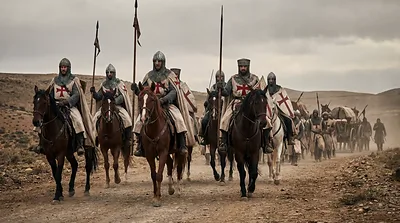
Oak Island researcher Jeff Irving presents his theory to the team. Irving argues that the Ark of the Covenant was smuggled out of Jerusalem by the Knights Templar, taken to Scotland, and then brought to Oak Island by Christopher Columbus and associates around 1500. Irving traces Columbus's Templar connections through his wife, Filipa Moniz Perestrelo, whose father Bartolomeu Perestrelo was a Grand Master in the Knights of Christ, the Portuguese incarnation of the Templars. Irving proposes that Juan Perez, Queen Isabella's accountant who helped secure funding for the expedition, disappeared after reaching the New World and was in fact burying the treasure on Oak Island. Portuguese explorers Gaspar and Miguel Corte-Real, both Knights of Christ, similarly vanished in 1501 and 1502 respectively, and Irving suggests they became guardians of the hidden treasure, marrying into the Mi'kmaq population and disappearing from European records.
The dive begins. Harvey is lowered into 10-X first, followed by safety diver Michael Gerhartz, who will remain at the 181-foot level connected to Harvey by a tether line. Harvey carries no communication devices; he and Michael communicate through tugs on the line, with Michael relaying information to dive supervisor Janine Goyetche on the surface. As both divers enter the water and Harvey begins his descent toward the bottom of 10-X, communications between Michael and the surface fail. The episode ends with Harvey submerged and the team unable to confirm his status.