Rick and Marty Lagina, Alex Lagina, Craig Tester, and Dave Blankenship travel to St. Mary's University in Halifax to have the purported Roman sword examined by Professor Myles McCallum, an expert in Roman archaeology. McCallum notes that the sword features Hercules iconography consistent with Roman culture but identifies a bivalve mold construction technique rather than the expected single lost-wax casting, making him highly skeptical that it is genuinely ancient. He suggests it could be a replica from the 18th or 19th century, which could still have significance, or it could be a modern fake. He arranges for Dr. Christa Brosseau, an associate professor of chemistry specializing in electrochemistry, to conduct scientific testing. The results are definitive: the base metal is brass with a high zinc content, indicating a post-1880 to 1890 manufacture date. The sword is a modern replica and of no archaeological significance to the mystery.
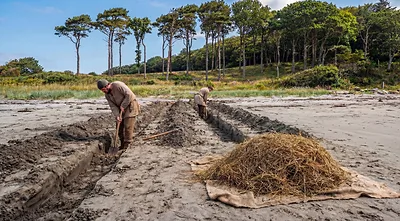
Jack Begley, Peter Fornetti, and Dan Henskee search for eel grass at Smith's Cove. In 1849, the Truro Syndicate discovered the elaborate box drain system at Smith's Cove, constructed of flat stones and densely packed with layers of coconut fiber and eel grass. Coconut fiber previously recovered from the site carbon dated to 1260-1400 AD with 95 percent confidence. Because eel grass decomposes faster than coconut fiber, dating a sample could provide a tighter timeframe for when the drains were constructed. Dan locates coconut fiber and what appears to be eel grass in layered deposits. The samples are sent for carbon dating, and the results return a 95 percent probability range of 1472 to 1650 AD, placing the construction of Smith's Cove firmly before the 1795 discovery of the Money Pit and consistent with several leading theories, including Portuguese, Spanish, and Templar involvement.
Father-and-son engineers Mike and Sean Harold visit from British Columbia, bringing the research of their late relative, Oak Island treasure hunter Laverne Johnson. From 1959 to 1963, Johnson theorized that the Money Pit was a decoy and that the real treasure was buried approximately 280 feet north of the pit, at a depth of about 30 feet, above sea level. His theory used sight lines between two mysteriously drilled stones, one at Smith's Cove and one north of the Money Pit, intersected with a line from the apex of the stone triangle. Jack Begley and Charles Barkhouse pace out the distance and discover a drilled rock along the bearing line, as well as a depression in the ground that could indicate a collapsed structure below.
The team drills several exploratory holes based on Johnson's grid. The first two holes on the east and west sides produce only bedrock. A third hole hits an obstruction at 31 feet and brings up a piece of wood with vertical grain from 31 to 35 feet, five feet deeper than Johnson's searcher shaft reached in 1962. The vertical orientation mirrors the wood found in the Money Pit borehole the previous year, where core samples from the Chappell vault showed wood standing on end. However, a follow-up hole at 45 feet produces no wood, suggesting the piece was not part of a larger structure.
Rick, Craig, and Dave Blankenship call world-renowned deep-sea diver John Chatterton, who has over 30 years of experience exploring the Britannic, the Lusitania, the Andrea Doria, and the Titanic. Chatterton will use umbilical-supplied air rather than scuba tanks and states that zero visibility is not a concern for determining what the team needs to know. The team agrees this will be their final attempt with divers: if Chatterton cannot reach the bottom of 10-X, they are done with the dive approach entirely.