About This Carved Stone
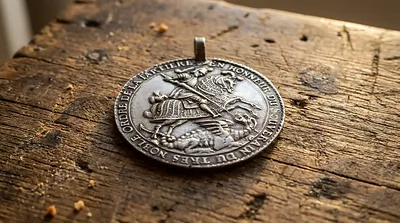
The Overton Stone is a large glacial boulder located on the Atlantic coast near Overton, Nova Scotia, split into two halves each roughly the size of a small car. On the vertical, south-facing surface of the inland half, a deeply carved inscription combines Christian and Mi'kmaw symbols: a stylised cross with outward-flaring arms enclosed in an oval with four dots, a pair of crossed Native tobacco leaves overlaid by an eagle feather, and a three-day-old evening crescent moon. The carving was cut into the stone's thick weathering patina using what appears to be a hard steel chisel, and repatination has begun in the deepest cuts, suggesting significant age. The stone was first reported around 2009 by local resident Beverly Wells-Pinkney and subsequently investigated by historian Terry J. Deveau, who introduced it to Rick Lagina and Charles Barkhouse in Season 3, Episode 4 - an episode that took its title from the stone. Deveau's analysis identified the cross as stylistically consistent with padrão crosses left by Portuguese explorers during the Age of Discovery, particularly the cross carved at Yellala Rock on the Congo River by Diogo Cão's expedition in 1485. Portuguese padrão crosses were closely associated with the Order of Christ, the Portuguese successor to the Knights Templar, whose cross adorned Portuguese sails throughout the era of global exploration. Deveau proposed that the carving commemorates a friendship treaty between Portuguese explorers and the local Mi'kmaq people. The tobacco leaves and eagle feather carry deep spiritual significance in Mi'kmaw culture, while the crescent moon corresponds to their tradition of observing the lunar cycle. Historical evidence supports sustained Portuguese-Mi'kmaq contact: Lopo Homem's 1554 map shows Mi'kmaw place names on the Cape Breton coast, and explorer Joam Alvares Fagundes conducted expeditions and founded a colony in Nova Scotia as early as the 1520s. The Bay of Fundy itself takes its name from the Portuguese "Rio Fundo." A separate, later carving of the initials "HT" and the date "06/07" appears one metre below the main inscription, likely carved by someone attempting to calibrate the weathering rate in order to estimate the age of the original work. Deveau also noted an area below the main carving where the stone surface appears to have been deliberately removed - possibly to destroy a date that would have validated a Portuguese territorial claim. The stone's relevance to Oak Island lies in the broader pattern of evidence for pre-colonial Portuguese activity in Nova Scotia connected to the Knights Templar's successor order, consistent with theories that Templar-linked Europeans operated in the Mahone Bay region centuries before the Money Pit's 1795 discovery.
Historical Context
Investigated by Terry J. Deveau (2009-present). Featured S3E4, referenced S4E10, S5E14. Research paper: "The Overton Stone" (Deveau, 2015).
Where It Was Found
Found at Overton, Nova Scotia (off-island).