About This Material
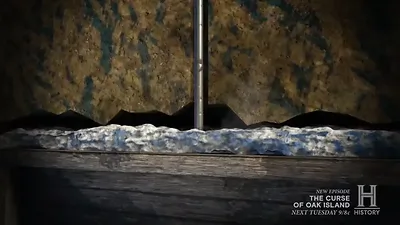
At roughly sixty feet below the surface, excavators found a bed of eelgrass (Zostera marina) laid alongside coconut fibre as part of the Money Pit's layered construction. Eelgrass is a flowering saltwater plant that grows in shallow coastal waters along the Nova Scotia shoreline. It does not grow underground and was clearly placed in the shaft by the original builders.
The same pairing of eelgrass and coconut fibre appeared at Smith's Cove, where the Truro Company discovered the box drain system in 1850. Five stone drains, each sixty-six feet long, converged at a collection point and fed seawater into the flood tunnel. The drains were packed with layers of coconut fibre and eelgrass that acted as a natural filter, allowing water to pass while preventing fine sediment from clogging the stone channels below. Coconut fibre recovered from Smith's Cove was carbon dated to 1260-1400 AD with ninety-five percent confidence. Eelgrass samples from the same location returned a narrower range of 1472 to 1650 AD, placing the construction of the drains firmly before the 1795 discovery of the Money Pit.
In Season 9, eelgrass appeared again when drilling borehole A13 in the Money Pit area. At approximately eighty-two feet, the core sample contained two pieces of material the team suspected was eelgrass, the same substance the Truro Company had found covering the box drains. Its presence at that depth in the Money Pit area raised the possibility that the flood tunnel system extended further inland than previously mapped.
Historical Context
Onslow Company
Where It Was Found
Found at Money Pit, 60 ft depth. Location: the original 1795 excavation shaft on Oak Island, Nova Scotia.