About This Structure
An equilateral triangle of large, round beach stones was discovered on Oak Island's south shore by Captain John Welling and Frederick Blair in 1897. Each side measured ten feet in length, with the stones roughly the size of a man's head placed on the grassy bank just above the high-water mark. A curved line of similar stones extended approximately three feet below the base, and a straight medial line of stones connected this curve to the apex, pointing true north in the direction of the Pole Star. When extended, this medial line passed directly through the location of the original Money Pit. Several observers noted the formation resembled a large sextant.
Blair showed the triangle to Gilbert Hedden during the 1930s excavation, and Hedden immediately recognised its potential significance in relation to a treasure map he was studying from Harold Wilkins's book Captain Kidd and His Skeleton Island. Hedden cleared the site and found the triangle still intact. Both Blair and Hedden were Freemasons, and the equilateral triangle is a geometric form with established significance in Masonic literature and ritual. Hedden used the triangle as one of several reference points, along with two drilled rocks he located on the island, to establish measurements he believed corresponded to markers on the Kidd map. He had the positions verified by Halifax land surveyor Charles Roper.
The original Stone Triangle was destroyed by Robert Dunfield during his aggressive excavation of 1965, when heavy earth-moving equipment obliterated the formation along with other surface landmarks. The triangle currently on the island is a reconstruction. A second triangular formation, known as the Mallon Triangle, was discovered in 1972 by P.J. Mallon of Northern Ireland on the south shore approximately 480 feet southeast of the Money Pit. Its sides measured ten feet by ten feet by 9.5 feet. Two additional triangle-shaped stones were located on the seabed approximately 300 feet offshore during a marine survey, aligned on a 360-degree bearing toward the shore triangle and the Money Pit. The Bedford Institute's data confirmed that sea levels were one to two metres lower 300 to 400 years ago, meaning these stones could have been exposed when placed.
In Season 11, archaeoastronomer Professor Adriano Gaspani analysed the Stone Triangle's coordinates and determined that it encoded two astronomical lines corresponding to sunrise and sunset at the winter solstice. Having previously dated Nolan's Cross to 1200 AD based on stellar alignments, Gaspani concluded that between 1200 and 1300, people arriving from Europe encoded messages by arranging stones in astronomically significant patterns. He identified the Templars as the most likely builders of Nolan's Cross, the Stone Triangle, and the Lot 15 stone cairns, noting that this astronomical knowledge belonged to monastic, religious, and knightly orders rather than common people.
Historical Context
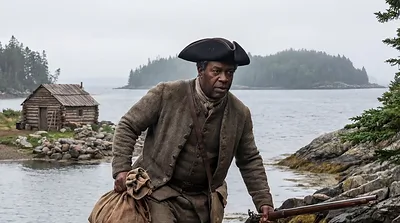
Captain Welling; 1897. The image is of a modern re-creation on the island.
Where It Was Found
Found at South shore, above high-water mark. Location: the shoreline areas of Oak Island.