About This Sample
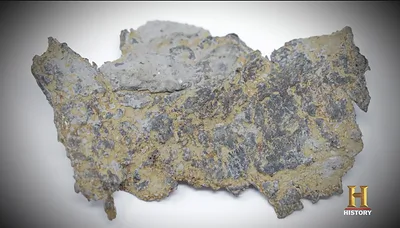
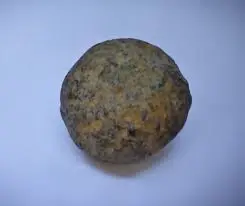
Two oak buds found embedded in a clay sample recovered from 196 feet depth in Becker Hole B11, one of the holes drilled in the Money Pit area during the Becker program of January to June 1967. The hole was advanced to its full depth of 200 feet with Becker casing, encountering wood at 168 feet and uniform clay from 184 to 200 feet. Because the hole was advanced with casing for its entire depth, Les MacPhie's 2008 technical review considered the recorded depth of 196 feet for the clay sample to be reliable. The clay layer itself is interpreted as puddled clay, a man-made deposit placed as a slurry and allowed to settle. In nearby Hole B13 the same layer showed coarser pebble sizes at regular intervals of about 18 inches, consistent with placement in successive 18-inch lifts. If the interpretation holds, the buds were sealed inside material handled by the original depositors, and they represent organic matter that could in principle be radiocarbon dated. No dating of the buds appears in the published record.
Historical Context
Sources: Les MacPhie, "The Money Pit, Oak Island, Nova Scotia: Summary of Geotechnical and Archaeological Conditions and the 1967 Becker Drilling Results", technical report, Montreal, January 2008 (Hole B11 description; Section 5.6 Artifacts). Becker Drilling (Alberta) Limited, 1967 drilling program, January to June 1967, as recorded by Dan Blankenship.
Where It Was Found
Found at Becker Hole B11, 196 ft depth, Money Pit area. Location: the original 1795 excavation shaft on Oak Island, Nova Scotia.