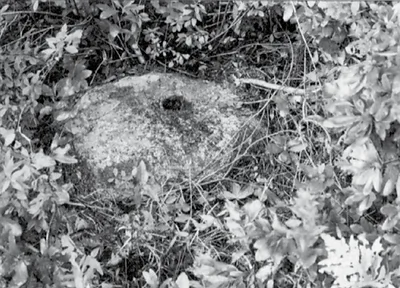
About This Artifact
In 1967, during the Becker drilling program paid for by David Tobias, a Montreal businessman, and run on the island by Dan Blankenship, Hole B25 entered a cavity in the bedrock from 202 to 209 feet below the original ground surface. Below the cavity the diamond drill cut into what was identified as an iron plate about half an inch thick. The cored disc of metal was not recovered; the identification rested on the sound of a diamond bit cutting through a solid metal object, which the drillers regarded as unmistakable. The hole could not be advanced below the plate, so it was never established whether the iron was the cover of an iron-lined chamber, a loose object or something else. Pieces of china, cement and wood came up from the same cavity.
Graham Harris and Les MacPhie, the geotechnical engineers who analyzed the Becker records, treat B25 together with Holes B24 and B35 as evidence of a close arrangement of cavities or chambers in the anhydrite bedrock that contain traces of human activity. Wood from a cavity in B24 was later carbon dated to about 1575, with a range of 1490 to 1660. In the authors' broader reading, the bedrock beneath the Money Pit is honeycombed with natural solution cavities, some of which the original diggers may have cleared and used. The depths follow the Becker convention of measuring from the original ground surface, about eleven feet above ground level at the time of drilling.
Historical Context
Graham Harris and Les MacPhie, Oak Island and its Lost Treasure, third edition (Formac Publishing, Halifax, 2013), chapter 6.
Where It Was Found
Found at Becker Hole B25, Money Pit area; cavity 202 to 209 ft below original ground, iron plate below the cavity. Location: the original 1795 excavation shaft on Oak Island, Nova Scotia.