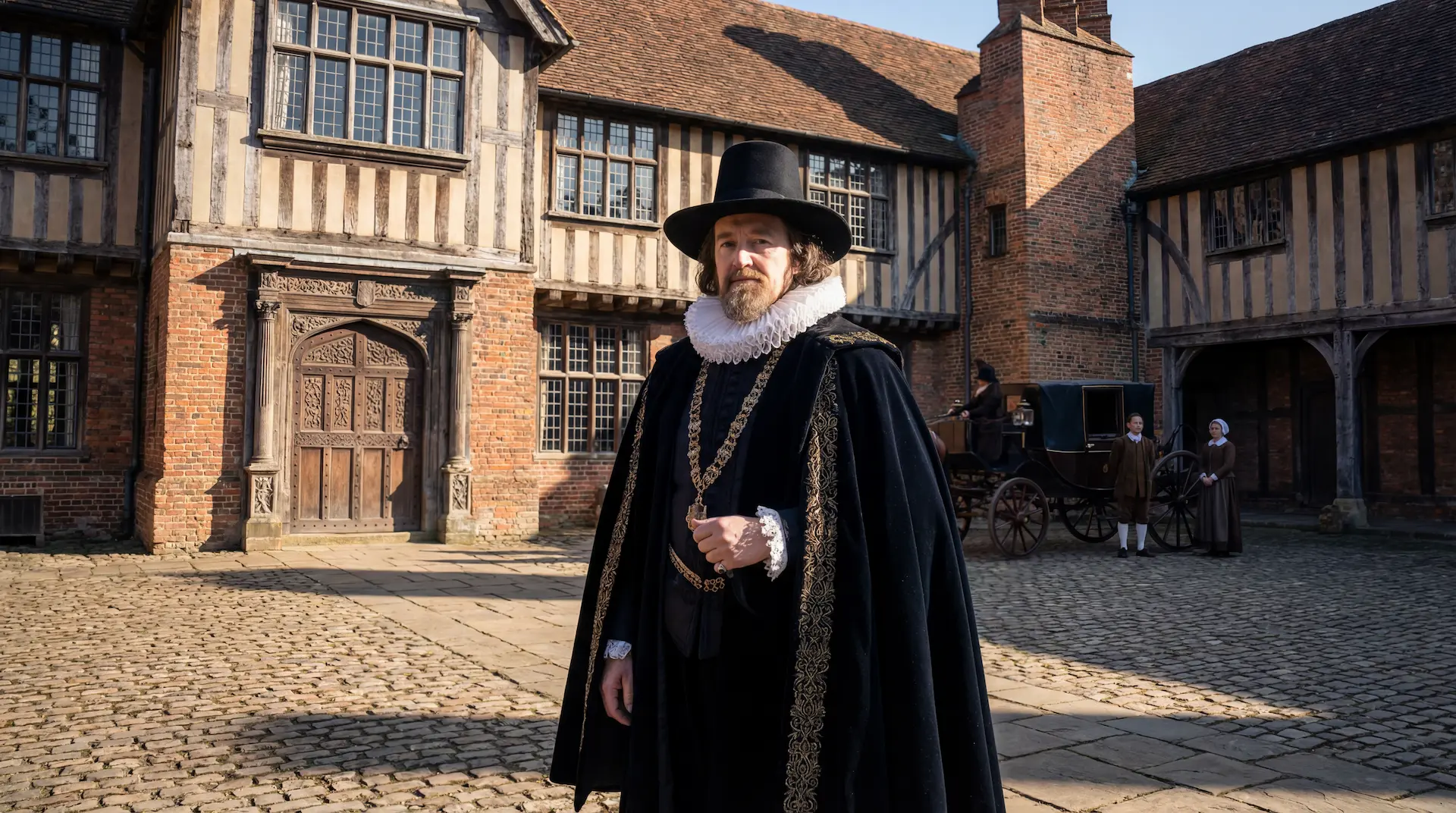
Between 1572 and 1596, Sir Francis Drake captured more Spanish treasure than any privateer in history. He seized mule trains loaded with silver and gold in Panama, plundered galleons off the coast of Ecuador, circumnavigated the globe aboard the Golden Hind, and played a decisive role in the destruction of the Spanish Armada. When he died of dysentery aboard his ship near Puerto Bello on January 27, 1596, his lead coffin was cast into the Caribbean Sea. It has never been recovered.
The Plunder
1 min
Drake was born around 1540 in Tavistock, Devon, of sturdy yeoman stock. Put to sea as a teenager under the tutelage of Sir John Hawkins, he learned early that English ships were expected by national pride, religion, and economic necessity to attack the vessels of Spain. He proved exceptionally good at it. In 1572, Drake joined the French buccaneer Guillaume Le Testu in an attack on a Spanish mule train transporting a massive shipment of silver and gold across the Isthmus of Panama. Le Testu was wounded and captured by the Spanish, who later beheaded him. Drake and his men escaped with more than twenty tons of precious metal. It was more than they could carry. They buried what they could not haul, then dragged the rest through eighteen miles of mountainous jungle to the coast, only to find their raiding boats gone and the Spanish closing in. Drake ordered his men to bury the remaining treasure on the beach, then built a raft and sailed ten miles south to reach his flagship. He later recovered both caches and returned to England a wealthy man. All subsequent stories of buried treasure, Randall Sullivan has observed, arise from these events.
The Golden Hind voyage of 1577 to 1580 produced even greater prizes. Off the northwest coast of Ecuador, Drake captured a Spanish galleon carrying twenty-six tons of silver and gold along with chests of emeralds and pearls. His total haul from the circumnavigation has been estimated at half a million pounds, a sum he presented to Queen Elizabeth I, who dined with him on his ship in gratitude. In his lifetime, Drake captured more than one hundred Spanish vessels. The Spanish themselves conceded that "were it not that he was a Lutheran, there was not the like man in the world."
The Tobias Theory
1 min
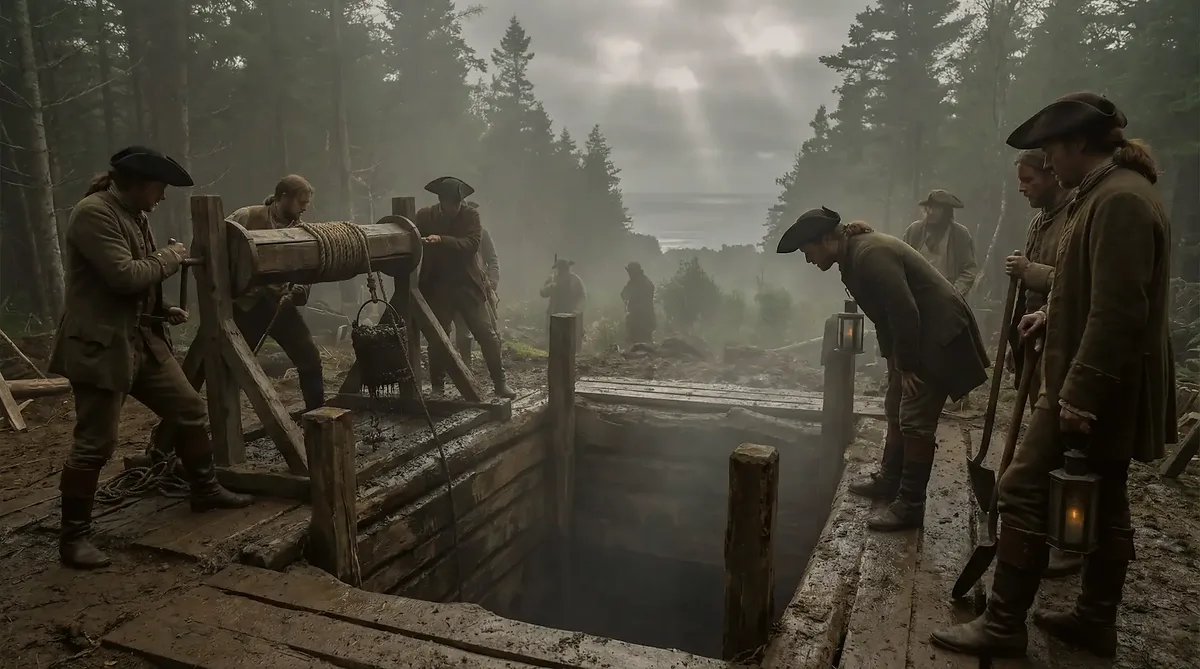
David Tobias, the Montreal businessman who co-founded Triton Alliance with Dan Blankenship in 1969, spent decades researching the origins of the Oak Island works. In his correspondence, Tobias observed that carbon-dating of artifacts recovered from underground on the island indicated that the original construction took place during the period of Drake's second or third voyage. Tobias proposed that during one of his earlier expeditions, Drake sent one or more ships north to Nova Scotia to establish a small secret colony on what would become Oak Island. The purpose was twofold. First, Drake's early raids on the Spanish were not officially sanctioned by Elizabeth I. England was bound by a peace treaty with Spain, and transporting stolen Spanish gold back to England would have been politically dangerous. A secret depository in the New World was a practical necessity. Second, Drake needed a safe base on the North American coast where he could repair, refurbish, and reprovision his ships. In the 1570s, the only British territorial claim in the Western Hemisphere rested on John Cabot's 1497 landing in Newfoundland and Nova Scotia.
There is little doubt Drake had the ability, the leadership, and the loyalty of enough strong and capable men to have carried out the work. There are two windows in the historical record when Drake would have had both the time and the motive: 1573 to 1575, after the Panama raids and before the circumnavigation, and 1585 to 1587, the period between his Caribbean campaigns and the Armada crisis. During both intervals, it would have been preferable from Elizabeth's point of view for her trusted privateer to maintain a safe and anonymous store overseas rather than sail into English harbours too frequently with what was obviously stolen gold, particularly during tense diplomatic periods in England's cold war with Spain.
The Cornish Miners
1 min
A persistent account links Drake to a company of Cornish miners who were shipped across the Atlantic in the late sixteenth century. According to material sent to Tobias by the Baconian societies in England and the United States, Drake transported Joachim Gans (also spelled Gaunse), a Bohemian mining engineer described as Europe's foremost specialist of his day, along with a group of Cornish miners to the New World. The miners were not heard from for two years and were supposedly on Oak Island during that period.
Randall Sullivan investigated this claim and found the trail inconclusive. Gans had in fact been brought to Virginia in 1584 by Sir Walter Raleigh as part of the group that founded the first English settlement on Roanoke Island. That colony lasted only two years before Drake evacuated the starving settlers and sailed them back to England. So there was a Drake connection, but no documented record of Gans being taken to any other part of North America afterward. Sullivan traced the Cornish miners story to the O'Dell House Museum in Annapolis Royal, Nova Scotia, where diver Tony Sampson said he had read about it, but when Sullivan contacted the museum, the public information officer had never heard the account. The foremost historian of the Bay of Fundy region told him the story existed only in "fanciful histories" written about Oak Island.
The claim remains unverified. What is verified is that Cornish miners of the sixteenth century possessed expertise in undersea coal mining and coastal excavation techniques that would have been directly applicable to the construction of the Smith's Cove flood tunnel and the Money Pit shaft system.
Drake and Bacon
1 min
One of the more layered dimensions of the Drake theory is its intersection with the Francis Bacon hypothesis. Drake's achievements brought him to the attention of Bacon, and Triton Alliance received confirmation from the Baconian societies that the two men worked closely together at times. Some of Drake's ships' logs remain missing despite having been turned over at court, and his less-publicized voyages along the North American seaboard, including the rescue of Raleigh's Roanoke colonists and a 1586 expedition northward from the Caribbean toward Newfoundland and Labrador carrying more than two hundred enslaved people for an unknown purpose, leave gaps that theorists have sought to fill.
Tobias's correspondence with the Francis Bacon Foundation and the Francis Bacon Society led him to propose that Drake supervised the original construction of the Oak Island works on Bacon's behalf. Sullivan noted the chronological problem: Drake died thirty years before Bacon did. A more plausible version of the theory, advanced by Mark Finnan in Oak Island Secrets, suggests that Drake or Raleigh first discovered and used the island's natural limestone caverns to hide captured Spanish gold, and that Bacon's associate Thomas Bushell, England's chief mining engineer under Charles I and an expert in underground water channels, later extended or completed the works. Bushell crossed the Atlantic at least once, though no record of his destination or purpose has survived. According to his diaries, Bacon entrusted him with his "dearest secret."
The Lead Coffin
1 min
In Season 5, Episode 7 of The Curse of Oak Island, local historian Paul Speed presented a theory in the War Room that added a new element to the Drake hypothesis. Speed argued that sixteenth-century Cornish miners, among Europe's most skilled excavators, possessed the coastal mining techniques needed to construct the island's underground tunnels and flood systems, and that Drake, who hailed from Plymouth near Cornwall, was the likeliest person to have employed them. Speed's most striking claim was that Drake himself may be buried on Oak Island in a lead coffin filled with mercury. Drake's coffin was cast into the sea off the coast of Panama and has never been found. Speed noted that Gilbert Hedden, who led excavations on Oak Island in the 1930s, recovered mercury flasks from the island's north side decades earlier. Mercury was used in the sixteenth century both for preserving documents and for embalming.
What the Theory Requires
1 min
The Drake theory does not rely on legend or cipher. It rests on a documented historical figure with proven access to enormous quantities of treasure, a demonstrated willingness to bury what he could not carry, documented expertise in maritime operations along the Atlantic seaboard, and a political motive for keeping captured wealth hidden from public view. It requires that Drake or men acting on his orders traveled to Nova Scotia during one of the gaps in the historical record, recognized the island's potential, and employed skilled miners to construct the underground works.
Whether that journey took place remains unproven. What is established is that carbon-dating of deep underground timbers on Oak Island has returned dates consistent with Drake's period of activity, that the engineering of the flood tunnel system reflects professional mining knowledge of a kind concentrated in sixteenth-century Cornwall, and that Drake had both the resources and the reason to build exactly the kind of secure, hidden vault that the Oak Island works appear to represent.