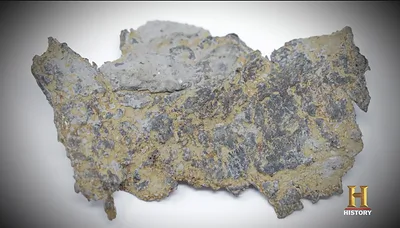
About This Material
Multiple wood samples recovered from deep boreholes and shafts across the Money Pit area, carbon dated between 1969 and 1996 by three separate laboratories. These represent the first systematic attempt to date subsurface structures at Oak Island.
THE FIRST OAK ISLAND C14 TEST (1969)
The very first carbon dating of Oak Island material was initiated by Michael J. Needham of T'ang Management Inc., Toronto. On 25 April 1969, Needham wrote to Harold Kruger at Geochron Laboratories, Cambridge, Massachusetts, enclosing three wood samples and requesting dating within a tolerance of ±10 years. He stressed urgency as the results would influence an upcoming drilling program commencing the week of 12 May 1969. Of the three samples, only one (Sample A, GX-1584) was large enough to date. Samples B (GX-1585) and C (GX-1586) were marked "TOO SMALL TO BE DATED." Kruger reported the results on 3 June 1969.
• Becker Hole 24, 193 ft depth - Wood chips reported by David Tobias, recovered 29 May 1967: Geochron GX-1584: 375 ±85 C-14 years BP → A.D. 1575 (range 1490-1660) Kruger noted: "Taking into consideration the analytical error associated with the age determination there is a possibility that the wood is very early colonial in age, although it is equally possible that it is just slightly pre-colonial and was emplaced by natural processes. Certainly the wood bears no relationship to glacial deposits since most of these have ages of almost 10,000 years or older." Donald C. Webster forwarded these results to Dan Blankenship on 10 June 1969, noting: "I think the carbon dating is quite interesting as it substantiates that the wood is from the date which we have predicted" - a reference to the time period associated with the publication "Adventures of the Sea."
GEOCHRON SECOND BATCH (1969)
Michael J. McCabe of Helix Investments Ltd. sent two additional wood samples to Geochron on 30 October 1969. Kruger reported on 19 December 1969:
• Oak peg from timber structure, Dan Blankenship, Oct 1969: Geochron GX-1692: 1090 ±140 BP → A.D. 860 (range 720-1000) Identified as "wood, probably cedar." Comment: "The wood may of course have had a significant age before fabrication."
• Inclined beam from timber structure, Dan Blankenship, Oct 1969: Geochron GX-1691: 815 ±110 BP → A.D. 1135 (range 1025-1245) Identified as "wood, probably pine." Comment: "The wood may of course have had a substantial age prior to fabrication." Kruger cautioned McCabe: "As you will see both of these samples give ages in the vicinity of 1000 years... the fragments of wood may have come, in each case, from rather large trees. This means, of course, that they may have had a rather substantial age at the time of fabrication. The radiocarbon age determination does not necessarily date the age of fabrication but rather the time at which each particular tree was formed."
TERASMAE / BROCK UNIVERSITY (1970)
Dr. Jan Terasmae of Brock University dated six samples from the Oak Island Exploration project (number 69126), reported 23 October 1970:
• Wood (chips) from BH 202, 125 ft: BGS-16A - approximately 25,000 years BP (estimate only). This is glacial deposit material, not human-worked. Terasmae noted the sample could have originated from non-glacial beds of mid-Wisconsinan age incorporated into glacial deposits of late-Wisconsinan age. In the case of sample BGS-16A, only an estimate of age is given because the sample was smaller than the minimum weight required for meaningful reliability.
• Wood from BH 103 (Heddon Shaft), 144 ft: BGS-16B - 174 ±85 BP → ~1776 AD (range 1691-1861) • Wood "Off shore": BGS-16C - 305 ±115 BP → ~1645 AD (range 1530-1760)
• Wood (chips) from BH 9 (Chappell Shaft), 198-206 ft: BGS-24 - 104 ±124 BP → ~1846 AD (range 1722-1970) Terasmae noted: "In the case of sample B.G.S. 24 there is a suggestion of contamination by modern wood material (presence of small round twigs) during the drilling operation."
• Wood "Upright" from 1-T: BGS-25A - 380 ±150 BP → ~1570 AD (range 1420-1720) • Wood "Peg" from 2-T: BGS-25B - 274 ±159 BP → ~1676 AD (range 1517-1835) Terasmae summarized: "It would appear that most of the submitted material has an average age of 250 or 260 years." He cautioned that some variance was caused by uncertainty about whether wood samples came from the inside or outside of logs, and that radiocarbon dates should be refined through comparison with dendrochronology.
WHOI / NOSAMS AMS (1995-96)
• Wood from borehole 10X, 165 ft, provided by Dan Blankenship (probably from 1971): WHOI receipt 10165 / OI-W6: 120 ±35 BP → ~1830 AD (range 1795-1865)
• Wood from borehole 10X(?), provided by Dan Blankenship (probably from 1971): WHOI receipt 10166 / OI-W7: 75 ±30 BP → ~1875 AD (range 1845-1905) The WHOI draft report (April 1996) noted that the provenance of both wood samples was unclear - whether they came from a log, worked wood, or inner/outer portions of the wood. Both dated to modern times, approximately 100 years old, and were considered of limited interpretive value.
BROCK UNIVERSITY / MELVILLE (1981)
Howard Melville at Brock University dated two samples for Triton Alliance Ltd.:
• Wood slat #1: BGS-677 - 1670 ±70 BP → ~280 AD (range 210-350) Analysed 4 March 1981. Full pretreatment applied.
• Wooden stake #2: BGS-678 - 1700 ±80 BP → ~250 AD (range 170-250) Analysed 6 March 1981. Full pretreatment applied. The summary table notes these had "no details on location" with a query mark suggesting they may be from the Nolan property. If accurate, these dates (~250-280 AD) would represent some of the oldest worked-wood dates from Oak Island.
Historical Context
Sources: Les MacPhie, "Summary of Documents and Results for Carbon Dating at Oak Island" (compiled July 2006), entire compilation. Geochron Laboratories reports: GX-1584, GX-1585, GX-1586 (May 1969), GX-1691, GX-1692 (December 1969). Correspondence: Needham to Kruger (25 April 1969, p. 3); Kruger to Needham (3 June 1969, pp. 4-5); Webster to Blankenship (10 June 1969, pp. 6, 8); McCabe to Webster (22 October 1969, p. 10); McCabe to Kruger (30 October 1969, pp. 12, 14); Kruger to McCabe (19 December 1969, pp. 13, 15-17). Brock University: Terasmae to Ellard (23 October 1970, pp. 22-23); Terasmae table of radiocarbon dates, project 69126 (p. 25). Brock University lab reports BGS-677, BGS-678 (March 1981, pp. 31-32); Melville to Tobias (23 March 1981, p. 30). WHOI draft report (8 April 1996), Table 6, receipts 10165-10166. Schofield to Terasmae (22 March 1971, p. 31) re: spruce identification by Forest Products Laboratory, Ottawa.
Where It Was Found
Found at Various boreholes. Location: the original 1795 excavation shaft on Oak Island, Nova Scotia.