Simeon Lynds is remembered as the man who turned the Oak Island story from a local curiosity into an organised treasure hunt. In 1803, he organised the company that carried out the first systematic excavation of Oak Island's Money Pit, the dig that recovered the inscribed stone, struck a hard layer at 95 feet, and ended after a second attempt in 1804 was also flooded. Beyond that single role, the documentary record on Lynds is sparse. A small set of letters in the Nova Scotia Archives, exchanged between Halifax lawyer R. V. Harris and Lynds's family in the 1930s, gives the clearest surviving outline of the man behind the company.
The Onslow Wheelwright
1 min
The only Simeon Lynds for whom genealogical records survive was born in Onslow, Nova Scotia, on 15 November 1774, a twin son of Thomas Lynds and Rebecca Blair. He lived either on East Mountain of Onslow or by the North River, worked as a wheelwright, and died unmarried on 15 August 1857. These details come from a December 1937 letter written by Martha Kirkpatrick of Shubenacadie to R. V. Harris, the lawyer who would later publish The Oak Island Mystery (1958). Kirkpatrick added that her mother could not recall past events readily and "evidently has no knowledge of any connection with the Oak Island treasure hunting." The letter is preserved in the Nova Scotia Archives, R. V. Harris papers, MG1 Vol. 380.
If this is indeed the man who organised the Onslow Company, the picture is modest. A tradesman from a farming and milling district north of Cobequid Bay, well connected by family, with no public standing recorded beyond his trade.
The Wedding Network of 1803
1 min
The earliest published account of the Onslow Company, by Jotham B. McCully in the Liverpool Transcript in June 1862, reports that about seven years after the original discovery, Lynds travelled from Onslow down to Chester and, on stopping in with Anthony Vaughan, was informed of what had taken place on Oak Island. A Colonist article of 2 January 1864 added that "the late Simeon Lynds" was a relative of Vaughan's father, brought into the secret through family ties, and suggested that it was his father Thomas Lynds who provided the money and social connections that launched the company.
Later authors have offered other versions. Lionel Fanthorpe records a tradition that Lynds was a doctor who attended the birth of John Smith's first child in 1802, while noting that the Smith child had been baptised in 1798. A second account presents Lynds as a businessman acquainted with the fathers of Vaughan and Smith, and a third has him meeting Vaughan in Chester by chance. The sources have not been brought into agreement.
Genealogical work published by Scott Clarke in Oak Island Odyssey (2023) offers a more economical route. The principal Onslow Company members (Colonel Robert Archibald, Captain David Archibald, Simeon Lynds, and Sheriff Thomas Harris) were related to one another by blood or marriage. Archibald had married Hannah Blair; Hannah's sister Rebecca was Lynds's mother. In May 1803, Anthony Vaughan Jr. married Elizabeth Nelson of Truro, whose mother Margaret Archibald was a first cousin of Robert Archibald. On Clarke's reading, the Oak Island story reached the Onslow circle through that wedding network in the spring of 1803, the same year the company was formed.
The Onslow Company, 1803-1804
1 min
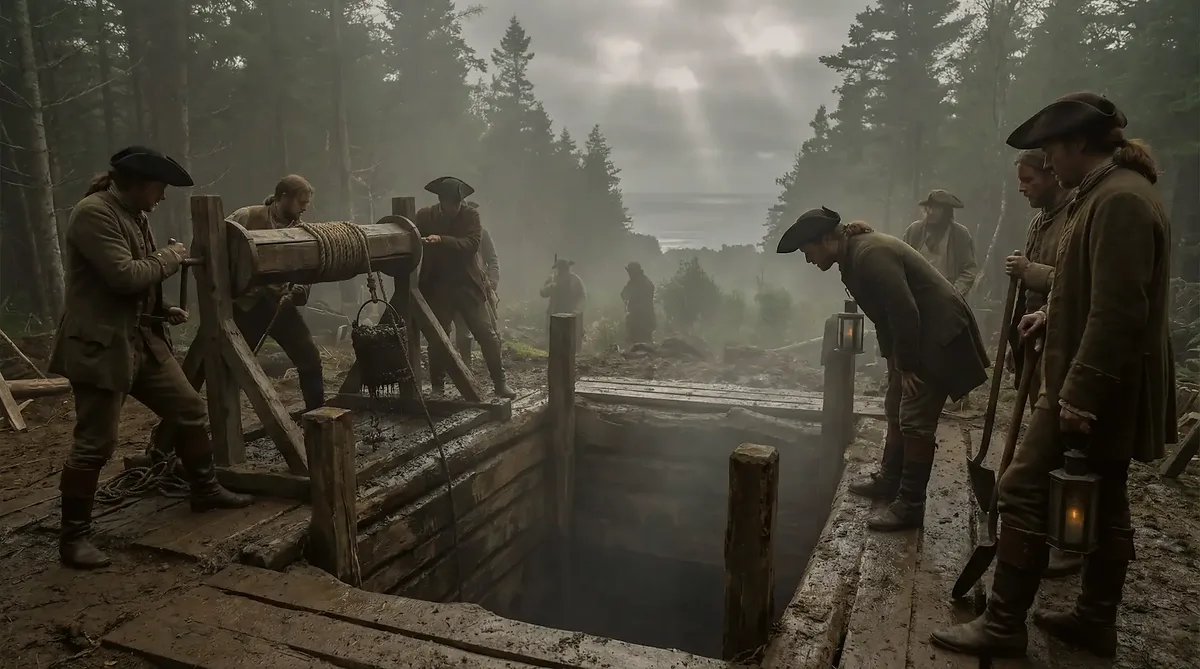
The company that Lynds helped raise included his father Thomas Lynds, Colonel Robert Archibald (its reported leader), Captain David Archibald, and Sheriff Thomas Harris, with perhaps twenty-five to thirty workmen and shareholders in total. In 1803 the crew reopened the original shaft, descending through the layers of oak platforms, charcoal, putty, and coconut fibre that Daniel McGinnis, John Smith, and Anthony Vaughan had only partly cleared in 1795, and recovered the inscribed stone at around 90 feet (see ). Water broke into the pit at that depth, increasing as the diggers continued. A crowbar driven into the floor at 95 feet struck a hard, impenetrable layer. By tradition the work paused on a Saturday evening; on Monday morning the pit had filled with water to within thirty feet of the surface.
A committee sought advice from a Mr. Mosher of Newport, who supplied an £80 pump. It burst before reaching the bottom and the season was lost. In the spring of 1804 the company sank a second shaft to the east of the original to 110 feet and drove a tunnel toward the Money Pit. Water broke through as the diggers approached, flooding both shafts to tide level. The company's resources were spent. The dig closed without a recovery and Lynds played no further public role in the search. The full sequence is set out on the page.
Two Lynds Brothers
1 min
The Lynds name reappears in the Oak Island story in 1849, when the Truro Company began work on the island. Among its investors was Dr. David Barns Lynds, born 10 September 1781, who practised medicine on Queen Street in Truro and died there on 9 June 1871. The Kirkpatrick letter treats him as a separate person from Simeon, and Randall Sullivan, working from independent records, identifies him as Simeon's younger brother.
The two figures have travelled together through the literature for more than a century. R. V. Harris was already working at the question in May 1935, when he wrote to the Reverend Henry I. Lynds in Lockport, New York, asking what could be established about a "Dr. John Lynds of Truro" said to have been interested in the Oak Island hunt and to have taken the inscribed stone to Truro for a period. Harris received no biographical material in reply. The "Dr. Lynds" who recurs in the early hunt accounts appears to draw on both brothers: Simeon's role in the 1803 excavation and David Barns Lynds's involvement with the Truro Company in the 1840s. The two strands gradually entwined as the story passed through later writers.
The Family's Silence
1 min
The most arresting line in the Kirkpatrick letter is the last. By 1937, the man who had set the first organised excavation in motion had passed out of family memory.
Several readings are available. Lynds played a brief, costly, and unsuccessful role in 1803-1804, lost what he had put in, and did not speak of it afterwards. He died unmarried in 1857 with no direct descendants to carry the story, and by the third generation, in a rural Nova Scotian family without published members, the episode could vanish from oral tradition without much difficulty. A different reading is that the Onslow Company's investors, having sunk private capital into a hole that produced nothing, treated the venture as an embarrassment rather than an exploit. The published 1862 newspaper accounts came from Jotham McCully and other figures connected with the later Truro Company, not from Onslow Company veterans. A third reading is simply that the Kirkpatrick branch had lost touch with the relevant line. None of these can be established from the surviving documents.
The Man and the Legend
1 min
Simeon Lynds is securely the named organiser of the Onslow Company, the first systematic excavation of the Money Pit. That role rests on independent accounts from the 1860s onward. The genealogical reconstruction offers a plausible route by which the Oak Island story reached him. The 1803 dig produced the inscribed stone and the first encounter with the flooding system, and the 1804 follow-up confirmed that the flooding was a structural problem the company could not solve.
Beyond that, the biographical record narrows to a single document. The Kirkpatrick letter of December 1937 gives a wheelwright from the Onslow district who lived to eighty-two and never married, and whose family by that date had no recollection of the dig that carries his name. The earlier published accounts, working from second- and third-hand sources, drew a fuller and more elevated portrait. Whether the historical Lynds resembled either figure remains, in the strict documentary sense, an open question.
Sources
1 min
- Martha Kirkpatrick to R. V. Harris, letter, Shubenacadie, 20 December 1937. Nova Scotia Archives, R. V. Harris papers, MG1 Vol. 380.
- R. V. Harris to Rev. Henry I. Lynds, letter, 21 May 1935. Nova Scotia Archives, R. V. Harris papers, MG1 Vol. 380.
- The First Treasure Company 1803/4, typescript working notes. Nova Scotia Archives, R. V. Harris papers, MG1 Vol. 380, p. 367.
- Jotham B. McCully, Liverpool Transcript, June 1862.
- The Colonist, 2 January 1864.
- Clarke, Scott. Oak Island Odyssey. 2023.
- DesBrisay, Mather B. History of the County of Lunenburg. 2nd edn. Toronto: William Briggs, 1895.
- Fanthorpe, Lionel, and Patricia Fanthorpe. The Oak Island Mystery: The World's Greatest Treasure Hunt.
- Harris, R. V. The Oak Island Mystery: The Secret of the World's Greatest Treasure Hunt. Toronto: Ryerson Press, 1958.
- Sullivan, Randall. The Curse of Oak Island: The Story of the World's Longest Treasure Hunt: The Story of the World's Longest Treasure Hunt. New York: Atlantic Monthly Press, 2018.