About This Carved Stone
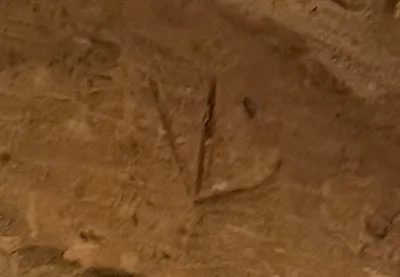
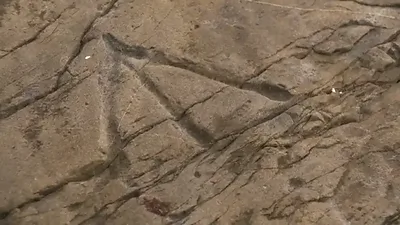
A large granite boulder above the harbour at Peggy's Cove, Nova Scotia, identified by historian Terry J. Deveau as a deliberately carved human face. Deveau presented the stone to Rick Lagina and Charles Barkhouse in Season 4, Episode 10 (About Face), roughly 50 miles east of Oak Island. He pointed to specific modifications that, in his reading, mark the boulder as worked rather than natural: areas where rock has been chipped back to accentuate a nose and eye sockets, and small shim stones placed beneath the boulder to hold it in a fixed orientation.
Deveau interprets the carving style as Mi'kmaq and proposes that the face depicts Glooscap, the white traveller of Mi'kmaq oral tradition. According to that tradition, Glooscap arrived in Nova Scotia in 1398 with an army of men and large ships. A line of researchers, beginning with Frederick J. Pohl in the 1950s, has identified Glooscap with Prince Henry Sinclair, the Scottish Earl of Orkney whose 1398 transatlantic voyage has been associated by some with a continuing Templar legacy. The identification rests on oral tradition rather than physical evidence.
A compass bearing taken at the stone places the carved face pointing roughly due west, in the direction of Mahone Bay and Oak Island. Rick Lagina drew an explicit parallel on screen with the carved headstone Fred Nolan recovered from the centre of Nolan's Cross, the granite cross of boulders on Oak Island itself. The Peggy's Cove stone has not been formally dated, has not been excavated, and has no direct physical connection to any documented site on Oak Island. Its significance rests on three separate claims: that the surface modifications are anthropogenic, that the carving style is Mi\'kmaq, and that the westward orientation is deliberate.
Historical Context
Identified and investigated by Terry J. Deveau, also responsible for the Overton Stone research. Presented in Season 4, Episode 10 (About Face), 2017, to Rick Lagina and Charles Barkhouse. The stone has not been formally dated or excavated.
Where It Was Found
Found at Peggy's Cove Preservation Area.
Gallery