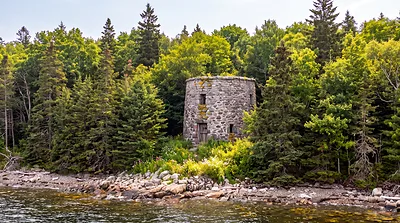
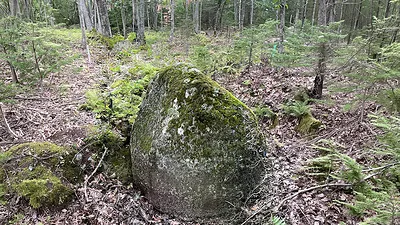
The carved boulder at Peggy's Cove links the site to a long-standing line of Oak Island research that traces a late fourteenth-century European presence in Nova Scotia. In Mi'kmaq oral tradition, Glooscap arrived from across the sea with a body of men and large ships. Frederick J. Pohl, writing in the 1950s, proposed that the Glooscap of oral…
About This Site
Peggy's Cove sits on the rocky Atlantic coast of Nova Scotia, west of the entrance to Halifax Harbour and roughly 50 miles east of Oak Island. The village was settled in the eighteenth century around a small fishing harbour and grew into one of the most photographed locations in Canada. Its character is defined by exposed granite, glacial erratics, and the absence of trees that gives the shoreline its distinctive openness. The same coast formed part of Mi\'kma\'ki, the traditional territory of the Mi\'kmaq, who lived and travelled along this section of the Atlantic shore for thousands of years before European arrival.
The Peggy's Point Lighthouse, built in 1915, sits at the tip of the cove on a wide apron of bare granite. It is the visual centre of the village and the anchor of the surrounding Peggy's Cove Preservation Area, a protected zone established to keep the granite shore free of development. The preservation area extends along the coast away from the village in both directions, and most visitors walk only the small section of bedrock immediately around the lighthouse.
The boulder that historian Terry J. Deveau identifies as a carved face sits within the preservation area, roughly a ten minute walk from the lighthouse along the granite shore. It rests on bare granite among the glacial outcrops and is not marked, signposted, or formally protected as an archaeological feature. Most visitors pass within view of it without recognising the modifications Deveau documents.
Connection to Oak Island
The carved boulder at Peggy's Cove links the site to a long-standing line of Oak Island research that traces a late fourteenth-century European presence in Nova Scotia. In Mi'kmaq oral tradition, Glooscap arrived from across the sea with a body of men and large ships. Frederick J. Pohl, writing in the 1950s, proposed that the Glooscap of oral history preserves a memory of Prince Henry Sinclair, the Scottish Earl of Orkney whose 1398 transatlantic voyage was first set out in the Zeno Narrative. Later Sinclair researchers have continued to develop the identification, although it remains contested within mainstream Mi'kmaq and Indigenous studies scholarship. If the boulder is read against the Glooscap tradition, it would be a Mi'kmaq response to a pre-Columbian European arrival, carved within view of the Atlantic and oriented toward the coast Sinclair is said to have reached.
A compass bearing taken at the carved face points roughly due west, in the direction of Mahone Bay and Oak Island. In Season 4, Episode 10 (About Face), Rick Lagina noted the parallel with the carved headstone Fred Nolan recovered from the centre of Nolan's Cross, the granite cross of boulders on Oak Island itself. Both stones combine deliberate modification with directional alignment, and both sit within the wider zone of Mi'kma'ki across which Sinclair-Glooscap identifications have been argued for seventy years.
The Peggy's Cove Glooscap stone has not been formally dated, has not been excavated, and has not been authenticated by independent archaeological analysis. The Glooscap-Sinclair identification rests on oral tradition and circumstantial geographic argument.
' '
Fieldwork Notes
The stone sits inside the Peggy's Cove Preservation Area, roughly a ten minute walk from the Peggy's Point Lighthouse along the granite shore. The preservation area is open to the public but unmarked: there is no signage indicating the boulder's location, and the stone is not on any tourist route. Visitors arriving at the lighthouse rarely see it without a guide who knows the route. Terry J. Deveau, who first identified the carving, has documented the position in his published research.
Deveau identifies three categories of modification on the boulder. The first is the worked surface around what he reads as a nose and eye sockets, where the granite has been chipped back to lower the surrounding rock and leave a raised facial profile. The second is the placement of smaller shim stones beneath the boulder, which appear to hold it in a fixed orientation rather than allowing it to sit naturally on the bedrock. The third is the compass bearing of the face, which points roughly due west toward Mahone Bay. The carving is not subtle once the modifications are pointed out, but the boulder reads as a natural feature on a casual approach.
'