About This Carved Stone
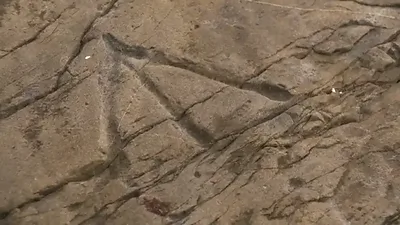
A goose paw symbol incised into the stonework of a chimney inside the upper-floor documents room of Palazzo Falson in Mdina, Malta. The carving sits next to a square-cross figure, the two marks cut close enough on the same surface to read as a paired set rather than accumulated graffiti. The chimney is part of a storey added to the palazzo in 1530 to accommodate the arrival of Philippe de Villiers de l'Isle-Adam, last Grand Master of the Knights Hospitaller in Rhodes and first in Malta. The Palazzo was his first residence on Malta. The carving has not previously been published or shown on television.
The mark was first noticed by Emiliano Sacchetti and Corjan Mol during a scouting visit to Palazzo Falson, where the upper floor now houses the museum's documents room. The two returned with a crew during the official filmed visit and recorded the goose paw and the adjacent square cross in detail, though the footage was not included in the broadcast. The carving sits in a position not visible to standard tourist traffic, recessed into the side of the chimney shaft, which accounts in part for its absence from published descriptions of the building.
The goose paw appears at multiple sites investigated as part of the Oak Island research thread on the Templars and the Order of Christ, with documented carvings at Camerano (Italy) Valkenburg (The Netherlands) the Igreja de São Sebastião (Azores), and Brooklyn (Nova Scotia), less than fifty miles from the island itself. The symbol has been linked elsewhere in Europe and the Middle East to twelfth-to-fourteenth-century Templar sites. A goose paw cut into Hospitaller fabric in 1530 does not alter that earlier chronology. What it adds is documentation of the symbol's continued use by the order that absorbed most former Templar properties, in a private architectural setting, at the moment that order took possession of Malta. The pairing with a square cross, placed inside a chimney rather than on a public surface, suggests internal use rather than external display.
Historical Context
Discovered by Emiliano Sacchetti and Corjan Mol