John Chatterton returns to the C-1 shaft for a third dive into the cavity at 170 feet, carrying an underwater metal detector to replicate the hits reported by Mike Huntley. Visibility has deteriorated further since the previous dives, with thick clouds of stirred-up clay silt reducing sight to near zero. Despite methodical sweeps of the walls, ceiling, and floor, Chatterton registers no metal detector hits during his allotted bottom time. When he surfaces, Huntley reports that his own earlier hits came from a smooth, stucco-like section of wall where the targets appeared to be embedded in the rock rather than sitting on the surface. In the War Room, Chatterton presents a detailed sketch of the cavity: a main chamber with a fissure extending back at roughly one o'clock, a high opening leading to an irregular passage, and a funnel-shaped depression from the hammer grab operations. He assesses the chance of the cavity being man-made as very small based on what he observed, though he notes the walls have a rough, chipped texture inconsistent with a purely natural formation. The team concludes that the gold-coloured object may have been dislodged by the caisson or hammer grab and now lies buried beneath feet of clay sediment on the chamber floor.
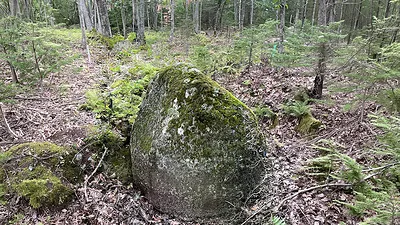
Rick Lagina and Charles Barkhouse travel roughly 50 miles east to Peggy's Cove at the invitation of researcher Terry Deveau, who has found a large boulder that he believes was deliberately carved to resemble a human face. Deveau points out modifications to the stone's surface, including areas where rock appears to have been hacked away to accentuate facial features such as a nose and eye sockets, and small shim stones placed beneath the boulder to hold it in a specific orientation. He identifies the carving style as consistent with Mi'kmaq art and suggests it depicts Glooscap, the mysterious white traveller who, according to Mi'kmaq oral tradition, arrived in Nova Scotia in 1398 with an army of men and large ships. Many researchers believe Glooscap was Prince Henry Sinclair, the Scottish Templar knight. Rick notes the parallels with the carved headstone Fred Nolan found buried at the centre of Nolan's Cross on Oak Island. A compass bearing shows the face points roughly due west, in the direction of Mahone Bay and Oak Island.
Back in the War Room, the team confronts financial reality. Having already exhausted most of the season's budget on the Valley 3 and C-1 operations, Rick, Marty, Craig Tester, and Dave Blankenship debate whether to dig a third hole in the Money Pit or return to 10-X. Rick argues they owe Dan Blankenship the chance to resolve 10-X after more than 50 years of dedication. Marty, who has long considered 10-X explored, concedes on the condition that the team first airlift the sediment from the bottom before putting anyone back in the hole. Craig agrees, stipulating that if anything comes up from the airlift, even a hinge, a strap, or a piece of gold, it would justify further investment. The team decides to attempt both projects, a go-for-broke strategy that will stretch the budget to its limits.
The airlift operation begins at 10-X with Irving Equipment. Andrew and the crew lower an airlift pipe into the 235-foot shaft and connect it through a cyclone separator, with pumps recycling the water back into the borehole. The system is designed to draw sediment from the bottom of the chamber and deposit it into the separator where it can be examined for artifacts. Dan Blankenship, who has long maintained that objects he observed on his original camera footage are buried beneath accumulated silt, watches as the compressors engage and the first material begins flowing up through the hose.