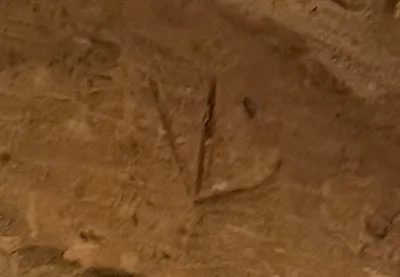
About This Carved Stone
A three-pronged carving consistent with the medieval goose paw symbol, discovered on a large flat rock surface known locally as the wharf stone at Brooklyn, Nova Scotia. The wharf stone functioned as a natural quay for the sheltered harbor at Liverpool, roughly 55 kilometers from Oak Island. In Season 10, Episode 11, Rick Lagina, Charles Barkhouse, and researcher Corjan Mol visited the site after being contacted by local residents Isaac Rafuse and Nick Fralic, who believed the carvings might relate to Oak Island.
The carving does not stand alone. Directly alongside it on the same rock surface are a Globus Cruciger, a cut circle, a fish symbol, and a double fish-tail with a cross in a circle. Mol identified the Globus Cruciger, a cross mounted on an orb, as a symbol of Christian dominion dating to the fifth century. The tripod carving was initially raised as a possible British broad arrow, a mark used to identify Crown property. Mol and Rick Lagina noted that the broad arrow was never applied to natural rock surfaces, identifying it instead as a goose paw. The broad arrow identification fails on four separate grounds. The policy applied exclusively to standing trees blazed into bark, never to natural rock. The only documented instances of the broad arrow on stone are Ordnance Survey benchmarks, which always carry a horizontal datum line above the arrow forming a composite symbol; the wharf stone carving has no such bar and therefore does not meet even that standard. The OS benchmark program was never conducted on the Nova Scotia coastline. And the White Pine Acts that created the policy date to 1721, while the symbols carved alongside the goose paw on the same surface, including a Globus Cruciger whose form originates in the fifth century, are consistent with a medieval origin predating the policy by potentially three to five centuries.
The goose paw, or patte d'oie in French, is a pilgrimage mark documented across medieval Europe from at least the 12th century. It appears at the entrances to churches and hospices along the Camino de Santiago, where it signaled the end of a journey. The symbol also served as a required identifying mark for the Cagots, a persecuted builder caste in Gascony and Navarre who constructed much of the Camino's pilgrimage infrastructure. Mol has documented goose paw carvings at a number of sites connected to the Knights Templar and the Knights Hospitaller across Europe.
At Camerano in Italy, a plaster mould taken from a sculpted segment of an old altar in the town's underground cave complex carries a goose paw formed from the three nails of the crucifixion arranged in the tripod configuration.
At Valkenburg in the Netherlands, a goose paw appears carved into the wall of the dungeon where Knights Templar were held following the order's suppression in 1307.
At the Palazzo Falson in Mdina, Malta, Mol and researcher Emiliano identified a goose paw in the room built for and used by Hospitaller Grand Master Philippe de Villiers de l'Isle-Adam following his arrival on the island in 1530 after the order's expulsion from Rhodes. That section of research was not aired in the television series.
In the Azores, the Igreja Matriz de São Sebastião on Terceira, built in 1455 under the Order of Christ, carries nine goose paws arranged in three groups of three, their original red pigment still preserved.
Historical Context
Corjan Mol research; The Curse of Oak Island Season 10 Episode 11
Where It Was Found
Found at Brooklyn, Nova Scotia (near Oak Island).
Gallery