In the catalogue of Oak Island suspects, most are men of action: pirates, soldiers, monks with swords. Sir Francis Bacon is something different entirely. He was a man of ideas, and arguably the most dangerous kind: ideas so powerful they reshaped the world, and so carefully guarded that some of them may still be hidden.
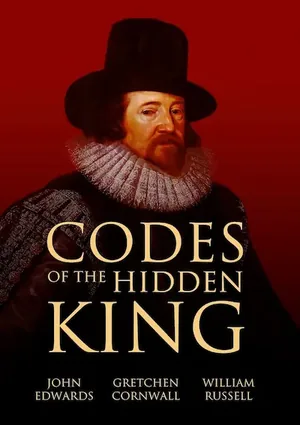
Bacon was born on 22 January 1561 at York House on the Strand in London, the youngest son of Sir Nicholas Bacon, Lord Keeper of the Great Seal, and Lady Anne Cooke, a woman of formidable learning who had translated religious works from Latin and Italian. From childhood, Francis moved in the orbit of the Elizabethan court. Queen Elizabeth reportedly called him "the young Lord Keeper" after being struck by the precociousness of his mind. He entered Trinity College, Cambridge, at the age of twelve, alongside his elder brother Anthony, studying under Dr. John Whitgift, the future Archbishop of Canterbury.
At sixteen, Bacon was sent to France in the retinue of the English Ambassador, Sir Amias Paulet. He spent nearly three years on the continent, absorbing the intellectual currents of the age and, by his own account, devising a system of writing in cipher during his time abroad. The sudden death of his father in 1579 recalled him to England at nineteen, virtually destitute, inheriting only a fifth share of Sir Nicholas's personal estate. From that point on, Bacon was under immediate pressure to earn a living, and he turned to the law.
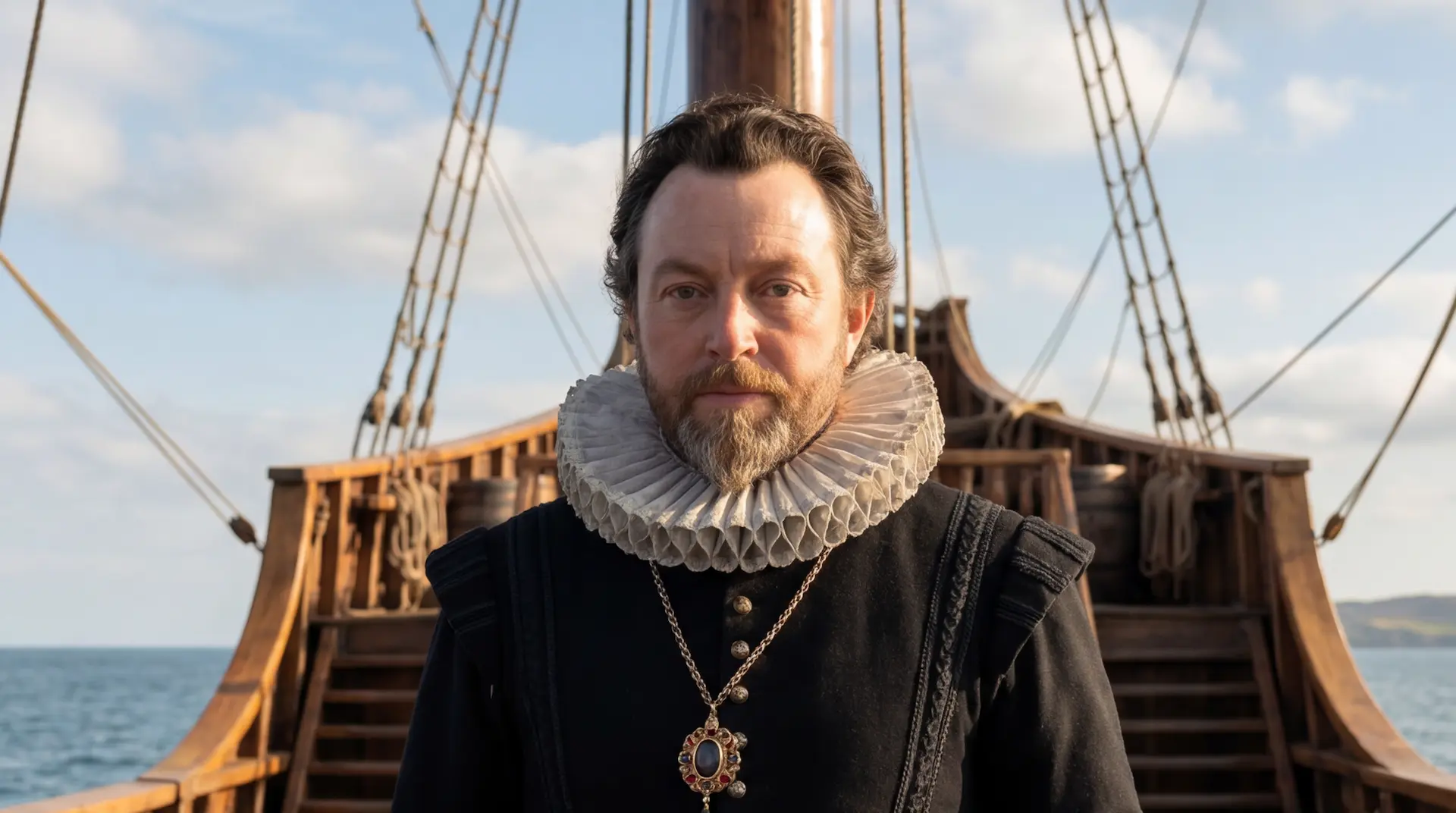 Sir Francis Drake, the Queen's Privateer→
The Rise and Fall of a Lord Chancellor
1 min
His ascent was slow, his ambitions vast, and his patience extraordinary. Bacon studied at Gray's Inn, was called to the bar, and entered Parliament in 1584. He spent the next three decades navigating the treacherous currents of Elizabethan and Jacobean politics, serving under both Elizabeth I and James I, accumulating offices and influence with the relentlessness of a man who believed he had been placed on earth for a specific purpose.
Under James I, his career accelerated. He was appointed Solicitor General in 1607, Attorney General in 1613, and Lord Keeper of the Great Seal in 1617. In 1618, he reached the summit: Lord Chancellor of England, the highest legal officer in the kingdom, elevated to the peerage as Baron Verulam. In 1621, he was created Viscount St Alban.
Within weeks, he fell. Accused of accepting bribes from litigants, Bacon was charged by Parliament, confessed, and was stripped of office, fined forty thousand pounds, and briefly imprisoned in the Tower of London. He spent his remaining years in retirement, writing furiously, producing some of his most important philosophical and scientific works before dying on 9 April 1626. The official account states he caught a chill while experimenting with the preservation of meat by stuffing a chicken with snow, an experiment in refrigeration that killed the experimenter. He was sixty-five.
The Father of the Scientific Method
1 min
Bacon's political career, remarkable as it was, was not what made him immortal. That distinction belongs to his philosophy. In Novum Organum, published in 1620, he laid out a systematic method for investigating nature through observation, experimentation, and inductive reasoning. He rejected the ancient reliance on received authority and argued that knowledge should be built from the ground up, through careful experiment. The Royal Society, founded in 1660, traced its intellectual lineage directly to Bacon's vision. He is widely credited as the father of the scientific method, and his influence on the Enlightenment was profound.
But Bacon's intellectual ambitions extended far beyond what he published openly. He was deeply interested in ancient mysteries and allegories, in hidden knowledge and concealed meaning. In the preface to The Wisdom of the Ancients, he wrote that "under some of the ancient fictions lay couched certain mysteries, even from their first invention." He was fascinated by codes and ciphers, and his contributions to the field were not merely theoretical. They were practical, ingenious, and centuries ahead of their time.
The Master of Ciphers
1 min
Bacon's most celebrated invention in this field was the biliteral cipher, described in De Augmentis Scientiarum, the expanded Latin edition of his Advancement of Learning. The system works by encoding a hidden message within ordinary printed text using two slightly different typefaces, designated "a" and "b." The differences between the typefaces are so subtle that a casual reader would never notice them. But to someone who knew the system, every group of five letters spelled out a single letter of the concealed message. It was, in essence, the world's first binary code, anticipating by three centuries the principles that would underpin modern computing.
The biliteral cipher was not a toy. It was a tool of extraordinary sophistication, designed by a man who understood that the most effective way to hide a secret was not to lock it away but to place it in plain sight, embedded within something so widely distributed that no one would think to look for it.
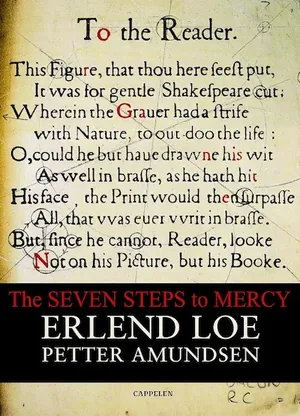
Elizabeth Wells Gallup, a schoolteacher from Michigan, spent decades in the late nineteenth and early twentieth centuries analyzing early printed editions of works attributed to both Bacon and Shakespeare. She claimed to have found biliteral messages running through them, messages that, if genuine, would confirm Bacon's authorship of the Shakespeare plays and reveal details of his true parentage and hidden purpose. Her work was controversial, and mainstream scholars dismissed it. But she was not the last to search, and the questions she raised have never been conclusively answered.
The New Atlantis
1 min
In 1627, a year after Bacon's death, his unfinished utopian novel The New Atlantis was published posthumously, bound together with Sylva Sylvarum, his great natural history. The novel described an ideal society called Bensalem, governed by a secretive order of scholars known as Salomon's House, dedicated to the study of nature and the accumulation of knowledge for the benefit of mankind. The society operated in secrecy, sending agents abroad to gather information while keeping its own island hidden from the rest of the world.
The title page of The New Atlantis depicted Father Time bringing a female figure out of the darkness of a cave, accompanied by an inscription that has haunted Baconian researchers ever since: "In time the secret truth shall be revealed."
For Baconians, this was not allegory. The New Atlantis described an island in the Atlantic, hidden from the known world, governed by a secretive intellectual brotherhood with access to extraordinary knowledge. They saw in it a blueprint, or perhaps a confession.
Bacon's protege Thomas Bushell took the connection further still. In 1659, Bushell published a new edition of The New Atlantis alongside his own mining tracts, explicitly linking Bacon's fictional vision to real-world engineering projects. It was Bushell who would prove to have the practical skills that Bacon's grander ambitions required.
Thomas Bushell: The Engineer
2 min
Thomas Bushell was born around 1593 in Cleeve Prior, Worcestershire. At the age of fifteen, he entered the service of Sir Francis Bacon, eventually becoming his seal-bearer and secretary. When Bacon was elevated to Lord Chancellor, Bushell accompanied him to court. According to Bushell's own account, Bacon personally instructed him in mineralogy and the practical science of mining, imparting to him, as Bushell later wrote, "many secrets in discovering and extracting minerals."
After Bacon's disgrace and death, Bushell retreated from public life. He adopted an ascetic vegetarian diet, lived disguised as a fisherman on the Isle of Wight, and then spent three years in solitary exile in a stone hut on the Calf of Man, a tiny islet off the southern tip of the Isle of Man. He described his retreat as a period of penance brought on by the collapse of his mining ambitions following his master's fall.
When Bushell re-emerged, he applied what Bacon had taught him. In 1637, he secured a grant to work the Royal silver and lead mines of Cardiganshire in Wales, which had been reported as inundated and abandoned. Using what he described as Bacon's own methods, including techniques for driving horizontal adits through hillsides and conveying air into deep workings using pipes and bellows, Bushell recovered several flooded mines and opened new branches from old ones. He employed Cornish miners, the most skilled underground workers in England, and established a Royal Mint at Aberystwyth Castle, where he struck silver coins bearing the Prince of Wales feathers. He raised a regiment from among his miners to fight for Charles I, clothed the king's army, and supplied forty thousand pounds from his own mineral proceeds to the Royalist cause.
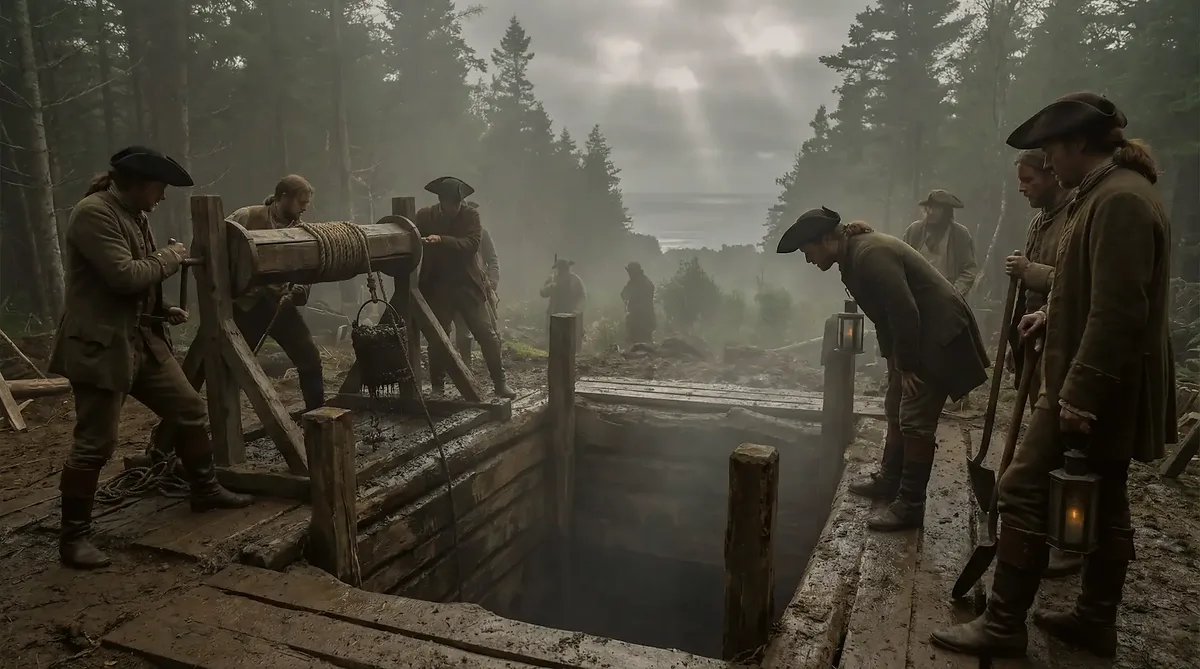
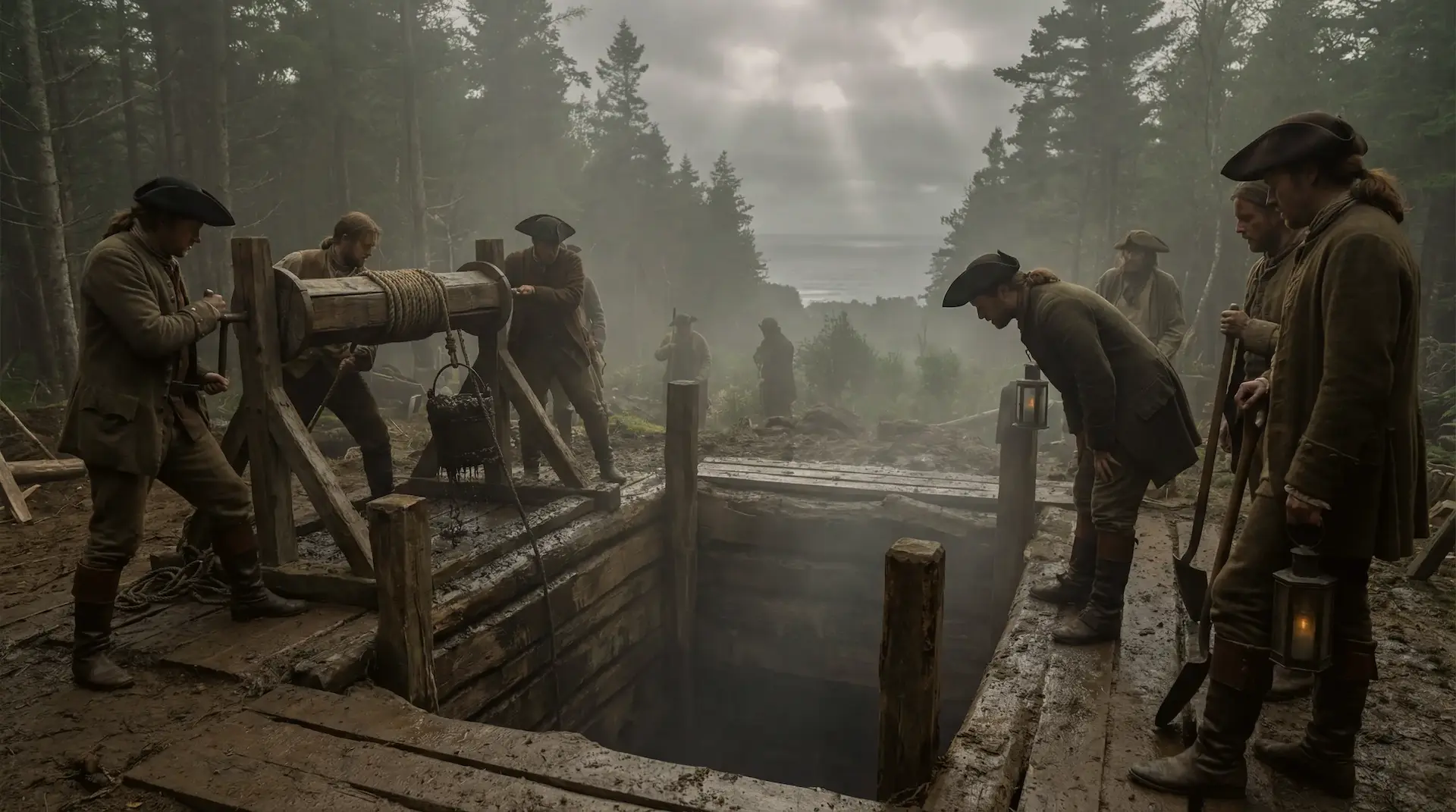
The relevance to Oak Island is not subtle. Bushell was a man trained personally by Francis Bacon in mineralogy and underground engineering. He demonstrably recovered flooded mines. He commanded a workforce of experienced Cornish miners. He operated on remote islands, including Lundy, which he defended as the last Royalist stronghold to surrender in the English Civil War. And he did all of this within the lifetime of men who could, theoretically, have carried out the construction of the Money Pit and its flood tunnel system. Bushell's own published tracts describe Bacon's method for "searching for metals by making adits through the lowest level of hills or mountains," a description that could serve as a summary of the engineering beneath Oak Island.
Bushell died in 1674 and was buried in the cloisters of Westminster Abbey.
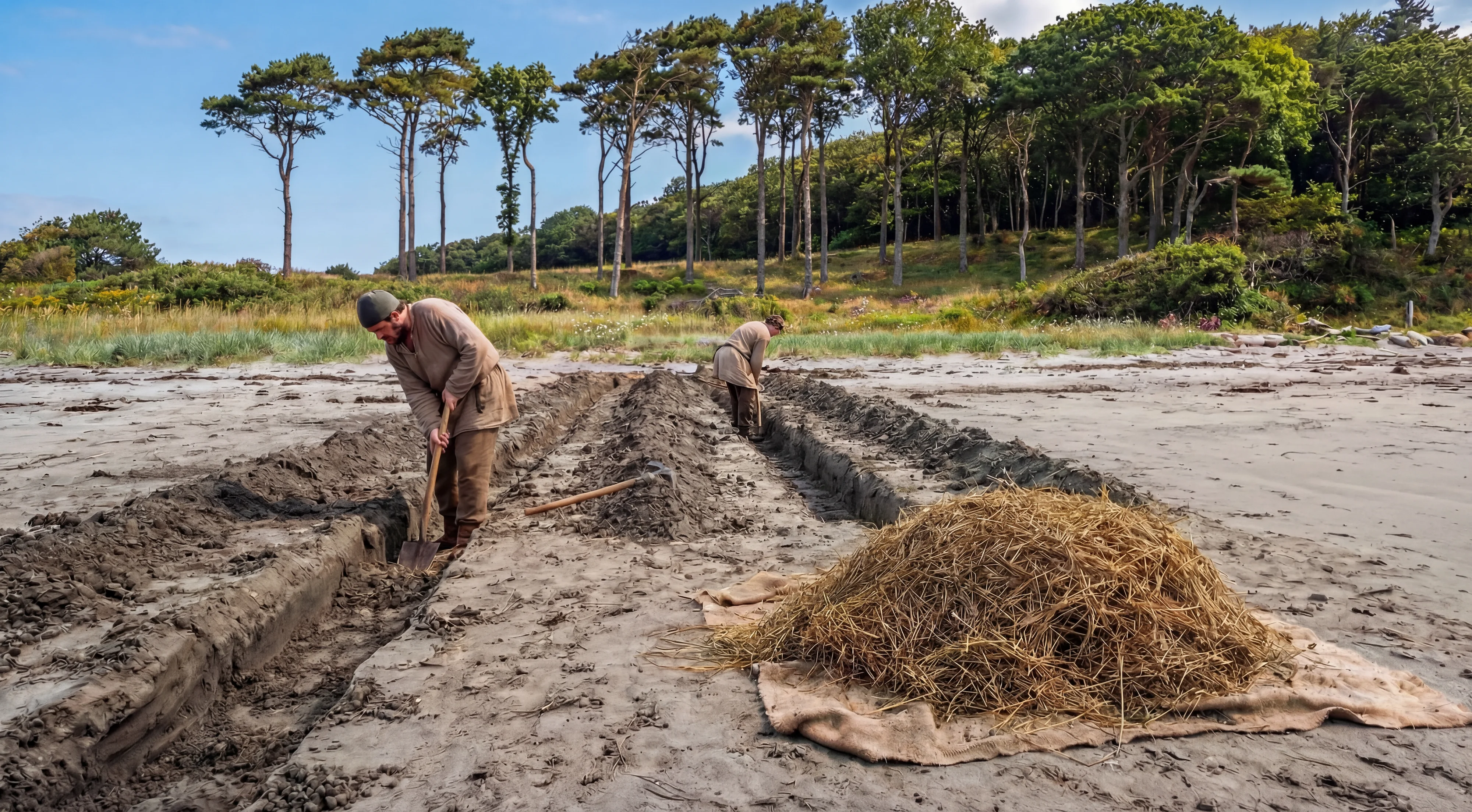 Oak Island Flood Tunnels and Box Drains: The Water Trap→
The Seawater Passage
1 min
Bacon's Sylva Sylvarum, the natural history published alongside The New Atlantis in 1627, contains a passage that has arrested the attention of every serious Oak Island researcher who has encountered it. In it, Bacon describes a method of obtaining fresh water by digging a pit on a seashore: "Dig a pit upon the sea-shore, somewhat above the high-water mark, and sink it as deep as the low-water mark; and as the tide cometh in, it will fill with water, fresh and potable."
For anyone familiar with the Oak Island story, the passage is extraordinary. It describes, in practical terms, the very mechanism that has tormented treasure hunters for over two centuries: a pit near the shore that fills with water according to the tide. The passage appears in a work published the year after Bacon's death, but Sylva Sylvarum was compiled from notes and experiments Bacon had been conducting for decades. Investigative journalist Randall Sullivan, who spent four weeks in Nova Scotia's archives researching the Oak Island mystery, cited this passage during a War Room presentation in Season 6 as one of the strongest pieces of circumstantial evidence connecting Bacon to the island.
Mercury and the Preservation of Documents
1 min
The same Sylva Sylvarum contains another passage of direct relevance: a detailed description of how objects can be preserved by immersion in mercury. Bacon discussed the properties of quicksilver as a preservative, noting its ability to exclude air and prevent the decay of organic materials, including paper and parchment.
Mercury has a long and documented history on Oak Island. Gilbert Hedden, who excavated the Money Pit area in the 1930s, recovered ancient flasks with traces of mercury on the island's north side. In 1936, he found pottery at a dump site on Lot 12 that also bore traces of mercury. Decades later, geoscientist Dr. Ian Spooner found elevated levels of lead and mercury at the base of core samples taken from the Eye of the Swamp, an anomalous finding he attributed to significant historic human activity. And in Season 7, laser ablation testing of a lead artifact found near the Money Pit by Rick Lagina and Gary Drayton revealed unusually high mercury and tin content. Because mercury is too volatile to survive the smelting process, geochemist Dr. Chris McFarlane of the University of New Brunswick concluded it must have been introduced by a separate, deliberate process.
The theory that Bacon arranged for the preservation of important documents in sealed mercury containers, then buried them beneath Oak Island, was first proposed in book form by Penn Leary in 1953, in The Oak Island Enigma. Leary's was the first published work to connect Bacon specifically to the Money Pit, and his argument rested on the convergence of Bacon's published preservation methods with the physical evidence from the island. More than seventy years later, the mercury keeps turning up.
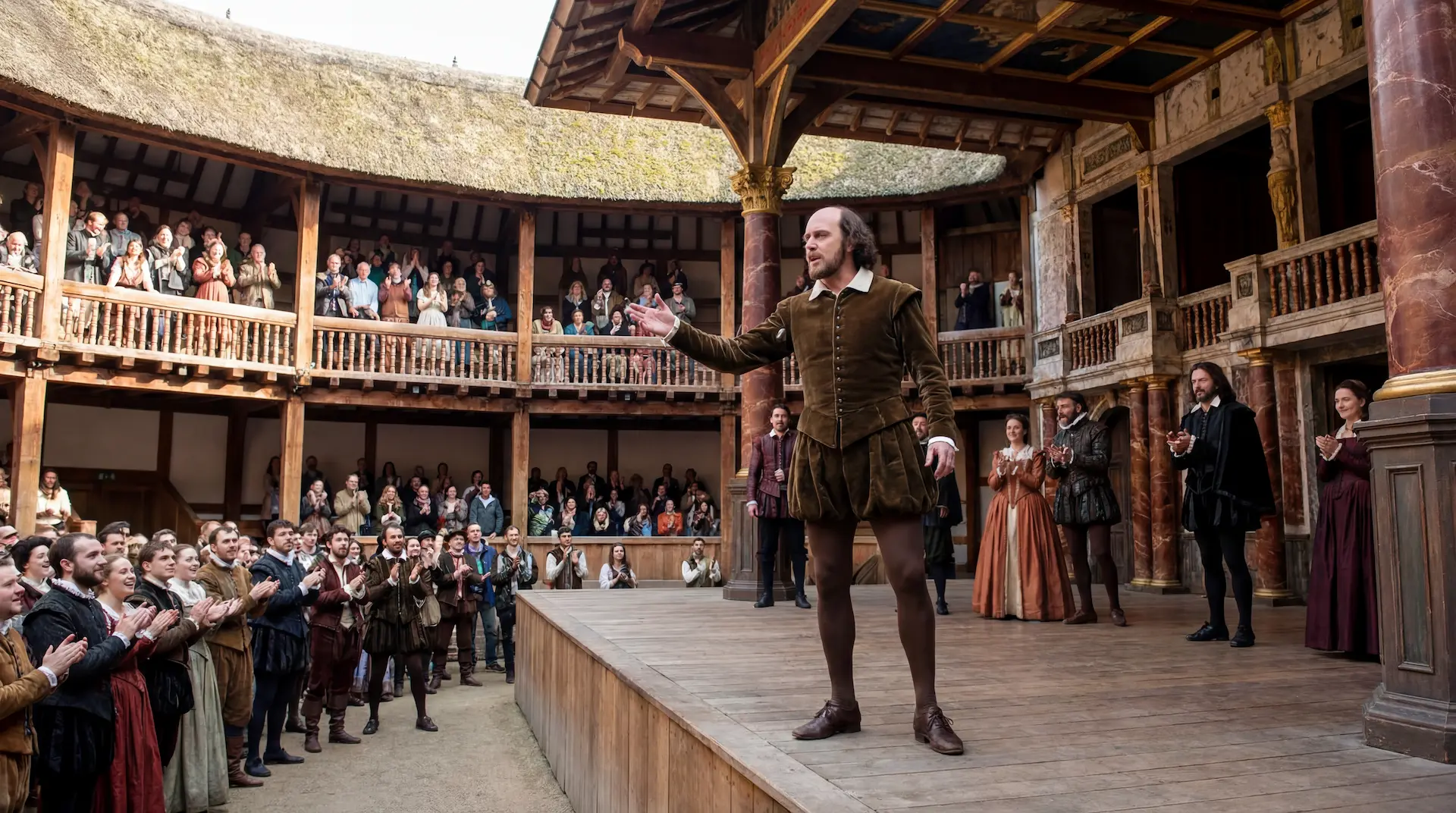 Shakespeare and Oak Island→
The Newfoundland Connection
1 min
In 1610, King James I granted Bacon land in Newfoundland as part of the colonization of the New World. The grant gave Bacon a direct, documented, legal connection to British North America, and specifically to the Atlantic provinces, at exactly the period when Bacon was at the height of his power and influence. It was the same year his mother died. It was the year Galileo's telescopic discoveries became known in England. And it was the decade in which, according to carbon dating of timbers recovered from the Money Pit area, significant construction activity was taking place on Oak Island.
A wood sample recovered from borehole FG-12 at 106 feet in the Money Pit area was carbon dated to as early as 1626, the year of Bacon's death. The sample was found just 25 feet from the H-8 shaft that had previously yielded pottery, parchment, leather bookbinding material, and 17th-century human bones. Craig Tester, reviewing the season's findings in the War Room, observed two distinct periods of intense activity on Oak Island: the 1100s through 1400s, consistent with Templar theories, and the 1600s, consistent with Rosicrucian and Francis Bacon theories.
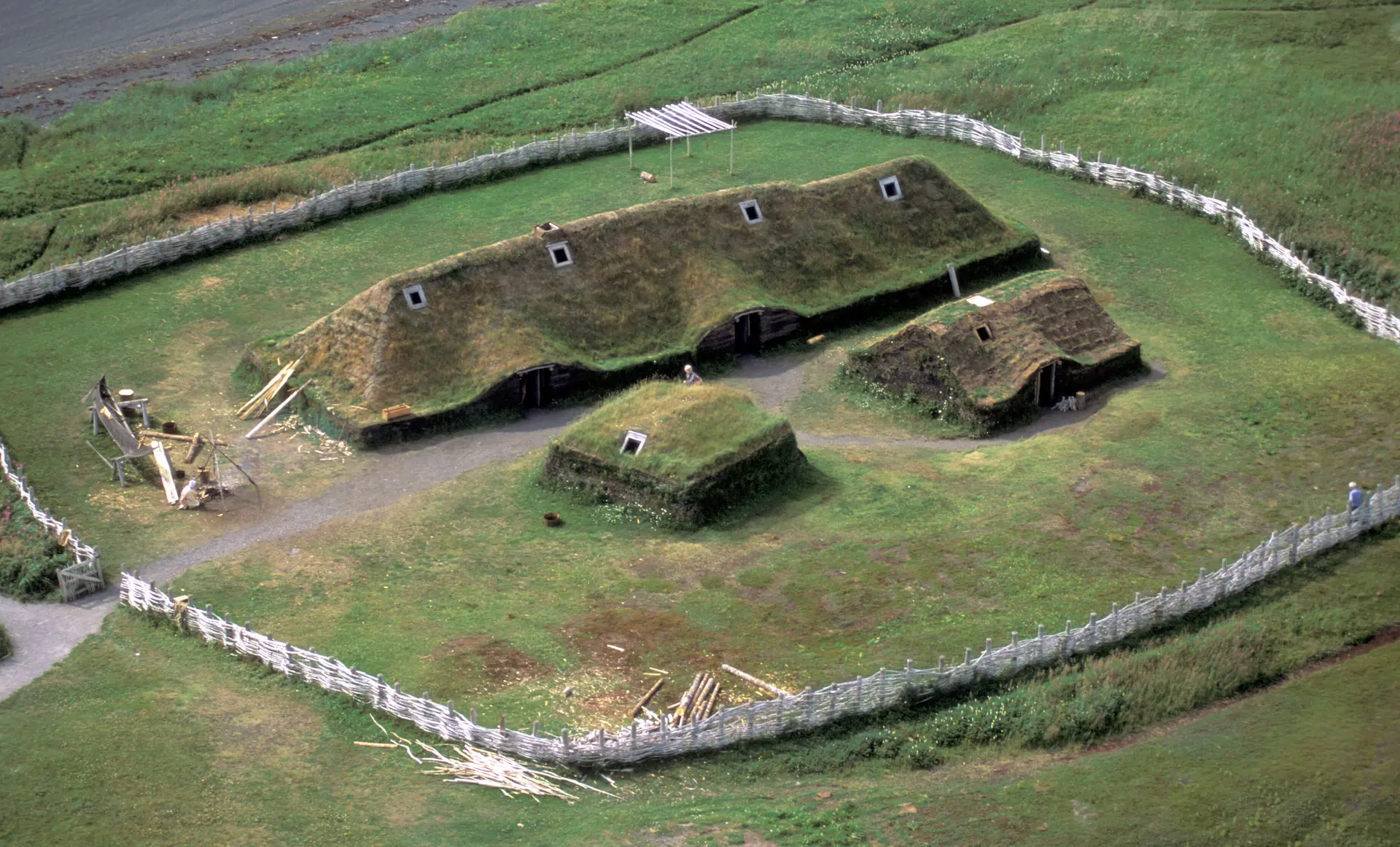 L'Anse aux Meadows→
The Rosicrucian Thread
1 min
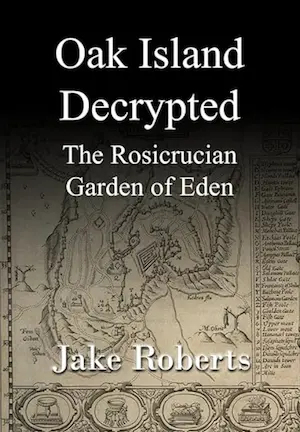
Bacon's role in the Rosicrucian movement remains one of the most debated questions in intellectual history. In 1614, the year after Bacon was appointed Attorney General, the Fama Fraternitatis appeared in print, the founding document of Rosicrucianism. It described a secret brotherhood founded by a traveller named Christian Rosenkreutz, who had been buried in 1484 in a hidden heptagonal tomb inscribed with the words: "I shall open after 120 years." The Fama's authors claimed to have found this tomb in 1604, the same year Bacon was appointed King's Counsel.
Whether Bacon wrote or inspired the Rosicrucian manifestos has been argued for centuries. What is not in dispute is that he moved in the same intellectual circles, shared the same philosophical commitments to hidden knowledge and the reformation of learning, and that his New Atlantis, with its secretive scholarly brotherhood on a remote island, reads like a dramatization of the Rosicrucian programme. His friend Ben Jonson wrote of Bacon on his sixtieth birthday in terms that suggest something more than ordinary admiration. His intimate friend Sir Toby Matthew wrote: "It is not his greatness that I admire, but his virtue."
The Rosicrucian connection to Oak Island is explored in its own article on this site. But it begins with Bacon.
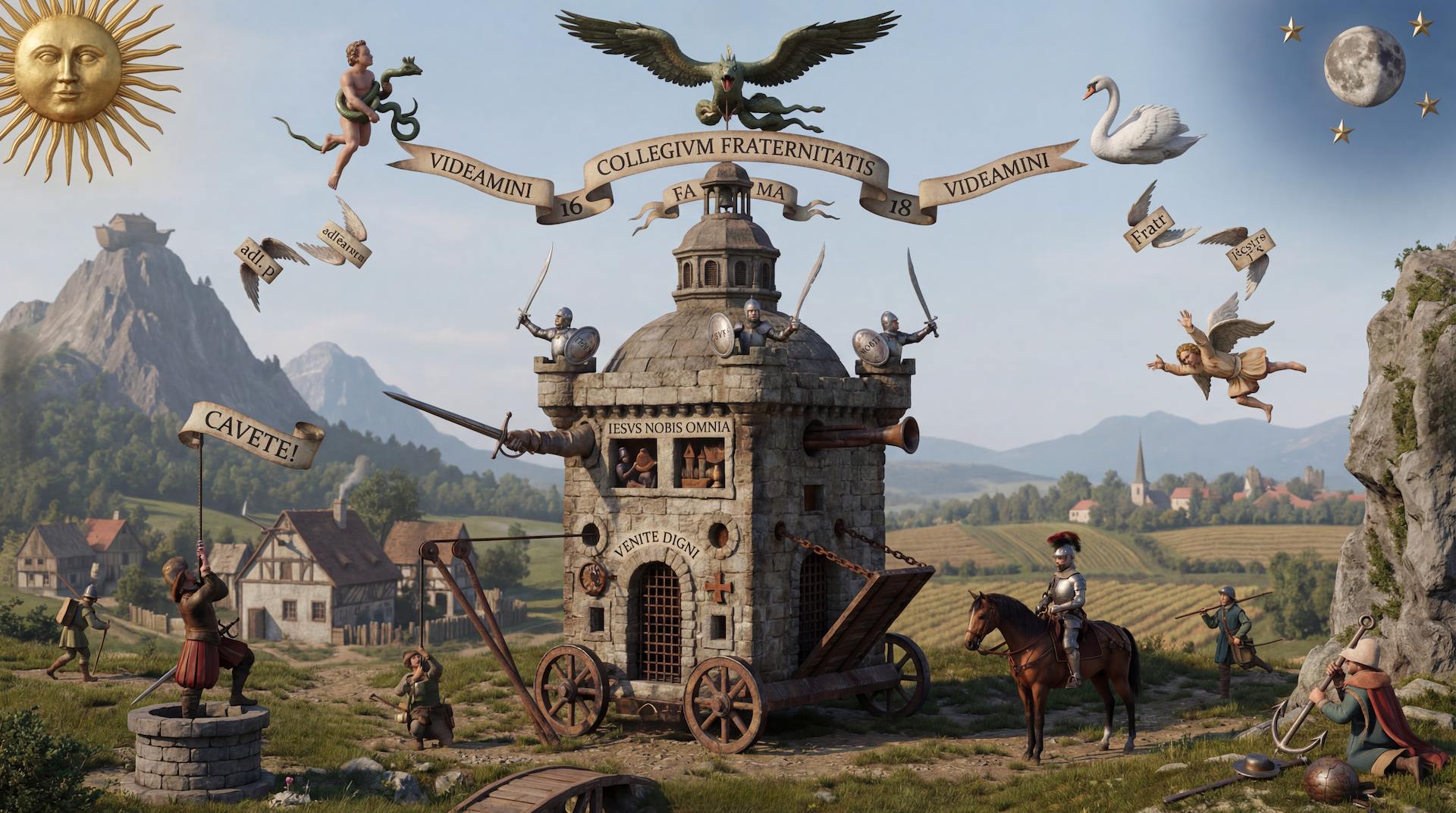 The Rosicrucian Connection→
The Shugborough Link
2 min
One final thread connects Bacon to the wider web of Oak Island mysteries. Shugborough Hall in Staffordshire, ancestral home of the Anson family, contains in its grounds a monument known as the Shepherd's Monument, a carved relief depicting a reversed copy of Nicolas Poussin's painting Et in Arcadia Ego. Below the carving runs an inscription that has defied decipherment for over 250 years: O.U.O.S.V.A.V.V., flanked by the letters D and M.
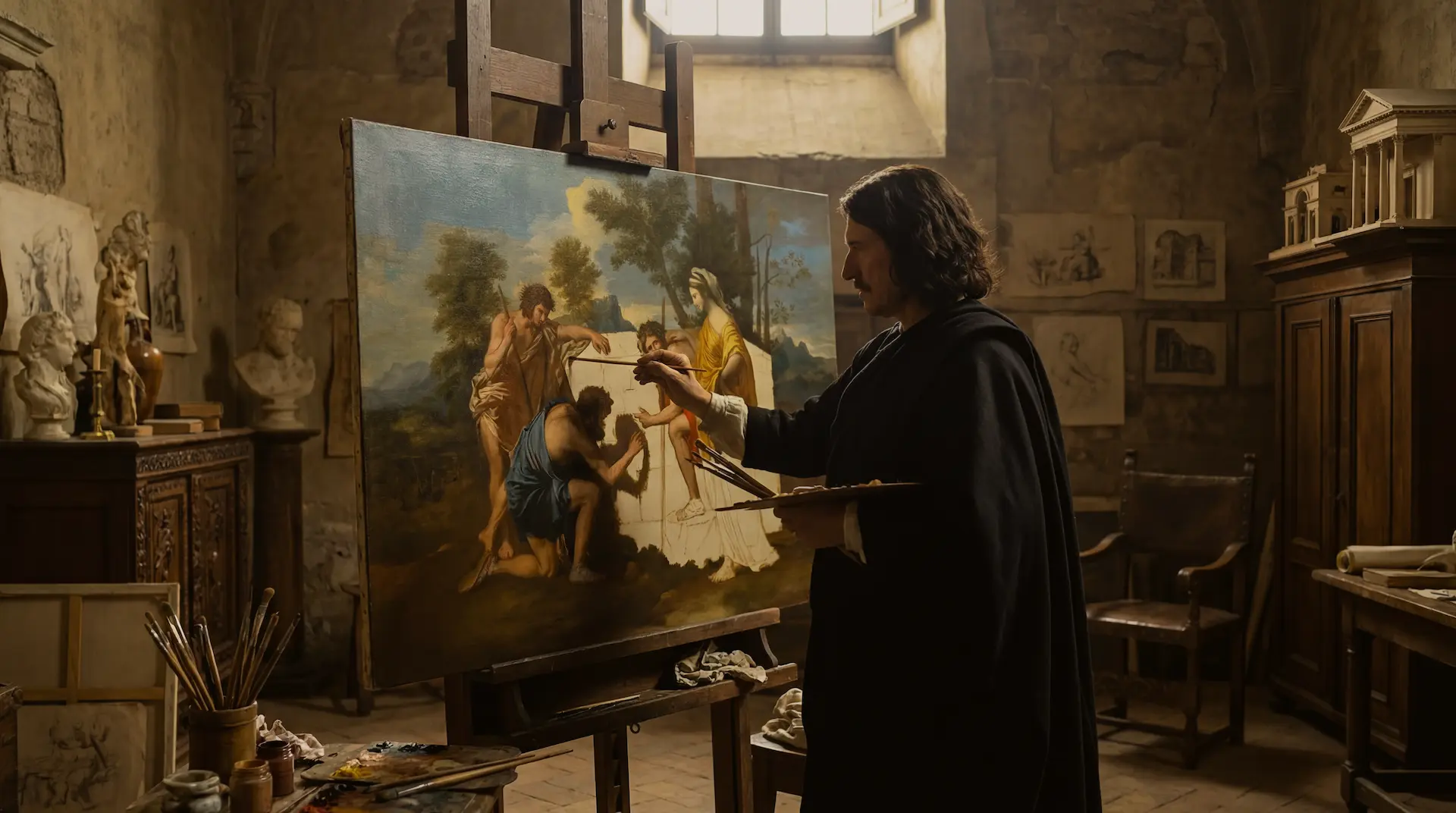 Nicolas Poussin, Keeper of Secrets→
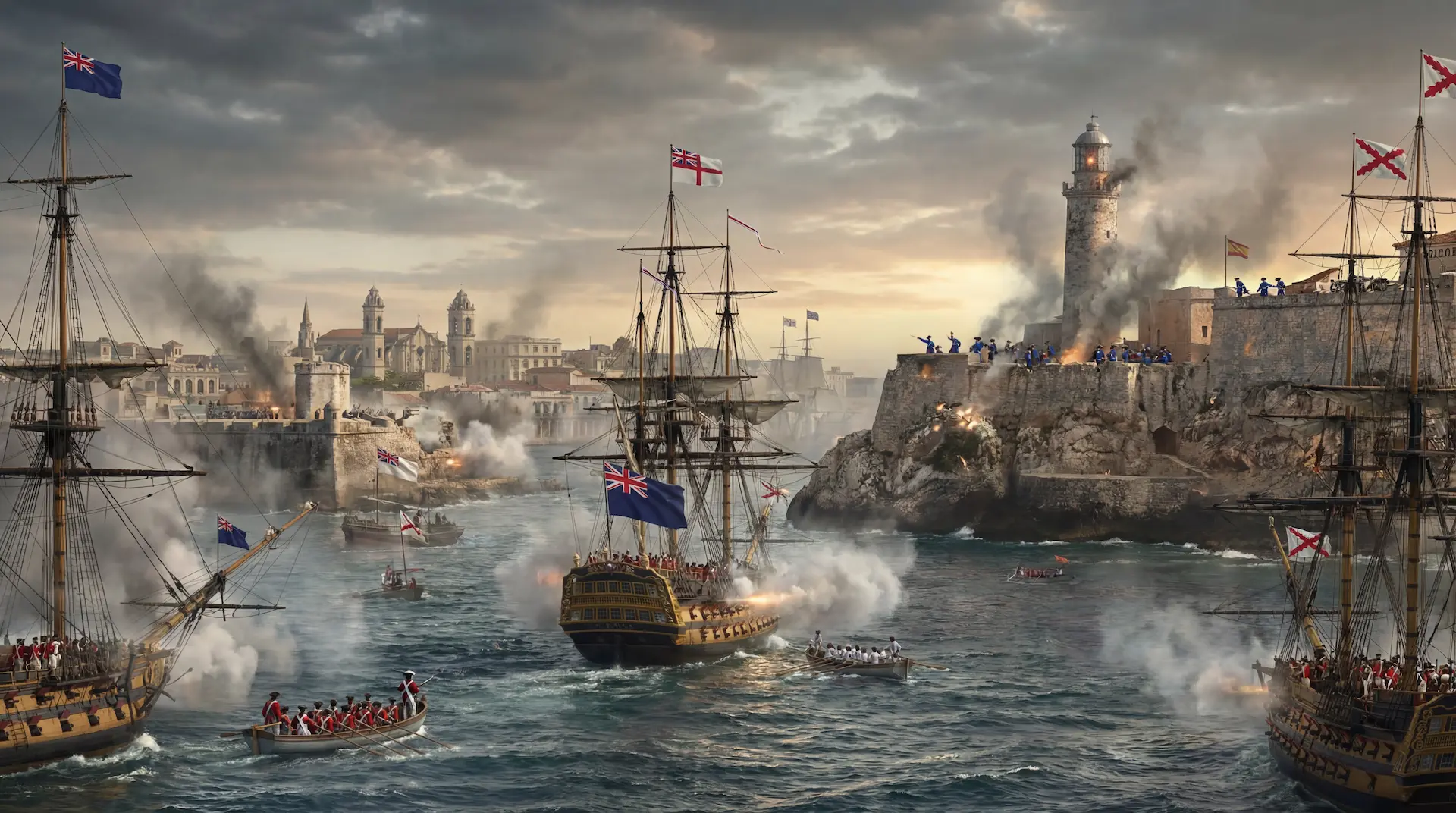
The Anson family's founder, William Anson, was a successful lawyer and a contemporary of Francis Bacon during the period of Bacon's political ascendancy. Bacon's legal background links him directly to the Anson circle, and through the Ansons to the Shepherd's Monument, to Poussin, and to the entire chain of mysteries connecting Rennes-le-Château, the Arcadian Treasure, and the Oak Island Money Pit. Admiral George Anson, a later descendant, returned fabulously wealthy from his round-the-world voyage in the 1740s and served on the Board of Admiralty during the capture of Havana in 1762, another event with its own Oak Island theory.
 The Sack of Havana→
Whether Bacon knew of Oak Island, helped design its underground works, or arranged for something to be buried there may never be proven by a document bearing his signature. But the circumstantial architecture is formidable. He had the intellect to design such a system. He had a protege with the mining skills to build it. He had access to land in the New World. He had a method for preserving documents underground. He described the very engineering principles that define the Money Pit. And he spent his entire life constructing elaborate systems for hiding the truth in plain sight.
The evidence beneath Oak Island includes parchment, leather bookbinding, and traces of mercury, exactly the materials his theory predicts. The carbon dates from the Money Pit fall within his lifetime. And the man who knew him best, Thomas Bushell, spent the rest of his life recovering flooded mines with Cornish miners and publishing his master's methods for the world to read.
Francis Bacon claimed to have "taken all knowledge to be his province." If the Money Pit was his final experiment, it remains, four centuries later, his most successful act of concealment.
 The Oak Island Money Pit→