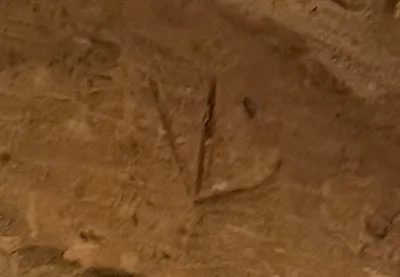
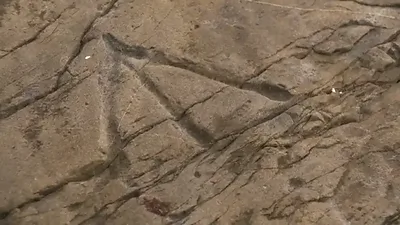
About This Carved Stone
A goose paw symbol carved into the stonework of a sealed catacomb chamber beneath Valkenburg Castle in Limburg, southern Netherlands. The chamber dates to the fourteenth century and is accessible only from above, through an opening in its ceiling, with no horizontal entry. The arrangement indicates the space doubled as an oubliette alongside its use as a burial chamber. Its walls carry a dense field of medieval graffiti, including simple crosses, four-dot crosses, human faces, and a ship under sail, which is rare for chambers of this period and location. The goose paw is cut into the lower stonework, in a section set with niches of the Roman type traditionally used to hold the deceased.
The carving was identified by Corjan Mol and the research team during exploration of the chamber. The space is closed to the public and is not part of the publicly accessible cave network at Valkenburg, and is distinct from the Fluweelengrot and from the nineteenth-century Romeinse Katakomben replica elsewhere in the town. The discovery was filmed with the full crew present during the official visit, though the scene was not broadcast. The mark sits within the lower zone of the chamber, on a wall surface clear of the heavier graffiti above.
Valkenburg Castle is the only hilltop castle ruin in the Netherlands and sits above an extensive network of marl chambers, some quarried for the building stone of the castle itself, others adapted as refuges, escape routes, and burial spaces. The fourteenth-century date of the catacomb places it after the suppression of the Knights Templar in 1312, in a period when most surviving Templar properties in northern Europe were transferred to the Knights Hospitaller by papal bull. The presence of Roman-style burial niches in the lower part of the chamber points to mixed periods of funerary use within the same architectural envelope.
The goose paw appears at multiple sites documented in the Oak Island research thread on the Templars and the Order of Christ, with prior records at Camerano in Italy, the Igreja de São Sebastião in the Azores, Palazzo Falson in Mdina, and Brooklyn, Nova Scotia. Each documented occurrence sits inside an enclosed or semi-private architectural space rather than on a public façade. A fourteenth-century example in a sealed chamber below Valkenburg Castle, paired with funerary niches and a ship-and-sail graffito, extends the symbol's documented geography into the southern Netherlands. What the carving establishes is the symbol's presence at this specific location. What it does not establish, on its own, is the identity of the carver or the date of incision within the chamber's possible centuries of post-construction use.
Historical Context
Discovered by Emiliano Sacchetti and Corjan Mol
Where It Was Found
Found In the Templar prison below Valkenburg Castle in the Netherlands.