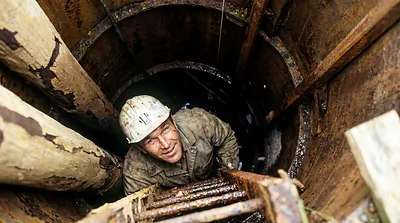
The Geotech drilling operation advances through the Money Pit grid, with geologist Terry Matheson logging the cuttings every five feet while Craig Tester and Jack Begley monitor progress on the surface. At borehole H-3.5, drilled to investigate a potential debris field from the original Money Pit collapse, the drill encounters stiff resistance at approximately 162 feet. Pieces of bright, shiny metal come up in the cuttings, raising hopes that the team has struck the same obstruction encountered by treasure hunters William Chappell and Frederick Blair in 1897 when they drilled into what they believed was a seven-foot wooden vault encased in concrete at a similar depth. The drill bit cannot penetrate the object without further damage, and the hole is abandoned with PVC pipe run to preserve it for future inspection.
On Lot 16, where Robert Dunfield left behind a massive spoils pile after his 1965 excavation collapsed, Rick and Marty Lagina join Dave Blankenship and metal detection expert Gary Drayton for a surface search. Gary recovers two English coins bearing the image of King Charles II: one dated 1673 and a second dated 1694, both inscribed with "Carolus." The coins place English activity on the island more than 120 years before the Money Pit's discovery and are contemporaneous with the 17th-century Spanish Maravedi found in the swamp. At Dan Blankenship's home, the 94-year-old treasure hunter examines the finds and confirms they provide hard evidence of an English presence near 1670, strengthening the case he has argued for decades that the island's history extends far beyond the 1795 discovery.
A letter from Nova Scotia's Department of Community, Culture and Heritage threatens to upend the entire operation. The province demands that all metal detecting be conducted under a Heritage Research Permit and that no excavation or removal of objects occur without formal archaeological oversight. Rick and Marty view the restrictions as unworkable and potentially the first step toward shutting down the island entirely. After a tense face-to-face meeting with provincial officials, a compromise is reached: the team will hire archaeologist Laird Niven, who has worked with them since helping secure the original Treasure Trove license seven years earlier. Under the agreement, Niven will hold a single Heritage permit, and an archaeologist must be present at every dig, though metal detecting may continue freely.
Laird's presence proves its value almost immediately. On Lot 24, the former property of Samuel Ball, Rick, Marty, and Gary pull tree stumps to expose ground that has never been metal-detected and quickly recover a copper spoon bowl that Laird dates to the 18th century, an iron strapping that may be a door hinge, and a fragment of pewter that Gary identifies as part of another spoon. Beneath one of the stumps, Laird spots large, rounded, stacked rocks that he believes are cultural, possibly a wall or foundation, and calls an immediate halt to all work at the site. The formation, hidden for centuries under the root system, will require careful archaeological investigation before the team can proceed, but the discovery suggests that far more is buried on Samuel Ball's former land than anyone had expected.