About This Carved Stone
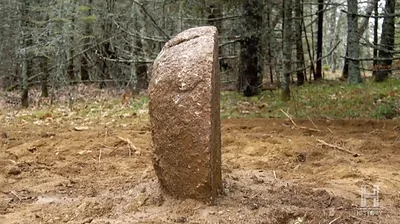
Fred Nolan found a worked sandstone monument standing upright with its upper portion exposed, while crawling on hands and knees along the prolongation of the median line of the arrowhead-shaped triangle of stone piles with a hand compass; the compass bumped into it, and he saw a painted end protruding from the ground. The stone is square in cross section. Two faces are smooth or natural; the other two are rough, as if cut by a chisel, and burn marks suggest heat was applied to split the rock. Nolan said some observers thought it resembled a Spanish galleon when laid on its side. He had it examined by geologist Robert Grantham, who reported that the upper six or seven inches had been weathered for a long time, that lichens grew on the top four inches, that vegetation marks below that showed where soil had surrounded the stone, and that the stone was found on end, which is not a natural stable resting position for a rock of that shape. Nolan concluded the monument was planted as a survey marker with no relationship to any property boundary, and that it is one of many sandstone markers on his land, some bearing marks and figures, which he believed were brought to the island for survey purposes since the island's native boulders are granite. Grantham's report establishes that the stone was placed by hand and stood for a long period; it does not establish when or by whom.
Historical Context
William S. Crooker, Oak Island Gold (1993), chapter 21; Robert Grantham (geologist) as quoted by Crooker
Where It Was Found
Found On the prolongation of the median line of the three stone piles, on Nolan's property — Oak Island, Nova Scotia, Canada.