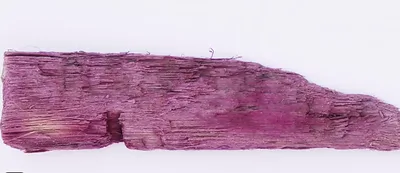
About This Sample
In 1898 the Oak Island Treasure Company pumped the Money Pit full of seawater above tide level, then released red dye into it, hoping to trace where the water was escaping. William Chappell and Reginald Harris watched the dye surface at three points on the south shore of the island, not at Smith's Cove, indicating at least one flood tunnel running to the Money Pit from the south shore independent of the cove. Frederick Blair recorded the same result. A second test conducted by a Hamilton-led crew in 1938 reproduced Blair's findings. In 1988, Dan Blankenship ran his own dye test at borehole 10-X and reported red dye appearing at Smith's Cove and off both the north and south shores of the island over three to four days.
The Lagina team repeated the experiment in Season 6, more than a century after the original test. A 2015 attempt using green dye at borehole 10-X had produced no visible result, in part because the color was difficult to spot against the water. For the Season 6 test, geologist Terry Matheson and Dan Henskee pumped fluorescent red dye into borehole C-1 at the Money Pit using a six-inch pump running at 600 gallons per minute, eventually introducing up to half a million gallons of seawater mixed with the dye. Three drones monitored the surrounding water from above, and diver Tony Sampson searched the shoreline by boat. Hours into the operation, Gary Drayton spotted rust-colored water flowing from beneath the Smith's Cove crane pad in ground that had been dry that morning. Jack Begley and Paul Troutman collected samples and tested them at the Oak Island Research Center with a fluorometer sensitive to dye concentrations as low as one part per trillion. A reading above 1.0 counts as a positive; the Smith's Cove sample registered 11.98, and a retest produced an even higher figure.
The result confirmed that dye pumped into the Money Pit traveled underground to Smith's Cove, reproducing the finding of the 1898, 1938, and 1988 tests and adding a fourth independent measurement to the same conclusion. The team used the result to argue that the crane pad sat over the convergence point where the stone box drains meet the flood tunnel, and pursued excavation there through the rest of Season 6. What the test establishes is a hydraulic connection between the Money Pit and Smith's Cove; it does not by itself identify who built the flood system or when, a question that remains tied to the dating of the box drains and the wider Smith's Cove structures.
Historical Context
Oak Island Treasure Company (1898); William Chappell, Reginald Harris, Frederick Blair; Hamilton dye test (1938); Dan Blankenship dye test (1988); The Curse of Oak Island Season 6, "Dye Harder" and "Detour" (2019)
Where It Was Found
Found at Money Pit → Smith's Cove. Location: the original 1795 excavation shaft on Oak Island, Nova Scotia.