About This Structure
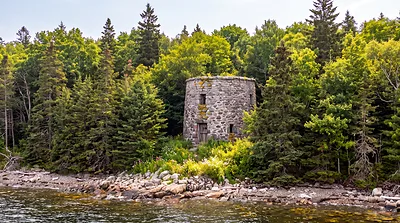
A crudely built stone well on Lot 26, on the south side of Oak Island, first noticed by Rick Lagina during a winter walk years before its investigation. Despite snow and ice covering the ground, the well remained unfrozen, a peculiarity that prompted further study.
In Season 10, geoscientist Dr. Ian Spooner investigated the well by extracting water samples and a piece of wood from the bottom that he believed had been used in its construction. The wood was carbon dated to between 1028 and 1172, placing it squarely within the medieval period alongside the coconut fibre deposits from the Money Pit (1036 to 1374) and the Smith''s Cove timber structures (720 to 1245).
The water sample returned with elevated silver content, making the Lot 26 well one of the few locations outside the Money Pit area where silver has been detected. Spooner noted that the well's crude and rough construction style was itself consistent with significant age, contrasting with the more refined stonework typical of 18th and 19th century Nova Scotian construction.
The well''s location on the south side of the island, far from the Money Pit and Smith''s Cove, suggests that activity during the medieval period was not confined to the northeastern corner of the island. Combined with the elevated silver readings, the well raises the possibility of a broader operational footprint by whoever was working on Oak Island in the 11th and 12th centuries.
Subsequent episodes saw archaeologist Laird Niven and his team expand their investigation to include a nearby stone wall on Lot 26 with a massive oak tree growing out of it. The reasoning was that the wall must pre-date the tree, so dating the tree would provide a minimum age for the wall. An expert consulted by the team suggested that if someone wanted to hide evidence of underground digging, the middle of a wall would be an ideal concealment location.
In Season 13, the well's dating gained renewed weight when the team visited Grota do Medo on Terceira in the Azores and found a cup-shaped cut-stone feature that Dr. Felix Rodrigues dates to the 12th century, the same window as the Lot 26 well, and roughly three centuries before the Portuguese officially settled the Azores in 1439.
Historical Context
Historical; Lagina team investigation
Where It Was Found
Found at Lot 26, south side of Oak Island. Location: Oak Island, Nova Scotia, Canada.