At the Money Pit, Rick Lagina, geologist Terry Matheson, and the team continue excavating borehole S-6, which three days earlier penetrated what they believe to be the Shaft Six tunnel at 101 feet, yielding a hand-cut oak timber, possible leather bookbinding, and iron chain. The spoils are now being processed through the large-scale wash plant near Smith's Cove, where Billy Gerhardt's crew recovers pottery fragments, old glass, and a pipe stem. Rick brings the finds to the War Room, where archaeologist Laird Niven examines them alongside Craig Tester, Doug Crowell, and Paul Troutman. Laird identifies a Blue Willow transfer-print pattern dating to the 1810s-1840s, a pipe bit from around the 1870s-1880s, and a piece of red-bodied stoneware with unusual tool-made striations that he places in the early 1700s, making it the first pottery from the site to potentially predate the Money Pit's discovery in 1795.
Drilling in S-6 pushes to 175 feet before crane operator Danny reports hitting limestone bedrock at 190 feet of casing. With the shaft now well below the debris field, Rick and Craig, conferring by phone, agree to shut the hole down. In the research center, Rick meets with Doug and Paul to choose the next drill location. Paul argues that the conglomeration of wood found between 103 and 120 feet suggests the original Money Pit lies slightly to the north, and the team designates a new target called FG-5.5. Surveyor Steve Guptill marks the coordinates with GPS, and when Vanessa from Irving Equipment asks what to name the new borehole, she christens it GG-1 after her daughter Gracie.
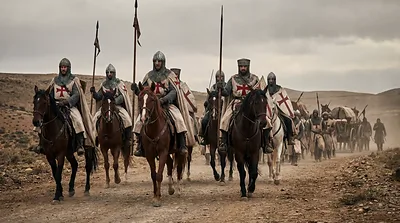
On the western shore at Lot 21, the property once owned by Money Pit co-discoverer Daniel McGinnis, Jack Begley and metal detection expert Gary Drayton uncover two pieces of decorated lead that fit together. The artifact features a floral or vine-like design and a square hole strikingly similar to the one in the medieval lead cross found at Smith's Cove the previous year. Paul Troutman notes the vine pattern may relate to the Tree of Life, the ancient Hebraic symbol the team observed carved into the walls of a 14th century Knights Templar prison during their visit to Domme, France, with Alex and Peter Lagina.
In the War Room, Rick, Marty, Craig, and Gary connect via video with geochemist Tobias Skowronek at the German Mining Museum in Bochum. Tobias reports that the lead isotope data from the Lot 21 artifact is identical to that of the cross, confirming both pieces came from the same ore deposit mined over 600 years ago in Southern France. He also identifies the artifact as a possible cloisonne art object, an ancient decorative technique dating as far back as 5000 BC that involves soldering metal wire into compartments filled with powdered glass and minerals. The confirmation that lead artifacts found on opposite ends of Oak Island share the same pre-15th century French origin strengthens the case for a Knights Templar connection to the island.
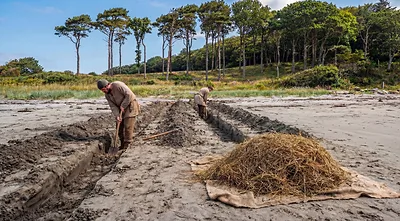
Meanwhile, Rick and Marty, having secured a cofferdam extension and renewed permits, decide to begin removing the 6,000-square-foot crane pad at Smith's Cove so the team can dig beneath it in search of the flood tunnel convergence point. The red dye pumped into borehole C-1 three weeks earlier was detected seeping from beneath this same area, and Billy Gerhardt begins the massive task of relocating some 2,500 tons of earth and gravel to clear the way for excavation before winter shuts down operations.